
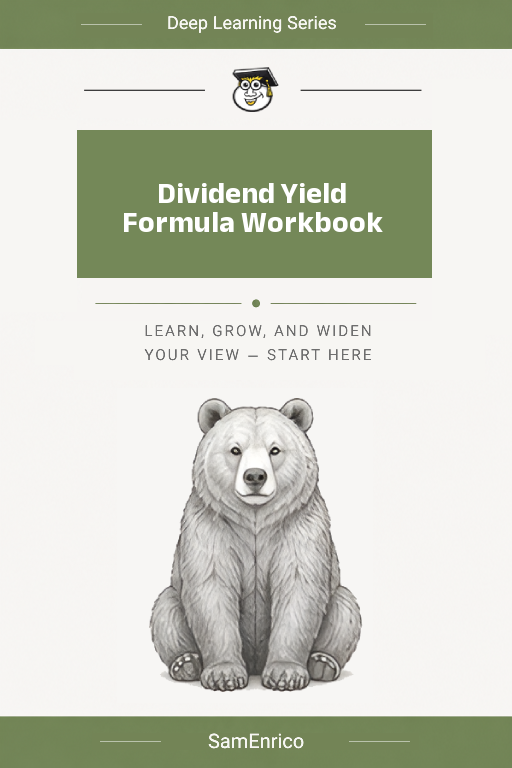
Non-FictionStudent's ShortcutDividends
Dividend Yield Formula Workbook eBook
Calculate dividend yield using Annual Dividend per
by Fields Daisy
Calculate dividend yield using Annual Dividend per Share divided by Price per Share.
Formats
Free sample
Chapter 1: The One Number You Need--–- The first time you heard the words "dividend yield," someone probably showed you a formula and told you it was simple. And they were right about the formula. But they were wrong about everything else.You don't remember where you first saw it. Maybe it was a You Tube video with a thumbnail of a guy pointing at a chart. Maybe it was a Reddit thread where someone claimed to be retiring at forty-two on dividends alone.
Maybe it was your own brokerage account, that little percentage next to a stock name that you always ignored because you weren't entirely sure what it meant.Here is what no one tells you about that percentage: it is the single most misunderstood number in all of personal finance. Not because it is complicated. Because it is deceptive in its simplicity.Financial advisors misuse it. Online gurus twist it. Software platforms display it in three different ways without telling you which one you are looking at.
And the result is that millions of investors—smart, hardworking people who balance their own checkbooks and file their own taxes—freeze up when they see a yield. They either chase the highest number they can find, or they ignore yield altogether because they don't trust what it's telling them.This chapter is going to fix that. Not by making the formula more complicated. By making sure you never misuse it again.The Formula That Launched a Thousand Retirements Let's get the obvious thing out of the way first. The dividend yield formula is this:Dividend Yield = Annual Dividend Per Share ÷ Price Per Share That is the entire mathematical universe of this chapter.
One division problem. A fifth grader could do it. A calculator from 1987 could do it. You have almost certainly done harder math today just to figure out how much to tip on lunch.But here is where the trouble starts. That simple division problem has two inputs.
And those two inputs can be measured in three different ways each. Which means there are at least nine different numbers you could plug into that formula and call it "the dividend yield." Nine. And only one of them is the right one for any given decision you are trying to make.This is why otherwise competent investors get confused. They learn the formula in thirty seconds. They spend the next ten years using it wrong without ever knowing it.So let's slow down.
Let's take apart each piece of that formula like a mechanic taking apart an engine. Not because you need to become an expert. Because you need to know which lever to pull when the dashboard lights up.Annual Dividend Per Share: The First Trap Most stocks pay dividends quarterly. Four times a year, money shows up in your account. This is wonderful.
But it creates the first common error in yield calculation: using the quarterly amount instead of the annual amount.Here is what the error looks like. You open your brokerage app. You see that a stock paid you 0.50persharelastquarter.Youlookatthestockpriceof0.50 per share last quarter. You look at the stock price of 0.50persharelastquarter.Youlookatthestockpriceof50. You do the math: 0.50 divided by 50 equals 0.01, or 1 percent.
You think the yield is 1 percent. You are wrong by a factor of four.The correct calculation: 0.50perquartertimesfourquartersequals0.50 per quarter times four quarters equals 0.50perquartertimesfourquartersequals2.00 per year. 2.00dividedby2.00 divided by 2.00dividedby50 equals 0.04, or 4 percent. That is a dramatically different number. And if you are comparing two stocks—one where you correctly annualized and one where you forgot—you will make terrible decisions.This sounds obvious when you read it.
But here is a confession from someone who has taught this material to hundreds of investors: almost everyone makes this mistake at least once. The quarterly dividend is the number staring you in the face. The brokerage app shows it prominently. The annual number requires you to multiply by four. And human beings are wired to take the path of least resistance.So before you calculate anything in this book, before you look at a single stock, you will train yourself to ask one question every single time: "Am I looking at a quarterly number or an annual number?"If it is quarterly, multiply by four.If it is semi-annual, multiply by two.If it is monthly (some REITs and bond funds pay monthly), multiply by twelve.If it says "annual" anywhere on the screen, you are safe.Write that question on a sticky note.
Put it on your monitor. You will thank yourself later.Trailing Yield vs. Forward Yield: The Battle of Expectations Now we get to the first real nuance. The dividend yield formula has a split personality, and most platforms do not tell you which personality they are showing you.The first personality is called Trailing Yield. This is the honest yield.
It uses the dividends the company has already paid over the last twelve months. Those numbers are real. They happened. No one can argue with them. If a company paid $2.00 per share over the last year, that is a fact.The second personality is called Forward Yield.
This is the hopeful yield. It uses the dividend the company says it will pay over the next twelve months. Those numbers are projections. They might happen. They might not.
A company can announce a dividend increase, and the forward yield will jump immediately. But until that increased dividend is actually paid, the trailing yield will show the old, lower number.Here is why this matters. Imagine a company that paid 1.00pershareoverthelasttwelvemonths.Thestockpriceis1.00 per share over the last twelve months. The stock price is 1.00pershareoverthelasttwelvemonths.Thestockpriceis20. The trailing yield is 5 percent.
Now imagine the company announces it is raising the dividend to 2.00persharestartingnextquarter.Thestockpricejumpsto2.00 per share starting next quarter. The stock price jumps to 2.00persharestartingnextquarter.Thestockpricejumpsto22 on the news. The forward yield is now 9 percent (2.00dividedby2.00 divided by 2.00dividedby22). The trailing yield is still 5 percent.Which yield is correct? Both of them.
For different purposes.If you are looking backward to understand what the company has actually done, you want the trailing yield.If you are looking forward to estimate what you might earn if nothing goes wrong, you want the forward yield.Most brokerage platforms default to showing forward yield. Because it is bigger. Because bigger numbers make people excited. Because excited people trade more. This is not a conspiracy theory.
It is the economics of user interface design.So here is your first rule of yield discipline: when someone shows you a yield number, always ask whether it is trailing or forward. If they cannot tell you, assume it is forward and discount it by 20 percent. That will save you from overpaying for hype.The Dirty Little Secret of Yield Hunting There is a type of investor you will meet online. They post screenshots of their portfolios. Every stock has a yield of 8 percent or higher.
They talk about "cash flow" and "mailbox money" and "living off dividends." They are very confident. They are also very likely to lose a lot of money.Here is the dirty little secret of high-yield investing: a stock's yield rises when its price falls.…
This is the end of the free sample. Get the eBook to keep going. Buy now
About this book
Details
- Author
- Fields Daisy
- Publisher
- SamEnrico
- Language
- English
- Genre
- Non-Fiction, Student's Shortcut, Dividends
- Released
- 2026-05-30
- Pages (approx.)
- 155
- Available as
- eBook, Audiobook

Read better in the ZLOADR app
Your eBooks on your phone or tablet. Sign in with your SamEnrico account and start reading.
More by Fields Daisy
 Sahara Desert Convoy LeaderFields Daisy$11.99
 Mnemonic Nursery Rhyme PegsFields Daisy$11.99
 Body Scan Meditation Coloring BookFields Daisy$11.99
 Time Blocking for Trello UsersFields Daisy$11.99
 Magnification Minimization ErrorFields Daisy$11.99
 Russian Programmer In BerlinFields Daisy$11.99
 Reverse Dieting GuideFields Daisy$11.99
 Atomic Habits For Habit AppFields Daisy$11.99
 The Clockwork Rebellion: How Machines Almost Overthrew Humanity in 1873Fields Daisy$11.99
 The Last Dance of the Shah: How Iran’s Crown Fell in 1979Fields Daisy$11.99
 A Collector's Handbook to the Singer 14Fields Daisy$11.99
 Growing CalophacaFields Daisy$11.99
You may also like
 Hong Kong Handover 1997Dunn Johnnie$11.99
 Zumba For Postnatal Recovery CourseNeal Christian$11.99
 Zumba for BeginnersLadner Nikia$11.99
 YouTube Comment Mining GuideHumes Pandora$12.99
 Worry Box MeditationCarlin Rudy$11.99
 Workplace Stress MeditationNguyen Lynn$11.99
 Workplace Stress and Sleep RepairHawley Ivory$11.99
 Workplace Perfectionism CureDelaney Jeffry$11.99
 Workplace Injustice Anger GuideWallen Isabelle$11.99
 Work Addiction and Burnout LinkGreenwood Ester$11.99
 Women in Yoga and WellnessBeattie Galina$11.99
 Women in Stand Up ComedyChun Evangeline$11.99