
Non-FictionBusiness BriefDividend Investing
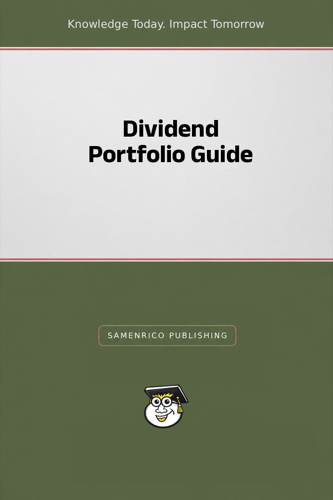
Dividend Portfolio Guide eBook
Teaches building equity income stream from blue ch
Teaches building equity income stream from blue chip dividend stocks.
Formats
Free sample
Chapter 1: The Paycheck Paradigm–- The day I stopped caring about stock prices was the day I started getting rich. Not "buy-a-yacht" rich, but wake-up-whenever rich. Walk-my-daughter-to-school rich. Tell-my-boss-thank-you-for-the-opportunity-and-goodbye rich. That day arrived exactly fourteen years after I bought my first dividend-paying stock, and it arrived not because I guessed the next Apple or Nvidia, but because I did something far simpler and far more boring: I built a machine that paid me every single quarter, whether the stock market was soaring or crashing.Before that day, I was like most investors.
I checked my portfolio every morning with a knot in my stomach. I watched financial television, where men in expensive suits yelled about resistance levels and moving averages. I bought stocks because a friend heard something from a cousin who knew a guy. I sold stocks because a headline scared me. I treated investing like a casino, and like most casino patrons, I lost more than I won.
Not catastrophically, but death by a thousand paper cuts: a bad trade here, a panic sale there, a "hot tip" that turned cold the moment I bought it.Then I discovered the Paycheck Paradigm, and everything changed.The Great Lie of Modern Investing Let me name the lie that Wall Street has sold you. The lie is this: the only way to make money in stocks is to buy low and sell high. This single statement has destroyed more wealth than every bear market in history combined. It has convinced ordinary people that investing is a game of prediction, that you need to be smarter than the market, that you need to time your entries and exits with surgical precision.The truth is exactly the opposite. The most successful investors in history—the ones who died rich rather than died wondering—did not make their money by guessing price movements.
They made their money by owning businesses that paid them to wait.Consider the following. Between 1930 and 2020, the S&P 500 generated an average annual return of approximately 9.8%. Of that 9.8%, roughly 40% came from dividends. That is not a typo. Nearly half of the stock market's long-term returns have come not from price appreciation but from cash dividends paid directly to shareholders.
And yet, most individual investors act as if dividends are an afterthought—a small bonus on top of the "real" money made from price gains.This is backward thinking. Dividends are not a bonus. Dividends are the point.When you buy a stock that does not pay a dividend, you are making a single bet: that someone else will pay more for that stock in the future than you paid today. That is speculation, not investing. You are counting on the "greater fool"—a buyer willing to pay an even higher price than you did.
There is nothing wrong with speculation if you understand it for what it is, but do not confuse it with investing.When you buy a stock that pays a dividend, you are making a different bet entirely. You are betting that the company will continue to generate profits, and that management will continue to share those profits with you, the owner. You get paid while you wait. If the stock price goes up, you win. If the stock price goes down, you still get paid.
If the stock price stays flat for a decade, you collect ten years of dividends.This is the Paycheck Paradigm. You stop caring about what Mr. Market—that manic-depressive character that Benjamin Franklin famously personified as a business partner—thinks your shares are worth on any given Tuesday. You care about one thing and one thing only: is the dividend check arriving on time, and is it getting bigger?The 1973-1974 Bear Market: A Case Study in Getting Paid to Wait To understand why this matters, we need to look at real history, not abstract theory. Let me take you to one of the worst periods in American stock market history: the bear market of 1973-1974.Between January 1973 and October 1974, the S&P 500 lost nearly 50% of its value.
The causes were multiple: an oil embargo, skyrocketing inflation, the collapse of the Bretton Woods monetary system, and the unfolding Watergate scandal. If you were an investor focused on stock prices, you were miserable. Your portfolio was cut in half. You watched helplessly as years of gains evaporated.But consider two investors: Speculative Sam and Dividend Diane.Sam owned growth stocks—companies that reinvested all their earnings and paid no dividends. His entire return depended on price appreciation.
By October 1974, his portfolio had lost 48%. He had received zero cash payments during the entire period. His net worth was cut nearly in half, and he had nothing to show for the two worst years of his investing life.Diane owned dividend-paying blue chips: companies like Procter & Gamble, Coca-Cola, and Johnson & Johnson. Her portfolio also fell. There is no escaping a broad market decline.
But Diane's experience was fundamentally different from Sam's in three critical ways.First, while her stock prices fell, her dividend checks kept arriving. The companies she owned had paid dividends through the Great Depression, through World War II, through the Korean War. They were not about to stop because of an oil embargo. Every quarter, cash landed in her account.Second, Diane reinvested her dividends. When Procter & Gamble paid her $100, she used that $100 to buy more shares of Procter & Gamble—shares that were now 40% cheaper than they had been a year earlier.
Every reinvested dividend bought more shares than it would have at the market peak. When the market eventually recovered (and it always does), Diane owned substantially more shares than she had started with.Third, Diane never had to make the agonizing decision of when to sell. Sam had to decide: do I sell now and lock in my losses, or do I hold and hope for a recovery? That decision paralyzed him. Diane had no such decision.
She was not selling. She was collecting.By the time the market fully recovered in 1976, Diane's portfolio had not only recovered its original value but had grown significantly, thanks to the additional shares purchased with reinvested dividends during the trough. Sam's portfolio had merely recovered to its original level. He had treaded water for three years. Diane had built wealth.This is not a theoretical exercise.
This is the mathematical reality of dividend reinvestment. And it is the foundation of everything that follows in this book.Why Dividends Are More Reliable Than Earnings Before we go further, I need to address a question that may be forming in your mind: how do we know which dividends are safe? How do we distinguish a genuine blue-chip dividend payer from a high-yield trap that will cut its dividend the moment trouble arrives?The answer lies in understanding the difference between earnings and cash.Publicly traded companies report their earnings every quarter. These earnings are calculated according to Generally Accepted Accounting Principles (GAAP), a complex set of rules that gives management considerable discretion. A company can make its earnings look better by changing how it depreciates assets, by counting revenue before it is collected, or by excluding "one-time" charges that seem to happen every quarter.…
This is the end of the free sample. Get the eBook to keep going. Buy now
About this book
Details
- Author
- Dockery Elfreda
- Publisher
- SamEnrico
- Language
- English
- Genre
- Non-Fiction, Business Brief, Dividend Investing
- Released
- 2026-06-07
- Pages (approx.)
- 147
- Available as
- eBook, Audiobook

Read better in the ZLOADR app
Your eBooks on your phone or tablet. Sign in with your SamEnrico account and start reading.
More by Dockery Elfreda
 Imposter Syndrome Recovery CourseDockery Elfreda$11.99
 Working Memory Journal LogDockery Elfreda$11.99
 Sleep Spindle Aging MemoryDockery Elfreda$11.99
 Second Generation EntrepreneurshipDockery Elfreda$11.99
 Low Income Subscription ChurnDockery Elfreda$11.99
 The Two Minute Distraction RuleDockery Elfreda$11.99
 Process Analysis Essay PromptsDockery Elfreda$12.99
 Paleo For Families WorkbookDockery Elfreda$11.99
 The Phantom of the Danube: Vienna’s Vanishing Heiress (1934)Dockery Elfreda$11.99
 Love and Siege: The Fall of Constantinople's Last DefendersDockery Elfreda$11.99
 Understanding FaintingDockery Elfreda$11.99
 How to Become a Marine EngineerDockery Elfreda$11.99
You may also like
 Hong Kong Handover 1997Dunn Johnnie$11.99
 Zumba For Postnatal Recovery CourseNeal Christian$11.99
 Zumba for BeginnersLadner Nikia$11.99
 YouTube Comment Mining GuideHumes Pandora$12.99
 Worry Box MeditationCarlin Rudy$11.99
 Workplace Stress MeditationNguyen Lynn$11.99
 Workplace Stress and Sleep RepairHawley Ivory$11.99
 Workplace Perfectionism CureDelaney Jeffry$11.99
 Workplace Injustice Anger GuideWallen Isabelle$11.99
 Work Addiction and Burnout LinkGreenwood Ester$11.99
 Women in Yoga and WellnessBeattie Galina$11.99
 Women in Stand Up ComedyChun Evangeline$11.99