
Non-FictionStudent's ShortcutDiversity
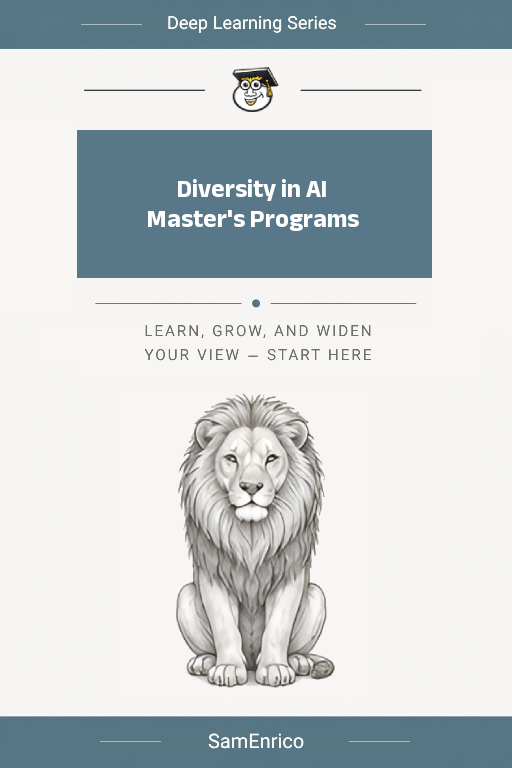
Diversity in AI Master's Programs eBook
Reviews women and underrepresented minority repres
Reviews women and underrepresented minority representation in top AI master's programs and support resources.
Formats
Free sample
Chapter 1: The Halfway Vanishing--The numbers looked promising at first. Maya had been one of them—a bright-eyed computer science graduate from a historically Black university, accepted into a top-five AI master's program. She had beaten the odds just to get there. Her undergraduate GPA was impeccable. Her research on bias in healthcare algorithms had won a national award.
Her recommenders had called her "one of the most promising AI researchers of her generation."She lasted one semester.Not because she couldn't code. Not because she failed her classes. Not because she lacked ambition or intelligence or grit. Maya left because she sat in a room of sixty students for three weeks before anyone spoke to her. Because when she finally raised her hand to answer a question, a male peer behind her whispered, "Diversity admit." Because her advisor, overwhelmed with twenty other students, never learned her name.
Because the only other Black student in her cohort dropped out in week five.Maya's story is not exceptional. It is not rare. It is, in fact, the norm.This book begins with Maya because her story contains a truth that the AI education industry has spent decades ignoring: we do not have a recruitment problem. We have a retention conspiracy.Over the past decade, universities have poured millions of dollars into recruiting women and underrepresented minorities (URMs) into AI and computer science. They have launched summer programs, diversity weekends, targeted marketing campaigns, and pipeline partnerships with K-12 schools.
And those efforts have produced modest gains. Undergraduate CS enrollment for women has risen to roughly 22% of bachelor's degrees. The number of Black and Latinx students in undergraduate computing has inched upward.Then comes the master's degree. And everything falls apart.The 50% Drop Let me give you a number that should keep every program director awake at night: Between undergraduate enrollment in AI-related fields and master's degree completion, the representation of women and URMs drops by approximately 50%.Let that sink in. For every two women who express interest in AI at the undergraduate level, only one completes a master's degree in the field.
For every two Black students who start down the path, only one finishes. This is not attrition. This is a massacre of potential—and it happens quietly, without fanfare, without anyone being held accountable.The data tells a consistent story across institutions. According to the National Center for Education Statistics, women receive approximately 22% of CS bachelor's degrees but only 15-18% of AI master's degrees. Black students represent roughly 9% of CS undergraduates but fall to 4-6% at the master's level.
Latinx students drop from 14% to 8-10%. First-generation college students—those whose parents never earned a four-year degree—disappear at even more alarming rates, with only one in three who start a master's program ever finishing.These numbers are not accidents. They are not the inevitable result of differing interests or abilities. They are the product of structural barriers that AI master's programs have built, maintained, and in some cases, actively defended.The Pipeline That Was Never a Pipeline For decades, the dominant metaphor in diversity work has been the pipeline. The idea is simple: if you pour more students from underrepresented groups into the early stages of education (K-12, undergraduate), they will eventually flow through to advanced degrees and careers.
The pipeline metaphor suggests a linear, mechanistic process. Inputs lead to outputs. Fix the leaks, and the system works.The pipeline metaphor is wrong.It is wrong because it assumes the problem is one of quantity rather than quality. It assumes that the barriers are primarily at the entry points. It assumes that once students are in the system, the system treats them fairly.
And most dangerously, it assumes that attrition is an individual failure—a student who "leaks" out must have been insufficiently prepared, insufficiently motivated, or insufficiently resilient.The research tells a different story. A landmark study published in the journal Diversity in STEM followed 1,200 URM students across twenty AI master's programs over five years. The researchers found that students who left the programs had, on average, identical incoming qualifications as those who stayed. Their undergraduate GPAs were the same. Their standardized test scores were the same.
Their research experience was the same.What differed was not the students but their experiences within the programs.Students who left were 3x more likely to report experiencing a microaggression in their first month. They were 2.5x more likely to report that no faculty member had ever spoken to them about their career goals. They were 4x more likely to report feeling like they did not belong. And they were 1.5x more likely to have received a single low grade—not a pattern of failure, but a single course where they underperformed.The pipeline metaphor blames the student for leaking. The evidence blames the structure for pushing them out.The Chilly Climate: An Introduction What pushes students out?
The answer lies in a concept that feminist higher education researchers have studied for decades but that AI master's programs have largely ignored: the chilly climate.The chilly climate is not one thing. It is a constellation of environmental factors that cumulatively signal to women and URM students that they do not belong. It includes:Microaggressions. These are subtle, often unintentional slights that communicate hostility or dismissal. A faculty member calling on every male student before noticing a woman's raised hand.
A peer asking a Black student, "How did you get into this program?" A group project where a Latinx student's technical suggestions are ignored until a white student repeats them verbatim and they are celebrated.Lack of belonging. Belonging is not a feeling. It is a measurable psychological state that predicts academic persistence better than GPA. When students do not see themselves reflected in their peers, their faculty, or their curriculum, they begin to question whether they deserve to be in the room. This questioning is not irrational.
It is an accurate reading of an environment that was not designed for them.High-stakes exams. Many AI master's programs use curved grading systems that guarantee a certain percentage of students will fail or receive low grades. These systems disproportionately harm students who lack prior coding experience—which is disproportionately URM and first-generation students. The irony is that students who enter without prior experience but complete the first year have identical long-term outcomes to their peers. They just drop out at higher rates before reaching that point.Isolation.
URM students in AI master's programs are often the only one in their cohort. Being the only one means no one to study with, no one to vent to, no one who intuitively understands the particular exhaustion of code-switching between one's home culture and the dominant culture of the program. Isolation is not an inconvenience. It is a predictor of attrition.The chilly climate is not a conspiracy. It is not the result of malicious individuals (though those exist).
It is the natural outcome of designing programs for a homogeneous student body and then being surprised when non-homogeneous students struggle.Why Master's Programs Are Different If undergraduate CS programs also have chilly climates, why do master's programs see such dramatic attrition? The answer lies in three unique features of…
This is the end of the free sample. Get the eBook to keep going. Buy now
About this book
Details
- Author
- Hutchinson Jeraldine
- Publisher
- SamEnrico
- Language
- English
- Genre
- Non-Fiction, Student's Shortcut, Diversity
- Released
- 2026-05-30
- Pages (approx.)
- 157
- Available as
- eBook, Audiobook

Read better in the ZLOADR app
Your eBooks on your phone or tablet. Sign in with your SamEnrico account and start reading.
More by Hutchinson Jeraldine
 Remote Company Retreats Technology ChecklistHutchinson Jeraldine$11.99
 Pattern Recognition for DiagnosticiansHutchinson Jeraldine$11.99
 The Osteoarthritis Self Care GuideHutchinson Jeraldine$11.99
 The John Muir Wilderness GuideHutchinson Jeraldine$11.99
 The Alchemist King: Paracelsus and the Birth of Modern MedicineHutchinson Jeraldine$11.99
 Understanding Semmerkrot–haraldsson–weenaes SyndromeHutchinson Jeraldine$17.99
 10 Ways to Use Dripping (Recipe Book)Hutchinson Jeraldine$11.99
 Franchise Pricing Global GuideHutchinson Jeraldine$12.99
 Restaurant ReviewerHutchinson Jeraldine$11.99
You may also like
 Hong Kong Handover 1997Dunn Johnnie$11.99
 Zumba For Postnatal Recovery CourseNeal Christian$11.99
 Zumba for BeginnersLadner Nikia$11.99
 YouTube Comment Mining GuideHumes Pandora$12.99
 Worry Box MeditationCarlin Rudy$11.99
 Workplace Stress MeditationNguyen Lynn$11.99
 Workplace Stress and Sleep RepairHawley Ivory$11.99
 Workplace Perfectionism CureDelaney Jeffry$11.99
 Workplace Injustice Anger GuideWallen Isabelle$11.99
 Work Addiction and Burnout LinkGreenwood Ester$11.99
 Women in Yoga and WellnessBeattie Galina$11.99
 Women in Stand Up ComedyChun Evangeline$11.99