
Non-FictionInformativeEducational
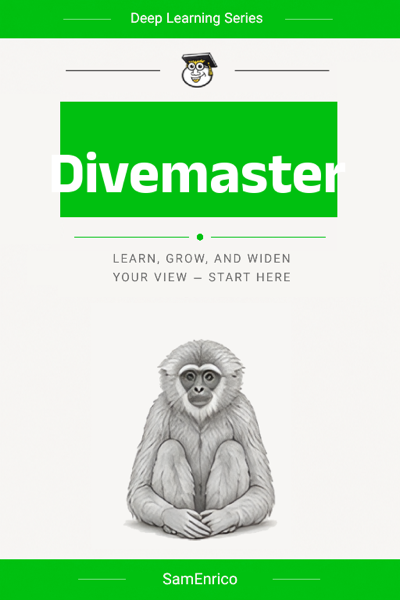
Divemaster eBook
A Coursebook on Divemaster
A Coursebook on Divemaster
Formats
Free sample
Chapter 1: The Judgment Seat...–- The ocean does not care about your certification card. At 18 meters, surrounded by blue water and six certified divers who are all looking at you, that truth becomes visceral. A Divemaster is not a "super diver." You are not the person in the group who can hold their breath the longest or swim the fastest or carry the most tanks up a beach. You are the professional whose primary tool is judgment, and whose primary liability is the calmness—or panic—that radiates from you like heat from a submerged engine.This chapter redefines the Divemaster from the ground up. It strips away the romantic image of the tanned, smiling guide pointing at sea turtles while guests snap photos.
That image is not wrong; it is simply incomplete. Beneath the surface of every guided dive, every training assist, every equipment check, lies a psychological reality: the DM’s emotional state is contagious. If you are calm, your divers are calmer. If you are anxious, your divers become anxious. If you panic, your divers will follow you into that panic like lemmings following a leader off a cliff—except lemmings, famously, do not actually do that.
Divers do.The Four Roles You Actually Play Every Divemaster training agency provides a list of roles and responsibilities. They are accurate, as far as they go. But they are written by committees, not by working DMs who have had to make a decision at 30 meters with 70 bar of air left and a diver who is quietly freaking out behind their mask. This chapter reframes those roles into four functional identities you will actually inhabit, sometimes all within a single dive.Supervisor. This is the most formal role and the one with the clearest legal boundaries.
As a supervisor, you are overseeing certified divers who have every right to be in the water and who may overestimate their own skills. Your job is not to teach them—they are certified, and teaching implies a student-teacher relationship that may not exist. Your job is to watch. You watch for air consumption rates that are falling too fast. You watch for buoyancy control that is damaging the reef or endangering the diver.
You watch for buddy teams that separate. And then you intervene before any of these observations become problems. The supervisor does not micromanage. The supervisor anticipates.Assistant. This role places you alongside an instructor, usually during a training course.
You handle logistics—tanks, weights, waivers, equipment setup—so the instructor can focus on teaching. But the assistant role is more subtle than logistics. A good assistant watches the instructor’s back. When the instructor is demonstrating a skill, the assistant watches the students for confusion. When a student is struggling, the assistant provides encouragement without contradicting the instructor’s feedback.
When an emergency happens, the assistant executes the emergency protocol while the instructor manages the group. A good assistant makes the instructor look great. A bad assistant looks to students like an unsafe diver, and that perception spreads.Guide. This is the role most people imagine when they think of a Divemaster. You are showing points of interest—wrecks, reef structures, marine life—while managing group position and air consumption.
The guide role demands site-specific knowledge: where the eagle rays cluster, where the current picks up, where the exit points are hidden at high tide. But it also demands group management. You cannot simply point at something and swim away. You must position yourself so that all divers can see the feature, then position yourself again for the next feature, all while tracking the lowest air consumption in the group. The guide who loses track of the air hog loses the dive.Mentor.
This is the most overlooked role and the one that generates the most repeat business. As a mentor, you model calm, competent behavior that students and new divers emulate unconsciously. The "Role Model Effect" is proven: divers under a calm DM exhibit lower heart rates (measured in multiple studies) and better air consumption (up to 20 percent longer dive times) than divers under an anxious or distracted DM. Your emotional state is not just your own business. It becomes the group’s baseline.
If you are relaxed, the group is relaxed. If you are checking your SPG every thirty seconds and frowning, the group will start checking their SPGs every thirty seconds and frowning, and the dive will end early for no reason other than transmitted anxiety.Here is the uncomfortable truth that no training manual states explicitly: Most DMs fail not because they lack skill but because they cannot manage their own emotional state underwater. They pass the skills circuit. They pass the stamina tests. They know the physics and the physiology.
And then they get into the water with six certified strangers, and they feel the weight of responsibility, and their breathing quickens, and the group notices, and the group’s breathing quickens, and the dive becomes a self-fulfilling prophecy of stress and early ascents.The Difference Between Controlling and Leading There is a word that appears frequently in Divemaster training materials: control. Control the dive. Control the group. Control the ascent. Control is not wrong, but it is incomplete.
Control is what you do when you do not trust the divers. Leading is what you do when you have earned their trust.Controlling a dive looks like this: The DM positions themselves at the front of the group and swims at a fixed pace. The DM points at features with a rigid arm. The DM stops the group periodically to count heads, then resumes. The DM signals "stop" when anyone drifts too far.
The DM ascends on a predetermined schedule regardless of group air consumption. Controlling is rigid, instructor-led, and stop-and-go. It works. It is safe. It is also exhausting for the DM and mildly unpleasant for the divers, who feel like they are being herded rather than guided.Leading a dive looks different: The DM positions themselves slightly below and in front of the group, not as a barrier but as a reference point.
The DM adjusts pace based on the slowest diver, not on a predetermined schedule. The DM points at features with a full arm extension (two fingers, not a pointed finger—pointing at people underwater is aggressive), then looks back to ensure everyone saw the feature before swimming on. The DM checks air consumption by watching the group’s SPG checks, not by stopping the group to ask for numbers. Leading is fluid, role-modeled, and adaptive. It is safer than controlling because it maintains group cohesion without creating stress.
And it is more enjoyable for everyone, including the DM.The shift from controlling to leading requires one thing above all others: trust. You must trust that the divers can manage their own buoyancy. You must trust that they will signal when they are low on air. You must trust that they will stay close without being told. And they, in turn, must trust that you know the site, that you will not lead them into danger, and that you will handle an emergency calmly if one arises.
Trust is not automatic. It is earned during the briefing, in the first ninety seconds of the dive, and in…
This is the end of the free sample. Get the eBook to keep going. Buy now
About this book
Details
- Author
- Meacham Lonnie
- Publisher
- SamEnrico
- Language
- English
- Genre
- Non-Fiction, Informative, Educational
- Released
- 2026-05-09
- Pages (approx.)
- 133
- Available as
- eBook, Audiobook

Read better in the ZLOADR app
Your eBooks on your phone or tablet. Sign in with your SamEnrico account and start reading.
More by Meacham Lonnie
 Metta for Grief HealingMeacham Lonnie$11.99
 The Adult Child of AlcoholicsMeacham Lonnie$11.99
 Murdoch's Covid CoverageMeacham Lonnie$11.99
 GH and Ketogenic DietMeacham Lonnie$11.99
 The Silk Road's Last BreatheMeacham Lonnie$11.99
 Payment Data Analytics for Export DecisionsMeacham Lonnie$12.99
 How to Become a Barrel-bridge AssemblerMeacham Lonnie$11.99
 How to Produce Brooches and Lapel PinsMeacham Lonnie$11.99
You may also like
 Hong Kong Handover 1997Dunn Johnnie$11.99
 Zumba For Postnatal Recovery CourseNeal Christian$11.99
 Zumba for BeginnersLadner Nikia$11.99
 YouTube Comment Mining GuideHumes Pandora$12.99
 Worry Box MeditationCarlin Rudy$11.99
 Workplace Stress MeditationNguyen Lynn$11.99
 Workplace Stress and Sleep RepairHawley Ivory$11.99
 Workplace Perfectionism CureDelaney Jeffry$11.99
 Workplace Injustice Anger GuideWallen Isabelle$11.99
 Work Addiction and Burnout LinkGreenwood Ester$11.99
 Women in Yoga and WellnessBeattie Galina$11.99
 Women in Stand Up ComedyChun Evangeline$11.99