
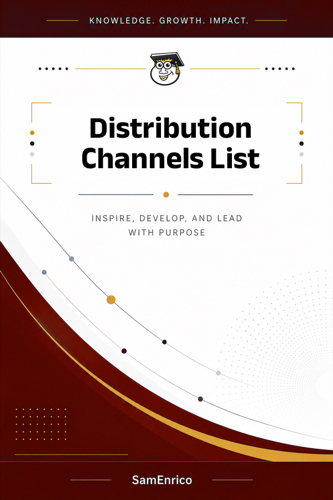
Non-FictionFirst 30 DaysDistribution
Distribution Channels List eBook
State how product reaches customers.
by Click Staci
State how product reaches customers.
Formats
Free sample
Chapter 1: Beyond the Box...--–- Most executives believe they understand distribution. They point to their warehouses, their trucking contracts, their retail shelf space, their Amazon storefront. They speak confidently about logistics optimization, last-mile delivery, and inventory turns. But ask them a more fundamental question—Why does your product reach customers the way it does?—and the confidence often falters. The answer, more often than not, reveals a strategy that evolved by accident rather than by design.This chapter dismantles a dangerous assumption that pervades boardrooms across every industry: the belief that distribution is merely a logistical function.
It is not. Distribution is the most underleveraged strategic asset in modern business, and treating it as a cost center is a fast route to irrelevance.The Cost Center Delusion For decades, the marketing discipline known as the "Four Ps"—Product, Price, Promotion, and Place—has placed distribution under the unassuming label of "Place." While Product commanded the attention of engineers and designers, while Price consumed the energy of finance and sales teams, while Promotion captivated the creativity of advertisers, Place was relegated to operations. It became synonymous with logistics: trucks, warehouses, shelves, and the unfortunate souls who managed them.This relegation was a catastrophic error.Consider two companies that appeared identical on paper a decade ago. Both manufactured high-end audio equipment. Both had premium pricing.
Both had glowing product reviews. Both invested heavily in advertising. One followed the traditional path: it sold through specialty electronics retailers, big-box stores, and eventually Amazon. The other made a different choice. It sold only through a carefully curated network of independent audio specialists who provided in-home demonstrations, custom installation, and lifelong support.
When customers had problems, they called the same person who sold them the equipment.The first company now competes primarily on price. Its products are stacked next to competitors on Amazon's search results, where the only differentiator is a half-star rating and a $20 price difference. Its brand has been commoditized. The second company commands prices three times higher than technically comparable products. Its customers do not comparison-shop because the channel itself—the experience of buying, the relationship with the specialist, the assurance of support—is inseparable from the product.
The distribution channel is not how the product reaches customers. The distribution channel is the product.This is not a theoretical distinction. It is the difference between being a commodity and being a brand.Defining Market Access Let us retire the word "distribution" as it is commonly used. It conjures images of pallets and conveyor belts. Replace it with a more accurate phrase: Market Access.Market Access is the strategic discipline of determining how a customer buys, receives, and experiences value.
It encompasses every touchpoint between the producer and the end user, from the moment a customer becomes aware of a product to the moment they dispose of it years later. Market Access decisions dictate:Brand positioning: A luxury watch sold through airport kiosks communicates something very different than the same watch sold through appointment-only boutiques.Pricing power: Channels that add genuine value (expertise, convenience, trust) enable premium pricing. Channels that merely transact drive prices to zero.Data ownership: Direct channels generate customer data that belongs to you. Intermediated channels generate customer data that belongs to someone else.Customer lifetime value: Channels that enable ongoing relationships (subscriptions, memberships, service contracts) capture recurring revenue. Transactional channels capture a single sale and nothing more.Competitive insulation: Unique channel relationships are difficult to copy.
A patent expires; an exclusive partnership with the most trusted distributor in an industry endures.The companies that understand this treat Market Access as a CEO-level strategic priority. They do not ask, "How do we get our product from the factory to the customer?" They ask, "What is the optimal path to the customer that maximizes brand equity, customer lifetime value, and competitive moat?"The Unidirectional Fallacy The traditional model of distribution is fundamentally unidirectional. Product flows in one direction: from producer to warehouse to retailer to customer. Money flows backward. Information flows sporadically, if at all.This model assumes that value is created solely in the production process and that distribution merely delivers that value to customers unchanged.
This assumption is false.In reality, distribution channels are value-creating systems in their own right. A distributor that provides just-in-time delivery to automotive factories creates value by reducing the manufacturer's inventory carrying costs. A retailer that offers expert advice and installation creates value by reducing the customer's risk of making a poor purchase. A platform that enables peer reviews and comparisons creates value by reducing information asymmetry.The channel is not a passive pipe. It is an active participant in value creation.
Recognizing this changes everything about how you design, manage, and invest in your route to market.Consider the example of Tesla. When the company decided to sell directly to consumers rather than through franchised automobile dealers, it was not making a logistics decision. There is nothing logistically superior about company-owned stores versus independent dealers. Tesla was making a market access decision. Direct sales enabled the company to control the customer experience from first touch to delivery.
It enabled Tesla to set consistent prices nationwide without negotiation. It enabled the company to capture customer data that would have otherwise belonged to dealers. And most importantly, it enabled Tesla to educate customers about electric vehicles—a complex product requiring explanation—without competing with dealers who made higher margins on gasoline vehicle service.Franchised dealers sued Tesla in multiple states. They lost in some places and won in others. The legal battles were expensive and distracting.
But Tesla's leadership understood that the distribution channel was not an operational detail. It was existential. A Tesla sold through a traditional dealership would have been a different product—likely a failed one.The Strategic Asset Audit How do you know whether your current distribution network is a strategic asset or merely a cost center? The answer lies in asking five diagnostic questions. Consider each carefully.Question One: Who owns the customer relationship?When a customer has a problem, a question, or a desire to buy again, who do they contact?
If the answer is "us," you own the relationship. If the answer is "our distributor," "our retailer," or "Amazon," you do not. The entity that owns the customer relationship captures long-term value. Everyone else performs a transaction.Question Two: What data do we capture from each transaction?When a sale occurs through your channel, what do you learn about the customer? Their identity?
Their preferences? Their usage patterns? Their willingness to pay? Direct channels generate rich data. Intermediated channels often generate only an aggregated sales number with no customer-level information.
Data is the raw material of modern business. Channels that do not generate data are strategically impoverished.Question Three: Can we differentiate our brand experience across channels?A luxury hotel chain cannot offer the same experience through a discount booking site that it offers through its own reservation system. The channel shapes the customer's perception of the brand. Can you control that perception? Or does your channel partner present your product in the same way it presents every other product on its shelves?Question Four: What is the margin contribution of…
This is the end of the free sample. Get the eBook to keep going. Buy now
About this book
Details
- Author
- Click Staci
- Publisher
- SamEnrico
- Language
- English
- Genre
- Non-Fiction, First 30 Days, Distribution
- Released
- 2026-06-06
- Pages (approx.)
- 139
- Available as
- eBook, Audiobook

Read better in the ZLOADR app
Your eBooks on your phone or tablet. Sign in with your SamEnrico account and start reading.
More by Click Staci
 Dreams of Reconciliation RecoveryClick Staci$11.99
 Constraints for TruckersClick Staci$11.99
 Anticipatory Grief MarriageClick Staci$11.99
 Road Rage Journal PromptsClick Staci$11.99
 Cannibalization AI GuideClick Staci$11.99
 The Hillsborough Disaster: Justice on the PitchClick Staci$11.99
 Breast Self Awareness Not PanicClick Staci$11.99
 Persuasion Psychology HandbookClick Staci$11.99
 Gold and Galley Sails: Athens' Financial Gambit in the Peloponnesian WarClick Staci$11.99
 How to Produce Pain Relief and First AidClick Staci$11.99
 A Collector's Handbook to the Triumph 2000 Roadster TraClick Staci$11.99
 Argentine National University System GuideClick Staci$12.99
You may also like
 Hong Kong Handover 1997Dunn Johnnie$11.99
 Zumba For Postnatal Recovery CourseNeal Christian$11.99
 Zumba for BeginnersLadner Nikia$11.99
 YouTube Comment Mining GuideHumes Pandora$12.99
 Worry Box MeditationCarlin Rudy$11.99
 Workplace Stress MeditationNguyen Lynn$11.99
 Workplace Stress and Sleep RepairHawley Ivory$11.99
 Workplace Perfectionism CureDelaney Jeffry$11.99
 Workplace Injustice Anger GuideWallen Isabelle$11.99
 Work Addiction and Burnout LinkGreenwood Ester$11.99
 Women in Yoga and WellnessBeattie Galina$11.99
 Women in Stand Up ComedyChun Evangeline$11.99