
Non-FictionInformativeEducational
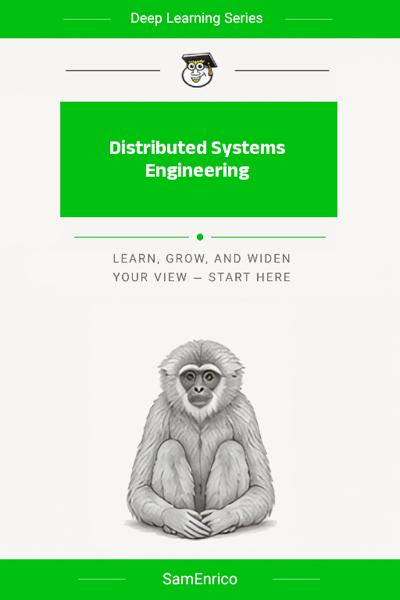
Distributed Systems Engineering eBook
A Coursebook on Distributed Systems Engineering
by Lucas Harold
A Coursebook on Distributed Systems Engineering
Formats
Free sample
Chapter 1: The 3 AM Page--–I remember the exact moment I stopped believing in reliable networks. It was 3:14 AM on a Saturday, my phone was vibrating across the nightstand like a trapped insect, and the on-call screen showed a single terrifying word: CASCADING_FAILURE. Twenty-seven services were red. Four million users were seeing “500 Internal Server Error.” And somewhere in a data center two thousand miles away, a load balancer that had worked perfectly for eighteen months had decided, for no discernible reason, to stop forwarding traffic to exactly three servers in a pool of forty-two.That load balancer wasn’t malicious. It wasn’t even broken, not really.
It was simply acting according to its nature: it was a machine, connected to other machines, by wires that ran through walls and switches and routers and undersea cables, across time zones and jurisdictions and weather patterns. And machines, as we are about to learn, lie. They lie about being alive. They lie about having processed your request. They lie about the time.
They lie about everything, but never with malicious intent – only because the universe they inhabit is fundamentally, gloriously, maddeningly unreliable.This book is not a gentle introduction to distributed systems. It is not a textbook that will hold your hand through the beauty of Paxos or the elegance of CRDTs. Those books exist already, and many of them are excellent. This book is something else: a survival guide for the 3 AM pages. A field manual for the engineer who has just been told that the database replication lag is now forty-five minutes and climbing.
A confession that the beautiful diagrams in those other books – the ones with neat boxes and solid arrows and happy little databases replicating cleanly to happy little replicas – are lies. Or rather, they are truths told about a world that does not exist outside of Power Point.The real world of distributed systems is messy. Networks drop packets for no reason. Clocks drift apart because a server’s battery died. A perfectly healthy node gets marked as dead because a heartbeat message got stuck behind a backup job.
A retry that was supposed to save you instead kills you, because every retry amplifies the load, and every amplified load causes more failures, and more failures cause more retries, until the entire system collapses under the weight of its own good intentions.I have seen this happen. I have caused it to happen. And I have sat in the postmortem meeting the next morning, drinking cold coffee, explaining to a room of bleary-eyed engineers why our elegant, theoretically sound architecture had turned into a self-destructing machine.That is what this chapter – and this book – is about. Not the theory of distributed systems, but the nightmares. And then, crucially, how to build systems that survive those nightmares.The Big Lie: Why Bigger Servers Won't Save You Let us begin with a story about a company that no longer exists.
In 2008, a social media startup called Pownce – you have never heard of it, because it failed – had a scaling problem. They were growing fast, hundreds of thousands of users, and their single database server was melting. Every evening at 8 PM, when users came home and started posting, the site would slow to a crawl. The founders did what seemed logical: they bought a bigger server. More RAM.
Faster disks. More CPUs.For three months, it worked. And then, inevitably, it didn't. Traffic grew again. The bigger server became the slow server.
They bought an even bigger server. This cycle – vertical scaling, the industry calls it – continued until they hit the ceiling. There were no bigger servers left to buy. The hardware vendors had nothing faster. They were trapped.Pownce eventually shut down.
Not because of this problem alone, but the inability to scale was a contributing factor. Meanwhile, a different social media company was facing the same problem and making a different choice. That company was Twitter, and their choice was to stop buying bigger servers and start buying more servers.This is the fundamental shift that defines distributed systems: moving from vertical scaling (a single, very powerful machine) to horizontal scaling (many, less powerful machines working together). The promise is seductive. If one server can handle 1,000 requests per second, surely ten servers can handle 10,000.
If one database has 1 TB of storage, ten databases have 10 TB. If one server fails, nine continue.But here is the catch, the one that every textbook explains and every engineer learns through pain: ten servers do not behave like one server times ten. They behave like ten servers, each with its own clock, its own memory, its own failure modes, connected by a network that is – and I want you to tattoo this on your forearm – fundamentally unreliable.The Eight Fallacies of Distributed Computing (And Why They Still Fool You)In 1994, a Sun Microsystems engineer named Peter Deutsch compiled a list of assumptions that programmers make about distributed systems. Every single assumption is false. Every single one has caused an outage.
Every single one will cause another outage today, somewhere, probably at a company you use.These are the Eight Fallacies of Distributed Computing. Learn them. Fear them. Print them out and tape them to your monitor.Fallacy 1: The network is reliable.This is the mother of all fallacies, the one that has caused more 3 AM pages than all others combined. The network is not reliable.
It is a chaotic soup of routers, switches, firewalls, load balancers, DNS servers, and cables that squirrels chew through (this has really happened, more than once). Packets get dropped. Connections time out. A perfectly healthy service becomes unreachable because someone reconfigured a firewall at 2 PM on a Tuesday and forgot to tell anyone.Real-world example: In 2021, a major cloud provider had a network outage that lasted for hours. The root cause?
A configuration change that was supposed to increase capacity instead caused network devices to broadcast route updates faster than they could process them. The network didn't break; it drowned in its own noise.Fallacy 2: Latency is zero.We write code as if sending a message to another server takes no time at all. We design systems that make dozens of network round trips per user request, each one adding milliseconds, each millisecond compounding until the user is staring at a loading spinner and rage-quitting.The reality: Even in the same data center, a network round trip takes 0.5 to 5 milliseconds. Between US East and US West, add 60-80 milliseconds. Between US and Europe, 80-150 milliseconds.
Between US and Australia, 200-300 milliseconds. And that's just the network. Add database queries. Add internal processing. Add queueing delays.
Add garbage collection pauses. Suddenly, your 50-millisecond service is taking 500.Fallacy 3: Bandwidth is infinite.The cloud era has made us lazy about bandwidth. We serialize JSON (text-based, verbose) instead of Protocol Buffers or Avro. We send the same data multiple times because caching is "too complicated." We replicate entire database tables across services instead of asking for just the columns we need.Then the company grows. Traffic doubles.
Then doubles again. Suddenly, your network interface is saturated at 10 Gbps. Packets queue. Queues overflow. Drops happen.
Retries happen. And because retries amplify load, the saturation gets worse, not better.Fallacy 4: The network is secure.This fallacy is…
This is the end of the free sample. Get the eBook to keep going. Buy now
About this book
Details
- Author
- Lucas Harold
- Publisher
- SamEnrico
- Language
- English
- Genre
- Non-Fiction, Informative, Educational
- Released
- 2026-05-09
- Pages (approx.)
- 144
- Available as
- eBook, Audiobook

Read better in the ZLOADR app
Your eBooks on your phone or tablet. Sign in with your SamEnrico account and start reading.
More by Lucas Harold
 The Grandparent as ParentLucas Harold$11.99
 Beginner Sitting Meditation GuideLucas Harold$11.99
 Amino Acids HGH BoostLucas Harold$11.99
 The Hearst Baltimore EstateLucas Harold$11.99
 The Forgotten Heir: The Amnesiac Son of Al Capone's RivalLucas Harold$11.99
 A Beginners Guide to Take It Easy (Volume 1)Lucas Harold$11.99
 How to Produce Broiling PansLucas Harold$11.99
 Payment Terms Negotiation with Foreign BuyersLucas Harold$12.99
You may also like
 Hong Kong Handover 1997Dunn Johnnie$11.99
 Zumba For Postnatal Recovery CourseNeal Christian$11.99
 Zumba for BeginnersLadner Nikia$11.99
 YouTube Comment Mining GuideHumes Pandora$12.99
 Worry Box MeditationCarlin Rudy$11.99
 Workplace Stress MeditationNguyen Lynn$11.99
 Workplace Stress and Sleep RepairHawley Ivory$11.99
 Workplace Perfectionism CureDelaney Jeffry$11.99
 Workplace Injustice Anger GuideWallen Isabelle$11.99
 Work Addiction and Burnout LinkGreenwood Ester$11.99
 Women in Yoga and WellnessBeattie Galina$11.99
 Women in Stand Up ComedyChun Evangeline$11.99