
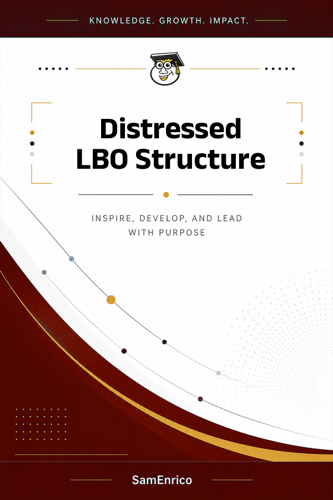
Non-FictionCapital & Valuation Register
Distressed LBO Structure eBook
Models acquisition of distressed assets through Ch
Models acquisition of distressed assets through Chapter 11 process.
Formats
Free sample
Chapter 1: The Graveyard Test...--–- The summer of 2009 was not a good time to be a mall owner. General Growth Properties, the second-largest mall operator in America, had just filed the largest real estate bankruptcy in U.S. history. Its $25 billion debt mountain had become an avalanche. The company was not operationally broken—its malls were full, its tenants were paying rent, and its properties were well-maintained.
But a $900 million bond maturity had come due, the credit markets had frozen, and no one was lending. Within ninety days, a company that had been profitable for forty-seven consecutive years was in Chapter 11.The vultures circled. Distressed debt funds bought General Growth’s bonds at twenty cents on the dollar, betting on liquidation. They saw a corpse. A handful of others—investors who would later be called the smartest in the room—saw something else.
They saw a healthy operating company buried under a bad balance sheet. They bought the fulcrum security, the specific debt instrument that would control the restructuring, and walked away with billions. By 2010, General Growth had emerged from bankruptcy, its equity had doubled, and the investors who understood the difference between a liquidity crunch and a business model failure had made the trade of a decade.This book is about becoming the second kind of investor. It is about learning to walk through the graveyard of distressed companies and knowing which corpses are actually just sleeping giants.The Anatomy of Financial Distress Before you can structure a distressed LBO, you must first understand what you are buying and, more importantly, what you are not buying. The distressed LBO investor does not seek liquidation value.
That is the domain of the traditional vulture—the asset stripper who buys a dying company to sell its parts. The distressed LBO investor seeks something far more valuable and far more difficult to identify: a viable operating company that has been suffocated by an unsustainable capital structure.This distinction is the single most important concept in this entire book. Get it wrong, and you will buy a company that continues to bleed cash no matter how much debt you erase. Get it right, and you will acquire a cash flow machine at a fraction of its intrinsic value.The Continuum of Corporate Decline Every distressed company sits somewhere on a continuum. At one end is temporary undervaluation—a company that is fundamentally sound but has been caught in a market panic, an industry-specific shock, or a liquidity squeeze.
At the other end is terminal insolvency—a company whose business model is broken, whose products are obsolete, or whose competitive position is permanently eroded.Between these poles lies the danger zone where most distressed investors lose money. A company can look like it is in temporary distress when it is actually in terminal decline. Revenue may be falling because of a cyclical downturn, or it may be falling because customers have permanently defected to a competitor. Margins may be compressing because of temporary commodity price spikes, or because the company has lost pricing power forever.The distressed LBO investor must become an expert at distinguishing between these scenarios. This requires moving beyond financial statements into operational due diligence.
You do not buy a balance sheet. You buy a business. And a business is defined by its ability to generate free cash flow from its operations over a sustained period.Liquidity Crunches Versus Business Model Failure The most common mistake in distressed investing is confusing a liquidity crunch with a business model failure. A liquidity crunch occurs when a solvent company cannot meet its short-term obligations because cash is trapped in working capital, debt maturities are poorly staggered, or credit markets have seized up. The underlying business remains profitable on an operating basis.
The company has positive EBITDA, positive operating cash flow, and a reasonable path to returning to growth once the liquidity constraint is removed.A business model failure is fundamentally different. Here, the company cannot generate sufficient operating returns regardless of its capital structure. The problem is not the balance sheet—it is the income statement and, ultimately, the cash flow statement. The company may have negative EBITDA, declining same-store sales, rising customer acquisition costs, or a product that no one wants to buy at any price. No amount of debt forgiveness will fix a broken business model.
You cannot restructure your way out of a product that nobody wants.The diagnostic framework presented in this chapter focuses on three questions, asked in sequence.First, is the company operationally viable? That is, does its core business generate positive returns on invested capital before considering debt service? If the answer is no, walk away. No LBO structure can save a company that loses money on every unit sold.Second, if the company is operationally viable, what caused the distress? Trace the chain of causality.
Did a specific event trigger the crisis—a maturing bond, a covenant breach, a lawsuit? Or has the company been in slow-motion decline for years, with the "event" merely the final straw?Third, can the distress be cured by changing the capital structure alone? If the answer is yes—if the company would be profitable with half its current debt burden—then you have found a candidate for a distressed LBO.The Fulcrum Security: Your Key to Control Every distressed company has a fulcrum security. This term appears throughout this book, and we define it here with precision. The fulcrum security is the most junior class of claims expected to receive positive recovery in a restructuring.
It sits at the boundary between claimants who are "out of the money" (receiving nothing) and those who are "in the money" (receiving full recovery). The fulcrum security determines control—not because it always receives a majority of new equity, but because its holders are the marginal voters whose approval is necessary for any restructuring plan to succeed.Understanding the fulcrum security is the single most important analytical skill in distressed LBO investing. If you buy debt that is too senior, you will be paid in full in cash—a safe but low-return outcome. If you buy debt that is too junior, you will receive nothing in the restructuring. If you buy the fulcrum security, you will receive the majority of the new equity in the reorganized company.
Your downside is protected—you will receive something—and your upside is asymmetric.To identify the fulcrum security, you must model the enterprise value of the distressed company relative to its debt stack. Enterprise value is the sum of all claims on the company: senior debt, unsecured debt, subordinated debt, preferred equity, and common equity. Arrange these claims in order of seniority. Then ask: at the company's likely going-concern value, where does the waterfall run dry?If the company has $100 million in senior debt, $50 million in unsecured debt, and an enterprise value of $120 million, the fulcrum security is the unsecured debt. The senior debt is fully covered ($100 million against $120 million of value).
The unsecured debt is partially covered ($50 million against the remaining $20 million). The unsecured creditors will take a haircut but will receive some recovery—likely in the form of equity in the reorganized…
This is the end of the free sample. Get the eBook to keep going. Buy now
About this book
Details
- Author
- Crowl Raymond
- Publisher
- SamEnrico
- Language
- English
- Genre
- Non-Fiction, Capital & Valuation Register
- Released
- 2026-06-11
- Pages (approx.)
- 134
- Available as
- eBook, Audiobook

Read better in the ZLOADR app
Your eBooks on your phone or tablet. Sign in with your SamEnrico account and start reading.
More by Crowl Raymond
 Alcoholism Recovery for Grandparents Raising KidsCrowl Raymond$11.99
 Art Therapy BurnoutCrowl Raymond$11.99
 Compulsive Spending Triggers WorkbookCrowl Raymond$11.99
 The Siege of Chittorgarh: Flames of DefianceCrowl Raymond$11.99
 Tamworth Pig BreedingCrowl Raymond$11.99
 Ultimate Handbook Guide to Dongyang : (China) Travel GuideCrowl Raymond$11.99
 Pre shipment Inspection WorkbookCrowl Raymond$12.99
 How to Produce Anchor ChainsCrowl Raymond$11.99
You may also like
 Hong Kong Handover 1997Dunn Johnnie$11.99
 Zumba For Postnatal Recovery CourseNeal Christian$11.99
 Zumba for BeginnersLadner Nikia$11.99
 YouTube Comment Mining GuideHumes Pandora$12.99
 Worry Box MeditationCarlin Rudy$11.99
 Workplace Stress MeditationNguyen Lynn$11.99
 Workplace Stress and Sleep RepairHawley Ivory$11.99
 Workplace Perfectionism CureDelaney Jeffry$11.99
 Workplace Injustice Anger GuideWallen Isabelle$11.99
 Work Addiction and Burnout LinkGreenwood Ester$11.99
 Women in Yoga and WellnessBeattie Galina$11.99
 Women in Stand Up ComedyChun Evangeline$11.99