
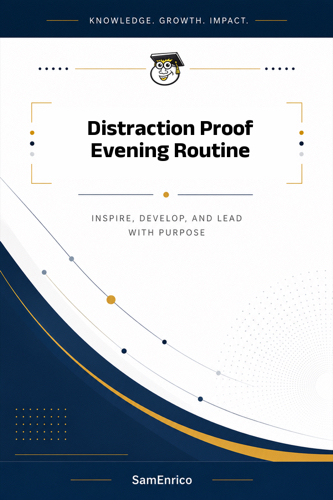
Non-FictionSelf-HelpEvening Rituals
Distraction Proof Evening Routine eBook
Clears digital clutter and sets up morning focus s
by Solomon Sung
Clears digital clutter and sets up morning focus so interruptions don't derail day-start momentum.
Formats
Free sample
Chapter 1: The 9 PM Tax--–- Your morning does not fail at 6:00 AM. It failed at 10:00 PM the night before.This is not a metaphor. It is a neurological fact. And until you understand why, every morning routine you attempt will crumble within the first thirty minutes.Let me describe a scene that will feel familiar. You set your alarm for 6:00 AM with noble intentions.
You will wake up early. You will exercise, meditate, write that proposal, or finally start that project. The alarm rings. For a beautiful moment, the day is yours. Then you reach for your phone.
You tell yourself it is just to turn off the alarm. But there is a notification. A text from a friend. A news alert. An email from a colleague who works in a different time zone.
Forty-five minutes later, you are still in bed. Your thumb has been scrolling through Instagram, Twitter, or Tik Tok. You have read three articles about things you cannot change. You have compared your ordinary morning to someone else's curated highlight reel. The proposal is not written.
The exercise did not happen. And you feel, in some vague and unsettling way, as though you have already lost the day before it began.You blame your willpower. You tell yourself that tomorrow will be different. But tomorrow arrives, and the same thing happens. Again.
And again.The problem is not your willpower. The problem is the night before. Every evening, you pay a hidden tax that most people do not even know exists. I call it The 9 PM Tax.What Is the 9 PM Tax?The 9 PM Tax is the cumulative cognitive cost of evening digital clutter. Every notification you check after dinner, every email you send at 10:00 PM, every "just one more video" you watch before bed—these actions do not disappear when you close your eyes.
They leave a residue. That residue fragments your attention, depletes your decision-making capacity, and hijacks the first hour of your morning.Think of your brain as a whiteboard. Every decision you make, every notification you process, every scroll through social media leaves a faint smudge. During the day, you have the energy to wipe the board clean occasionally. But by 9:00 PM, you are tired.
You stop wiping. The smudges accumulate. When you go to sleep, your brain does not magically erase the board. Instead, it goes into maintenance mode, trying to process the backlog of half-finished thoughts, unresolved decisions, and emotional fragments from your evening scrolling. When you wake up, the board is still cluttered.
You have less working memory, less focus, and less resistance to distraction than you would have if you had simply put the phone down three hours earlier.This is not opinion. It is neuroscience. And once you understand it, you will stop blaming yourself for failed morning routines and start fixing the real problem: your unprotected evening.The Neurological Chain Reaction To understand why the 9 PM Tax is so damaging, you need to understand three interconnected brain phenomena: decision residue, the dopamine hangover, and open loops.Decision Residue is a term coined by decision scientist Sophie Leroy. It describes the way unfinished decisions linger in your mind, consuming cognitive resources even when you are not consciously thinking about them. Every time you scroll through Netflix without choosing something, every time you read a work email and decide to reply "later," every time you see a notification and choose to ignore it—all of these micro-decisions leave residue.
By 10:00 PM, the average person has accumulated hundreds of these residues. They do not disappear during sleep. They follow you into the morning, making your first hour feel foggy and unfocused.The Dopamine Hangover is the second piece. Your brain releases small bursts of dopamine when you scroll social media, check notifications, or watch short videos. This feels pleasurable in the moment.
But dopamine is not just a pleasure chemical; it is also a motivation regulator. When your brain gets accustomed to frequent, low-effort dopamine hits in the evening, it recalibrates. By morning, your baseline dopamine level is lower than normal. This means that important but effortful tasks—writing, exercising, planning, creating—feel unbearably dull. Your brain craves another quick hit.
So you reach for your phone again. The dopamine hangover is why the first thirty minutes of your morning are the most dangerous. Your brain is in withdrawal, and your phone is the dealer.Open Loops are the third piece. Every email you read and do not answer, every text you see and do not respond to, every task you add to your mental to-do list without scheduling—these become open loops. Your brain hates open loops.
It will keep them active in your working memory, trying to close them, even while you sleep. This is why you sometimes wake up already stressed about an email you read at 11:00 PM. Your brain has been chewing on it all night. Open loops fragment your sleep and leave you with less attention available in the morning.Together, decision residue, the dopamine hangover, and open loops create the 9 PM Tax. If you scroll after 9:00 PM, you are not just losing sleep.
You are borrowing focus from tomorrow. And the interest rate is brutal.The Research Behind the Tax This is not self-help speculation. The research is clear.A 2018 study published in the journal Sleep found that each hour of smartphone use within ninety minutes of bedtime reduced morning alertness by 24 percent, independent of total sleep duration. That means you could sleep eight full hours, but if you scrolled for one hour before bed, you would wake up as groggy as someone who slept only six hours.A 2020 study from the University of California, Irvine, found that it takes an average of twenty-three minutes to fully refocus after a digital interruption. If you check your phone three times in the evening, you have lost over an hour of cognitive clarity.
That loss carries over into the next day because your brain never fully disengaged.Perhaps most damning is research on what is called the "attention residue" effect. When you switch from one task to another, a portion of your attention remains stuck on the first task. This is why you cannot truly relax while scrolling. Your brain is switching between posts, videos, messages, and notifications hundreds of times per hour. By the time you put the phone down, your attention is scattered across dozens of mental contexts.
None of them close completely. You go to sleep with a browser full of open tabs in your brain. You wake up the same way.The 9 PM Tax is the cumulative cost of all of these effects. And most people pay it every single night without ever realizing it exists.The Illusion of Willpower If you have ever tried to fix your mornings with willpower alone, you have already discovered the dirty secret: willpower does not work at 6:00 AM because it was already depleted at 10:00 PM.Willpower is not an infinite resource. It is more like a battery that drains throughout the day.
Every decision you make, every temptation you resist, every time you force yourself to focus on something boring—all of these draw from…
This is the end of the free sample. Get the eBook to keep going. Buy now
About this book
Details
- Author
- Solomon Sung
- Publisher
- SamEnrico
- Language
- English
- Genre
- Non-Fiction, Self-Help, Evening Rituals
- Released
- 2026-06-08
- Pages (approx.)
- 135
- Available as
- eBook, Audiobook

Read better in the ZLOADR app
Your eBooks on your phone or tablet. Sign in with your SamEnrico account and start reading.
More by Solomon Sung
 HGH in Long Lived SpeciesSolomon Sung$11.99
 Procrastination For Graduate StudentsSolomon Sung$11.99
 Learning Goal RoadmapSolomon Sung$11.99
 Meth Vaccine GuideSolomon Sung$11.99
 The Second Career Nonprofit GuideSolomon Sung$11.99
 Parent Illness Death GriefSolomon Sung$11.99
 Apache Struts Vulnerability Zero DaySolomon Sung$11.99
 The Silent Revolution: Descartes and the Birth of Modern ThoughtSolomon Sung$11.99
 The Battle of Nihriya: The Hittites Strike Back (1450 BC)Solomon Sung$11.99
 How to Produce Medical SuppliesSolomon Sung$11.99
 Growing AgrostisSolomon Sung$11.99
 Remote Employee Legal TrapSolomon Sung$12.99
You may also like
 Hong Kong Handover 1997Dunn Johnnie$11.99
 Zumba For Postnatal Recovery CourseNeal Christian$11.99
 Zumba for BeginnersLadner Nikia$11.99
 YouTube Comment Mining GuideHumes Pandora$12.99
 Worry Box MeditationCarlin Rudy$11.99
 Workplace Stress MeditationNguyen Lynn$11.99
 Workplace Stress and Sleep RepairHawley Ivory$11.99
 Workplace Perfectionism CureDelaney Jeffry$11.99
 Workplace Injustice Anger GuideWallen Isabelle$11.99
 Work Addiction and Burnout LinkGreenwood Ester$11.99
 Women in Yoga and WellnessBeattie Galina$11.99
 Women in Stand Up ComedyChun Evangeline$11.99