
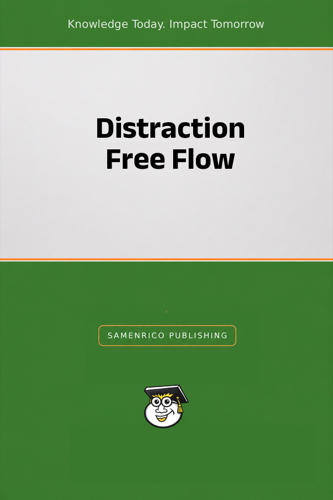
Distraction Free Flow eBook
Eliminate notifications and interruptions that bre
by Lyman Danae
Eliminate notifications and interruptions that break concentration.
Formats
Free sample
Chapter 1: The $1 Trillion Lie--–- You are not lazy. You are not undisciplined. You are not broken.You have been told, probably hundreds of times, that your inability to focus is a personal failure. Your boss implies it when you miss a deadline. Your partner hints at it when you scroll through your phone at dinner.
Your own inner voice shouts it when you sit down to work for the fourth time in one day, only to find yourself checking email, then Slack, then the news, then back to email, then Instagram, then back to Slack, then staring at a blank screen for forty-five minutes while your brain feels like it's filled with static.The message is everywhere, whispered and shouted alike: If you just tried harder. If you had more willpower. If you cared more. If you were a better person, a harder worker, a more disciplined human being—you would be able to focus.This message is a lie. And it is a lie that has been deliberately, scientifically, and profitably engineered.The truth, which will serve as the foundation for every page of this book, is this: Your inability to focus is not a moral failing.
It is the natural, predictable, biologically normal response to an environment that has been meticulously designed to destroy your attention. The average office worker now attempts to focus on any single task for only about three minutes before an interruption occurs. Three minutes. That is not enough time to read a single page of a book, let alone solve a complex problem, write a persuasive memo, or create something valuable.Here is what happens in those three minutes. You open a document.
You write two sentences. A notification badge appears on your Slack icon. You glance at it. You don't even click—just glance. That glance costs you nothing, you think.
But neuroscience disagrees. That glance introduces a "cognitive residue"—a fragment of the interruption that remains lodged in your working memory. You return to your document. But the fragment remains. You write one more sentence.
Your phone buzzes. You pick it up. You see an email subject line. You put the phone down. The fragment multiplies.
You write half a sentence. You remember that you meant to look up something for dinner. You open a browser tab. You get distracted by a headline. You close the tab.
You stare at the screen. Thirty minutes have passed. You have written three sentences. You feel exhausted. You feel ashamed.
You feel lazy.You are none of those things. You are a human being swimming in a sea of interruptions, and no amount of willpower can make you breathe underwater.The Statistic That Should Make You Angry Let me give you a number. Carry it with you. Write it on a sticky note and put it on your monitor if you have to. That number is twenty-three.Twenty-three minutes.
That is how long it takes, on average, for the human brain to return to a previous state of deep focus after a single interruption. Not to "get back to work"—anyone can do that in thirty seconds. To return to the same depth of focus, the same cognitive immersion, the same flow of ideas and execution that existed before the interruption. Twenty-three minutes.Now do the math with me. If you experience just one interruption per hour—one email notification, one Slack message, one glance at your phone—over an eight-hour workday, you are spending more than three hours of that day simply recovering from interruptions.
Not working. Not creating. Not solving. Recovering. And that is assuming only one interruption per hour, which is laughably optimistic.
The average knowledge worker switches tasks every three minutes, which means they are experiencing roughly twenty interruptions per hour, which means they are spending nearly the entire day in a state of recovery, never actually arriving at deep focus at all.This is not a productivity problem. This is a crisis.The global economy loses more than one trillion dollars annually to attention fragmentation. That is not a typo. One trillion. With a T.
That is more than the GDP of most countries. That is the cost of building and launching a thousand Mars rovers. That is the cost of ending homelessness in the United States several times over. And we are burning that money, hour by hour, notification by notification, because we have been convinced that our inability to focus is our own fault.The Two Kinds of Work (And Why You're Doing the Wrong One)Before we go any further, I need you to understand a distinction that will structure everything that follows. This distinction comes from Cal Newport's work on deep work, and it is the single most useful lens for understanding your relationship with attention.There is shallow work.
Shallow work is logistical, low-cognitive, non-creative labor that can be performed while distracted. Replying to routine emails. Scheduling meetings. Filling out expense reports. Moving information from one spreadsheet to another.
Updating a status field in a project management tool. These tasks require attention, yes, but not deep attention. You can do them with half your brain while the other half wanders. Shallow work feels productive because it produces visible outputs—a sent email, a checked box, a closed ticket. But shallow work rarely creates new value.
It merely rearranges existing value.Then there is deep work. Deep work is professional activity performed in a distraction-free state of concentration that pushes your cognitive capabilities to their limit. These are the tasks that create new value. Writing a proposal that wins a client. Solving a coding problem that unlocks a feature.
Strategizing a campaign that changes market perception. Designing a system that automates a workflow. Diagnosing a problem that has stumped your team for weeks. Deep work is hard. Deep work is uncomfortable.
Deep work produces the outputs that actually matter for your career, your business, and your sense of accomplishment.Here is the problem, and it is a cruel one: shallow work is easier to do when you are distracted. In fact, shallow work is almost designed for a distracted brain. The quick dopamine hit of sending an email. The satisfying click of closing a ticket. The social reward of answering a Slack message.
Shallow work gives you immediate feedback, immediate completion, immediate relief. Deep work, by contrast, requires sustained focus, tolerates delayed gratification, and offers no dopamine hits along the way. You write for two hours and end up with three good paragraphs. You debug for ninety minutes and find one error. You strategize for a morning and produce a single page of notes.Your brain, which evolved to seek immediate rewards, will naturally prefer shallow work when given the choice.
And your environment, which has been engineered to provide constant shallow work opportunities in the form of notifications, will constantly offer you that choice. This is not a bug in your brain. This is the environment working exactly as designed.The Environment Is the Enemy (Not You)In his book Stolen Focus, Johann Hari spent years investigating why our collective attention span has collapsed. He interviewed neuroscientists, psychologists, and tech executives. He traveled across continents.…
This is the end of the free sample. Get the eBook to keep going. Buy now
About this book
Details
- Author
- Lyman Danae
- Publisher
- SamEnrico
- Language
- English
- Genre
- Non-Fiction, Self-Help, Focus
- Released
- 2026-06-09
- Pages (approx.)
- 147
- Available as
- eBook, Audiobook

Read better in the ZLOADR app
Your eBooks on your phone or tablet. Sign in with your SamEnrico account and start reading.
More by Lyman Danae
 Walking Meeting Efficiency GuideLyman Danae$11.99
 Social Eating Pressure GuideLyman Danae$11.99
 Chronic Illness Couples GuideLyman Danae$11.99
 The Drag Along Tag Along GuideLyman Danae$11.99
 The Cartel's Shadow: The Assassination of MarasánLyman Danae$11.99
 Understanding Weismann–netter–stuhl SyndromeLyman Danae$17.99
 Madrid Portfolio ToolsLyman Danae$12.99
 Ghana Startup Tax GuideLyman Danae$12.99
 Store Support AssociateLyman Danae$11.99
 How to Start a Bleach Works Business (Beginners Guide)Lyman Danae$11.99
You may also like
 Hong Kong Handover 1997Dunn Johnnie$11.99
 Zumba For Postnatal Recovery CourseNeal Christian$11.99
 Zumba for BeginnersLadner Nikia$11.99
 YouTube Comment Mining GuideHumes Pandora$12.99
 Worry Box MeditationCarlin Rudy$11.99
 Workplace Stress MeditationNguyen Lynn$11.99
 Workplace Stress and Sleep RepairHawley Ivory$11.99
 Workplace Perfectionism CureDelaney Jeffry$11.99
 Workplace Injustice Anger GuideWallen Isabelle$11.99
 Work Addiction and Burnout LinkGreenwood Ester$11.99
 Women in Yoga and WellnessBeattie Galina$11.99
 Women in Stand Up ComedyChun Evangeline$11.99