
Non-FictionSelf-HelpCognitive Reframing
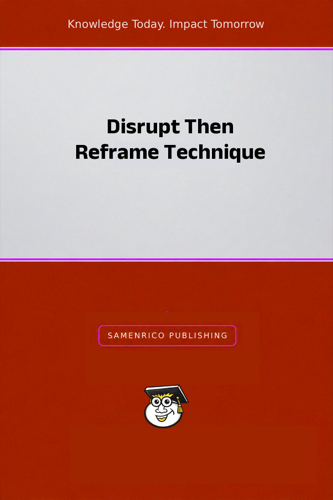
Disrupt Then Reframe Technique eBook
Break expected pattern then introduce new perspect
by Arce Johnna
Break expected pattern then introduce new perspective for influence.
Formats
Free sample
Chapter 1: The Autopilot Lie--–- You are not in control. This is not a philosophical statement about free will or the nature of consciousness. It is a simple, verifiable, and uncomfortable fact about how your brain actually works. Right now, as you read these words, your pupils are dilating and contracting in response to light levels you have not noticed. Your diaphragm is moving air in and out of your lungs in a rhythm you did not set.
Your heart is beating two or three times before you finish this sentence, and you had no intention of making it do so. These automatic processes keep you alive without asking for your permission. But they are only the beginning. The vast majority of your decisions—what you buy, who you trust, what you believe, how you respond to requests—also happen on autopilot. And that autopilot has a single, overriding directive: preserve energy, maintain stability, and reject anything that does not fit the existing script.The lie you have been told, by every salesperson, politician, and self-help guru who has ever tried to persuade you, is that you make decisions rationally.
You consider evidence. You weigh pros and cons. You arrive at conclusions through a process of conscious deliberation. This lie is comforting because it makes you feel intelligent and in charge. It is also demonstrably false.
The truth is that your conscious mind is not the CEO of your brain. It is the press secretary—an interpreter that arrives after the decision has already been made, constructs a plausible story about why you chose what you chose, and then presents that story to the world as if it were the real reason.This chapter pulls back the curtain on the autopilot. You will learn why your brain fights every attempt to change your mind, how a single unexpected word can temporarily disable your mental defenses, and why the most effective influence techniques do not try to convince you of anything. Instead, they do something far more elegant: they temporarily break the script, wait for your brain to search for an explanation, and then provide one that serves their purpose. By the time you finish this chapter, you will never again believe that persuasion is about logic.
And you will begin to see the glitches everywhere—the tiny cracks in the autopilot where real influence becomes possible.The Cognitive Miser Let us begin with a number that will haunt you for the rest of this book: eleven million. That is how many bits of information your sensory systems collect every single second. Eleven million pieces of data—light frequencies, sound vibrations, pressure changes, chemical signatures, thermal gradients, proprioceptive signals—flood into your nervous system at a rate that would overwhelm any supercomputer ever built. Your brain handles this firehose with effortless grace, but it does so by ignoring almost everything. Of those eleven million bits per second, your conscious mind registers approximately forty to fifty.
The rest is discarded as noise. You are not aware of the feeling of your shirt against your left shoulder blade. You were not aware of the hum of your refrigerator until this sentence mentioned it. You have no memory of the last fourteen times you blinked.This filtering is performed by a small bundle of neurons at the base of your brainstem called the Reticular Activating System, or RAS. The RAS is your brain’s bouncer.
It sits at the door of consciousness and decides what gets in. Its criteria are simple and brutal: threat, novelty, and the personally relevant. Anything else—the vast ocean of ordinary experience—is turned away.Threat is the highest priority. A sudden loud noise, a fast-moving object in your peripheral vision, a stranger approaching too quickly—these bypass the RAS entirely and trigger an immediate fight, flight, or freeze response. Your conscious mind does not get a vote.
By the time you are aware of the threat, your body has already begun responding.Novelty is the second category. Your RAS is exquisitely sensitive to what does not belong. A single red flower in a field of yellow. A typo in a familiar logo. A person walking backward through a crowd.
A price quoted in pennies instead of dollars. These anomalies trigger what psychologists call the orienting response: a brief, involuntary pause in which all other mental processes stop, and the brain asks a single question: “What is that?”The personally relevant category is the most interesting. Your RAS is trained to notice anything related to your name, your goals, your fears, and your desires. This is why you can be deeply absorbed in a conversation and yet snap to attention when someone across the room says your name. It is why you notice car models you are thinking of buying, pregnancy announcements when you are trying to conceive, and the word “cancer” in any context if you have recently received a worrying diagnosis.
Your RAS is constantly scanning the world for signals that matter to you, and it elevates those signals to consciousness while ignoring everything else.Now consider what this means for influence. The average person is exposed to approximately ten thousand marketing messages per day. Ten thousand attempts to persuade, to sell, to convince, to change behavior. Almost all of these messages are filtered out by the RAS before they ever reach consciousness. They are not rejected.
They are not evaluated. They are simply deleted—discarded as noise, as irrelevant, as wallpaper.The messages that do get through are the ones that signal threat, novelty, or personal relevance. And here is the problem that every persuader faces: threat triggers resistance, not compliance. Personal relevance is difficult to establish without an existing relationship. Novelty, therefore, is the most reliable path through the RAS.
But most persuasion attempts are the opposite of novel. “Here are three reasons to buy our product.” “This offer expires at midnight.” “Our service is trusted by millions.” These are scripts. Your brain has heard them thousands of times. They do not trigger the orienting response. They trigger the autopilot’s dismissal routine: “Seen this.
Ignore this. Move on.”The Hidden Architecture of Automaticity Psychologists call the brain’s autopilot programs schemas. A schema is a mental structure that organizes knowledge, guides attention, and directs behavior without conscious effort. You have schemas for everything: how to order coffee, how to greet a colleague, how to respond to a salesperson, how to argue with a spouse, how to drive to work, how to brush your teeth. Each schema is a script—a sequence of actions and responses that unfolds automatically when triggered by the right cues.The coffee shop schema is a perfect example.
You walk in. You scan the menu, though you already know what you want. You wait in line. When it is your turn, you say, “Medium coffee, black.” The barista says, “That’ll be two seventy-five.” You hand over a card. You wait.
You take the coffee. You leave. This entire sequence requires almost no conscious thought. Your brain is free to wander, to worry, to plan, to daydream, while your body executes the coffee script flawlessly.The problem is that schemas are…
This is the end of the free sample. Get the eBook to keep going. Buy now
About this book
Details
- Author
- Arce Johnna
- Publisher
- SamEnrico
- Language
- English
- Genre
- Non-Fiction, Self-Help, Cognitive Reframing
- Released
- 2026-06-06
- Pages (approx.)
- 147
- Available as
- eBook, Audiobook

Read better in the ZLOADR app
Your eBooks on your phone or tablet. Sign in with your SamEnrico account and start reading.
More by Arce Johnna
 Values And Mission Alignment Conflict Resolution GuideArce Johnna$11.99
 The Artist's Block BreakthroughArce Johnna$11.99
 The Effort Praise CourseArce Johnna$11.99
 The Office Politics Survival GuideArce Johnna$11.99
 The Eureka Stockade: Birth of Australian DemocracyArce Johnna$11.99
 How to Become a Plating Equipment TenderArce Johnna$11.99
 Localization for International FranchiseArce Johnna$12.99
 SBA Business Plan ToolArce Johnna$12.99
 Understanding Trichomegaly Cataract Hereditary SpherocytosisArce Johnna$17.99
 Aviation Radio TechnicianArce Johnna$11.99
You may also like
 Hong Kong Handover 1997Dunn Johnnie$11.99
 Zumba For Postnatal Recovery CourseNeal Christian$11.99
 Zumba for BeginnersLadner Nikia$11.99
 YouTube Comment Mining GuideHumes Pandora$12.99
 Worry Box MeditationCarlin Rudy$11.99
 Workplace Stress MeditationNguyen Lynn$11.99
 Workplace Stress and Sleep RepairHawley Ivory$11.99
 Workplace Perfectionism CureDelaney Jeffry$11.99
 Workplace Injustice Anger GuideWallen Isabelle$11.99
 Work Addiction and Burnout LinkGreenwood Ester$11.99
 Women in Yoga and WellnessBeattie Galina$11.99
 Women in Stand Up ComedyChun Evangeline$11.99