
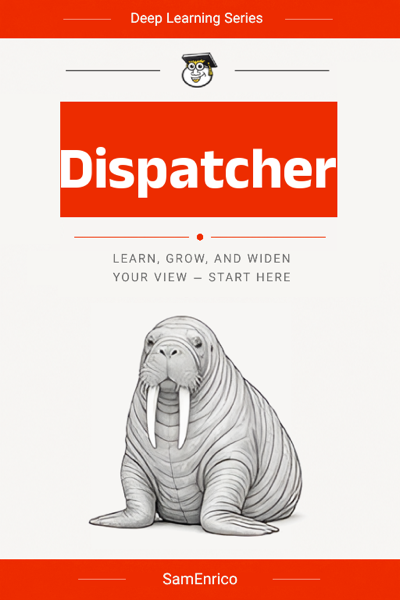
Non-FictionInformativeEducational
Dispatcher eBook
A Coursebook on Dispatcher
A Coursebook on Dispatcher
Formats
Free sample
Chapter 1: The Silence Before Chaos--–- The phone rings. For most people, that sound means a friend checking in, a delivery confirmation, or a spam call to ignore. But for the dispatcher, every ring is a potential threshold between order and catastrophe. Before the first word is spoken, before the fingers touch the keyboard, before the map loads on the screen—there is silence. That silence is not empty.
It is the space where decisions will be made, where lives will hang on the clarity of a single sentence, where the difference between a rescue and a recovery is measured in seconds.This book is not about answering phones. It is about something far more demanding: the cognitive architecture required to sit at the nerve center of chaos and impose order without moving from a chair. The modern dispatcher is not a call-taker. Call-takers gather information. Dispatchers synthesize, prioritize, predict, and command.
They are the unseen pivot point upon which every emergency response, every time-sensitive delivery, and every security operation turns. And yet, for all their importance, they remain the most misunderstood and undervalued professionals in the chain of response.This chapter establishes the foundational truth that will guide everything that follows: dispatching is a high-performance cognitive function, not a clerical job. It introduces the three distinct worlds in which dispatchers operate—Public Safety, Transportation, and Corporate/Private Security—and explains why a coursebook that attempts to cover all three must be structured carefully to avoid the inconsistencies that plague lesser texts. Most importantly, this chapter tells you what is at stake. The cost of error in dispatching is measured in lives, lawsuits, and collapsed organizations.
By the time you finish this chapter, you will understand why mastering the material in this book is not optional for anyone who sits before a console.The Three Pillars of a Hidden Profession Before we can discuss how to dispatch, we must understand who dispatches and where. The term "dispatcher" is a job title that spans radically different industries, each with its own protocols, legal frameworks, and failure modes. A coursebook that pretends these worlds are identical does a disservice to readers. A coursebook that treats them as completely separate misses the unifying cognitive thread. This book takes a third path: it acknowledges the differences while building a shared foundation of situational awareness, decision-making, and communication that applies across all three pillars.Pillar One: Public Safety Dispatching The most familiar form of dispatching occurs in Public Safety Answering Points (PSAPs), police and fire dispatch centers, and emergency medical communications hubs.
These are the men and women who answer 911 calls, dispatch police officers to domestic violence scenes, send ambulances to cardiac arrests, and coordinate fire department responses to structure fires. They work in high-liability environments where a wrong address can mean a death, a delayed response can trigger a federal lawsuit, and a misunderstood radio transmission can send an officer into an ambush.Public safety dispatchers operate under government authority. They are bound by constitutional restrictions, state laws governing emergency communications, and federal regulations like HIPAA for medical privacy. Their decisions can trigger Section 1983 civil rights lawsuits if they fail to protect individuals in custody or knowingly send officers into danger. They work in 24/7 centers, often under civil service rules, with shift rotations that destroy circadian rhythms.
The emotional toll is enormous: studies consistently show that public safety dispatchers experience PTSD at rates comparable to frontline officers and firefighters, despite never leaving their chairs.Yet for all the stress, public safety dispatching offers a unique form of satisfaction. When the structure fire is contained, when the cardiac arrest patient walks out of the hospital, when the missing child is found—the dispatcher knows, with absolute certainty, that their calm voice and rapid decisions made that outcome possible. No other profession combines such high stakes with such immediate feedback.Pillar Two: Transportation and Logistics Dispatching Less visible but equally vital is the world of transportation dispatching. These professionals coordinate the movement of freight across continents, manage truck driver schedules, track shipments, and ensure that the supply chain—upon which every other industry depends—does not collapse. A transportation dispatcher might work for a major trucking carrier, a third-party logistics firm, or as an independent broker coordinating dozens of owner-operators.The legal framework here is entirely different from public safety.
Transportation dispatchers operate under the Federal Motor Carrier Safety Administration (FMCSA) regulations, which govern Hours of Service (HOS), drug and alcohol testing, vehicle maintenance, and driver qualifications. Violations result in civil penalties, not criminal liability, but the financial consequences can be devastating. A dispatcher who coerces a driver into falsifying logs can bankrupt a small carrier through fines and lawsuits after a fatigue-related crash.The cognitive demands are different as well. Where public safety dispatchers face sudden emergencies with high emotional content, transportation dispatchers face chronic pressure: managing driver fatigue, negotiating rates with brokers, solving routing problems in real time, and keeping trucks moving while respecting legal limits. The work requires contract law literacy, negotiation skills, and the ability to track dozens of variables simultaneously.
A transportation dispatcher who loses situational awareness might send a driver into a blizzard, book a load that pays less than fuel costs, or unknowingly participate in a cargo theft scheme.Yet for all these challenges, transportation dispatching offers a path to entrepreneurship that public safety dispatching does not. Independent dispatchers can build their own books of business, work from home, and scale their operations. The best in the field earn six-figure incomes while providing essential services that keep the economy moving.Pillar Three: Corporate and Private Security Dispatching The least understood pillar is corporate and private security dispatching. These professionals work in Security Operations Centers (SOCs), corporate command centers, executive protection teams, and private surveillance networks. They coordinate responses to access control alarms, monitor CCTV feeds for suspicious activity, track executive protection details in real time, and manage security for high-value assets like data centers, research laboratories, and critical infrastructure.Corporate dispatchers operate under private law, not constitutional restrictions.
This gives them more flexibility in some areas (they can detain individuals based on company policy rather than probable cause) but less protection in others (they cannot rely on qualified immunity in lawsuits). Their legal exposure comes from negligent security claims, false imprisonment lawsuits, and violations of state-specific private security regulations. Many must hold state-issued security licenses and complete continuing education requirements.The cognitive demands blend elements of the other two pillars. Like public safety dispatchers, corporate security dispatchers must handle emergencies—active shooters, natural disasters, medical events—but within private facilities rather than public spaces. Like transportation dispatchers, they must manage resources efficiently, balancing coverage across multiple sites with budget constraints.
They also face unique challenges: distinguishing between genuine threats and false alarms in environments where security is expected but not always welcomed, maintaining relationships with local law enforcement without ceding authority, and protecting client confidentiality while complying with legal disclosure requirements.Corporate security dispatching is growing rapidly as companies recognize the need for centralized security management. The best positions offer stable hours, professional development, and clear career paths into security management. But the work requires a unique blend of customer…
This is the end of the free sample. Get the eBook to keep going. Buy now
About this book
Details
- Author
- Baca Nicholle
- Publisher
- SamEnrico
- Language
- English
- Genre
- Non-Fiction, Informative, Educational
- Released
- 2026-06-02
- Pages (approx.)
- 145
- Available as
- eBook, Audiobook

Read better in the ZLOADR app
Your eBooks on your phone or tablet. Sign in with your SamEnrico account and start reading.
More by Baca Nicholle
 Naomi Osaka Silent PowerBaca Nicholle$11.99
 The Floating on Clouds GuideBaca Nicholle$11.99
 Online Proctoring Anxiety WorkbookBaca Nicholle$11.99
 Workplace Esteem VisualizationBaca Nicholle$11.99
 Equifax CISO Position VacancyBaca Nicholle$11.99
 The Forge of the Tuatha Dé Danann: Crafting the Weapons of GodsBaca Nicholle$11.99
 The Last Duel of the Iron Lady: Margaret Thatcher’s Final BattleBaca Nicholle$11.99
 Understanding Geleophysic DwarfismBaca Nicholle$17.99
 Last Minute Booking PatternsBaca Nicholle$12.99
 Apprentice to Permanent Resident GuideBaca Nicholle$12.99
 Ultimate Handbook Guide to Vijayawada : (India) Travel GuideBaca Nicholle$11.99
You may also like
 Hong Kong Handover 1997Dunn Johnnie$11.99
 Zumba For Postnatal Recovery CourseNeal Christian$11.99
 Zumba for BeginnersLadner Nikia$11.99
 YouTube Comment Mining GuideHumes Pandora$12.99
 Worry Box MeditationCarlin Rudy$11.99
 Workplace Stress MeditationNguyen Lynn$11.99
 Workplace Stress and Sleep RepairHawley Ivory$11.99
 Workplace Perfectionism CureDelaney Jeffry$11.99
 Workplace Injustice Anger GuideWallen Isabelle$11.99
 Work Addiction and Burnout LinkGreenwood Ester$11.99
 Women in Yoga and WellnessBeattie Galina$11.99
 Women in Stand Up ComedyChun Evangeline$11.99