
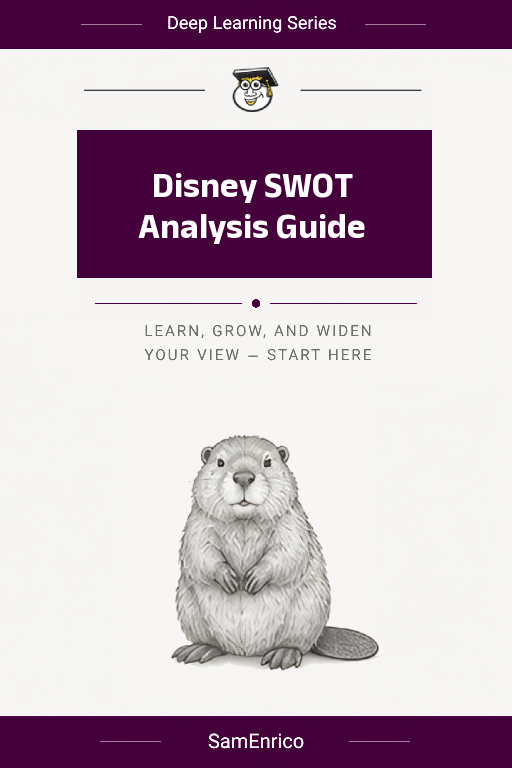
Non-FictionStrategic AtlasMedia
Disney SWOT Analysis Guide eBook
Analyze IP library, theme parks recovery, streamin
Analyze IP library, theme parks recovery, streaming profitability, and cord-cutting headwinds for media giant.
Formats
Free sample
Chapter 1: The Creativity Trap...--–- The conference room at Disney’s Burbank headquarters smelled of fresh paint and desperation. It was January 2023, just weeks after Bob Iger had returned to the CEO chair he had vacated in 2020, and the man who had built Disney into the world’s most formidable entertainment empire was staring at a spreadsheet that made his stomach turn. Disney+ had lost $4 billion in the previous fiscal year. Marvel’s theatrical slate was underperforming. And the company’s stock had fallen to levels not seen since the early days of the pandemic.
Iger turned to his senior vice president of content strategy and asked a question that no one in the room was prepared to answer: “If we stopped making sequels tomorrow, what would we make instead?”The silence lasted eleven seconds. That silence, the author argues, is the most damning indictment of Disney’s modern creative culture. The company that had once turned a swamp into an empire—building Pirates of the Caribbean from a theme park ride, The Lion King from a B-list Shakespeare adaptation, High School Musical from a low-budget TV movie—had become incapable of imagining anything that did not already exist in its vault. The intellectual property library that Wall Street had valued at $100 billion had become not a launchpad but a prison.This chapter begins where any honest analysis of Disney must begin: with the uncomfortable truth that the company’s greatest asset is also its greatest liability. The IP library is a defensive moat against bankruptcy—it prevented complete collapse during the pandemic, when Disney+ subscribers kept the lights on—but it is not a growth strategy.
More dangerously, it has created what the author calls the Creativity Trap: the more valuable your existing IP becomes, the less willing you are to risk creating new IP. And when you stop creating new IP, you stop growing. You merely maintain. And in entertainment, maintenance is a slow form of death.The $100 Billion Question To understand the Creativity Trap, one must first understand the sheer scale of Disney’s IP library. The company owns approximately 5,000 film titles, 10,000 television episodes, and hundreds of thousands of pieces of ancillary content across its acquisitions of Pixar (2006), Marvel (2009), Lucasfilm (2012), and 21st Century Fox (2019).
In 2019, just before the Disney+ launch, a Morgan Stanley analyst attempted to value this library using a discounted cash flow model. His conclusion: between 80billionand80 billion and 80billionand120 billion, with a midpoint of $100 billion. To put that number in perspective, it is larger than the GDP of more than half the countries on Earth. It is more than Netflix has spent on content in its entire history. It is, by any measure, the most valuable collection of stories ever assembled by a single company.But value is not the same as utility.
A library of a thousand masterpieces does you no good if you cannot figure out how to open a single new volume. And herein lies the paradox: Disney’s IP library is so valuable that the company has become terrified of damaging it. Every creative decision is filtered through a risk-avoidance lens. Will this new Star Wars character alienate traditionalists? Will this Marvel storyline confuse audiences who haven't watched the Disney+ series?
Will this Frozen spin-off dilute the brand? The result is not better stories. It is safer stories. And safe stories, in the modern entertainment landscape, are the fastest path to irrelevance.Consider the numbers. Between 2010 and 2019, Disney released 37 live-action remakes of its animated classics, from Alice in Wonderland (2010) to The Lion King (2019).
The aggregate box office of those 37 films was approximately 12billion.Thatsoundsimpressiveuntilyourealizethattheoriginalanimatedfilmsthatinspiredthemcostafractiontoproduceandgeneratedcomparableculturalimpact.∗The Lion King∗(1994)cost12 billion. That sounds impressive until you realize that the original animated films that inspired them cost a fraction to produce and generated comparable cultural impact. *The Lion King* (1994) cost 12billion.Thatsoundsimpressiveuntilyourealizethattheoriginalanimatedfilmsthatinspiredthemcostafractiontoproduceandgeneratedcomparableculturalimpact.∗The Lion King∗(1994)cost45 million and became a generational touchstone. The Lion King (2019) cost $260 million and was forgotten within six months. The remake was not a creative achievement; it was a financial instrument—a way to extract residual value from an asset that had already been fully depreciated.
This is not filmmaking. This is asset management.The Netflix Comparison: Why Desperation Breeds Creativity The most revealing comparison is not between Disney and its traditional studio rivals (Warner Bros., Universal, Sony) but between Disney and Netflix. Because Netflix has the opposite problem: it has no IP library. When Netflix launched its original content division in 2013 with House of Cards, it owned almost nothing. Every show, every movie, every special had to be invented from scratch.
This was not a choice; it was a necessity. And necessity, as the old saying goes, is the mother of invention.Between 2013 and 2023, Netflix released over 2,000 original films and series. The vast majority were mediocre or worse. But a handful—Stranger Things, Squid Game, The Crown, Wednesday—became global phenomena. More importantly, Netflix learned something that Disney has forgotten: failure is a prerequisite for breakthrough.
When you have no library to fall back on, you cannot play it safe. You have to swing for the fences. And when you swing for the fences, you strike out often—but you also hit home runs that change the game.Disney, by contrast, has stopped swinging. The company’s theatrical slate between 2019 and 2024 consisted of 78% sequels, remakes, or franchise extensions. Only 22% were original films.
And of that 22%, most were small-budget projects like The Boogeyman (2023) or The Creator (2023) that received minimal marketing support. Disney has not released a major original animated film since Moana (2016)—nearly a decade ago. Every animated release since has been a sequel (Frozen 2, Toy Story 4), a remake (The Lion King), or a franchise extension (Raya and the Last Dragon, which was originally developed as a sequel before being rebranded as original). The message from leadership could not be clearer: original stories are too risky. Stick to the vault.The Pirates Lesson: When a Ride Became a Franchise To understand what Disney has lost, one need look no further than the most improbable franchise in the company’s history: Pirates of the Caribbean.
In 2001, Disney was desperate. The studio had just endured a string of flops (The Country Bears, Max Keeble’s Big Move, Snow Dogs) and was losing market share to Dream Works and New Line Cinema. A junior executive named Brigham Taylor proposed adapting the Pirates of the Caribbean ride—a 35-year-old attraction that most audiences had never ridden—into a feature film. The idea was met with derision. Ride adaptations were box office poison.
The Haunted Mansion (2000) had bombed. Mission to Mars (2000) had bombed. No one had ever turned a theme park ride into a successful film franchise.But Disney was desperate. So the company took a gamble. It hired Ted Elliott and Terry Rossio (the screenwriters behind Shrek and The Mask of Zorro) to write a script.
It cast Johnny Depp, a known drug user and box office wildcard, in the lead role. It gave an unknown director named Gore Verbinski $140 million—then the largest budget ever for a film based on an original concept not adapted from a book, comic, or previous film. And it held its breath.The rest is history. Pirates…
This is the end of the free sample. Get the eBook to keep going. Buy now
About this book
Details
- Author
- Renfro Leeanne
- Publisher
- SamEnrico
- Language
- English
- Genre
- Non-Fiction, Strategic Atlas, Media
- Released
- 2026-05-29
- Pages (approx.)
- 150
- Available as
- eBook, Audiobook

Read better in the ZLOADR app
Your eBooks on your phone or tablet. Sign in with your SamEnrico account and start reading.
More by Renfro Leeanne
 Pertussis Whooping Cough ReturnRenfro Leeanne$11.99
 Athlete Performance AffirmationsRenfro Leeanne$11.99
 TM For Addiction Recovery WorkbookRenfro Leeanne$11.99
 Equifax's Morale Collapse AftermathRenfro Leeanne$11.99
 The Feeling Unworthy of Love GuideRenfro Leeanne$11.99
 The Siege of Vukovar: Blood on the Danube (1991)Renfro Leeanne$11.99
 Understanding Muscular Dystrophy Limb-girdle With Delta-sarcoglyan DeficiencyRenfro Leeanne$17.99
 How to Start a Central Sterile Supply Department (private Sector) Business (Beginners Guide)Renfro Leeanne$11.99
 AI Financial Data IntegrationRenfro Leeanne$12.99
 Yttrocerite MiningRenfro Leeanne$11.99
You may also like
 Hong Kong Handover 1997Dunn Johnnie$11.99
 Zumba For Postnatal Recovery CourseNeal Christian$11.99
 Zumba for BeginnersLadner Nikia$11.99
 YouTube Comment Mining GuideHumes Pandora$12.99
 Worry Box MeditationCarlin Rudy$11.99
 Workplace Stress MeditationNguyen Lynn$11.99
 Workplace Stress and Sleep RepairHawley Ivory$11.99
 Workplace Perfectionism CureDelaney Jeffry$11.99
 Workplace Injustice Anger GuideWallen Isabelle$11.99
 Work Addiction and Burnout LinkGreenwood Ester$11.99
 Women in Yoga and WellnessBeattie Galina$11.99
 Women in Stand Up ComedyChun Evangeline$11.99