
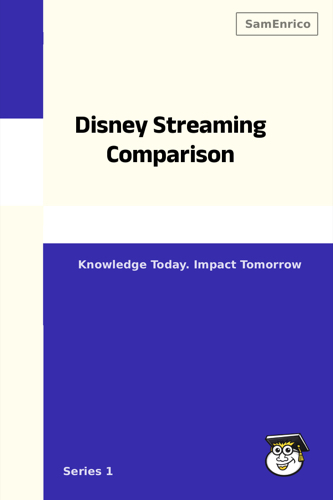
Free sample
Chapter 1: The King’s Slow Dance...--–- The boardroom was silent. Twenty-three executives sat around a mahogany table in Burbank, California, on a Tuesday morning in August 2017. Bob Iger, then sixty-six years old and fourteen years into his tenure as Disney’s CEO, had called the meeting with only forty-eight hours’ notice. That alone was unusual. Iger was known for meticulous planning, for calendars booked six months in advance, for a leadership style that rewarded preparation over improvisation.
A last-minute meeting meant a crisis.The crisis had a name, and its name was Netflix.Iger stood at the head of the table. Behind him, a large screen displayed two numbers. On the left: Disney’s market capitalization, $158 billion. On the right: Netflix’s market capitalization, $159 billion. The room exhaled collectively.
Netflix, a company that had started as a DVD-by-mail service, a company that Disney had once supplied with movies as a minor licensing partner, had just become more valuable than the Walt Disney Company. The House of Mouse was no longer the king of entertainment. It was the challenger.“We have a decision to make,” Iger said. “And we have to make it today.”The decision was simple in concept, terrifying in execution. Disney had been licensing its movies and shows to Netflix for years.
The deal was lucrative—Netflix paid Disney approximately $300 million annually for the right to stream titles like Star Wars: The Force Awakens, Captain America: Civil War, and Finding Dory. That money came with no risk, no infrastructure costs, no customer service headaches. It was free money, or as close to free as anything in Hollywood ever got.But Iger was proposing to kill that deal. He wanted Disney to pull all of its content from Netflix, terminate the licensing agreement, and invest billions of dollars into building a streaming service from scratch. He wanted to compete with Netflix directly, on Netflix’s own turf, using Disney’s intellectual property as the only weapon.A board member raised a hand.
“Bob, you’re asking us to spend five billion dollars to build something that might fail, while giving up three hundred million in guaranteed revenue. What happens if families won’t pay for another subscription?”Iger paused. Then he said the line that would become the thesis of Disney’s next decade: “Then we stop being Disney.”The Disruptor’s Dilemma To understand why Disney nearly waited too long to enter streaming, you first have to understand the single most important concept in modern business strategy: the disruptor’s dilemma. The term was coined by Clayton Christensen, a Harvard Business School professor, in his 1997 book The Innovator’s Dilemma. Christensen studied why successful companies so often fail when faced with disruptive technologies.
His conclusion was counterintuitive. Companies don’t fail because they are incompetent or lazy. They fail because they are too good at their existing business.Here is how the dilemma works. Every successful company has a business model that generates reliable profits. For Disney in 2015, that business model was built on two pillars.
The first pillar was theatrical releases: Marvel movies, Star Wars films, Pixar animations, and Disney live-action remakes. Each film cost $150–250 million to produce and another $150 million to market. In return, a successful Disney film could generate $800 million to $2 billion at the global box office. The second pillar was cable television, specifically ESPN. In 2015, ESPN was generating approximately $10 billion in annual revenue from cable affiliate fees alone.
Every household that paid for basic cable paid $7–10 per month to ESPN, regardless of whether anyone in that household watched sports.Both pillars were incredibly profitable. Both pillars also made streaming nearly impossible to embrace.Why? Because streaming threatened to cannibalize those existing revenue streams. If Disney released a new Marvel movie simultaneously on Disney+ and in theaters, why would families pay $50 for tickets, popcorn, and parking when they could watch the same film at home for $8 per month? If Disney moved ESPN content to a streaming service, why would cable companies continue paying billions for the right to carry the ESPN cable channel?
Every dollar earned from streaming would be a dollar lost from the existing business. The disruptor’s dilemma meant that Disney executives faced a perverse incentive: the better they were at their current jobs, the more reasons they had to resist streaming.Christensen’s research showed that this pattern repeats across industries. Kodak invented the digital camera in 1975 but buried the technology because it threatened film sales. Blockbuster had the opportunity to buy Netflix for $50 million in 2000 but passed because the executives could not imagine a future without physical video rental stores. Sears, once the Amazon of its era, spent the 1990s and 2000s protecting its catalog business while Amazon ate its lunch.Disney in 2015 was standing at the same precipice.
Iger could see the future. He had visited Netflix’s headquarters in Los Gatos, California, in 2016 and met with Reed Hastings, the company’s co-founder and CEO. Hastings showed Iger data that was both impressive and terrifying. Netflix had 75 million subscribers globally. Netflix was spending $5 billion annually on original content.
Netflix’s algorithm was learning what viewers wanted before viewers knew themselves. And most ominously for Disney, Netflix had a presentation slide titled “Legacy Media Will Be Dead by 2025.”The slide predicted that by the middle of the 2020s, cable television would have collapsed to half its 2015 size. Theatrical windows would shrink to thirty days or less. Traditional studios would become content suppliers to streaming platforms, with no direct relationship with consumers. The only survivors, the slide argued, would be the companies that owned the direct subscription relationship.Iger returned to Burbank with a single question: did Disney want to be a supplier or a survivor?The Forgotten Experiment: Disney’s First Streaming Attempt What most observers forget is that Disney had already tried streaming once before.
In 2002, the company launched a service called Disney Movie Club. It was not a streaming service in the modern sense—this was the era of dial-up internet and DVD players—but it was a direct-to-consumer subscription model. Families paid a monthly fee to receive Disney DVDs by mail. It was, in essence, the same model that Netflix used for its DVD business, but focused entirely on Disney’s library.The Disney Movie Club was modestly successful. At its peak, it had approximately 1.5 million active subscribers.
More importantly, it proved that families were willing to pay a recurring fee for access to Disney content. But the service was never treated as a strategic priority. It was managed by Disney’s home entertainment division, which reported to the consumer products group, which was far more focused on selling toys and clothing than building digital infrastructure. When Netflix began transitioning from DVDs to streaming in 2007, Disney did not see the shift as a threat. Disney’s executives were still thinking in terms of DVD sales and cable licensing.Then came 2012.
Netflix began producing original content with Lilyhammer, followed by House of Cards and Orange is the New Black. These shows were not blockbusters, but they signaled a fundamental change in the industry’s power structure. Netflix was no longer just a distributor. It was becoming a…
This is the end of the free sample. Get the eBook to keep going. Buy now
About this book
Details
- Author
- Greene Laurence
- Publisher
- SamEnrico
- Language
- English
- Genre
- Non-Fiction, Self-Help / Entertainment
- Released
- 2026-06-06
- Pages (approx.)
- 138
- Available as
- eBook, Audiobook

Read better in the ZLOADR app
Your eBooks on your phone or tablet. Sign in with your SamEnrico account and start reading.
More by Greene Laurence
 Foster Care Self Worth GuideGreene Laurence$11.99
 ABC Prioritization for PilotsGreene Laurence$11.99
 Single Family Rental GuideGreene Laurence$11.99
 Meditation Myths DebunkedGreene Laurence$11.99
 Michael Singer GuideGreene Laurence$11.99
 Sober Curiosity Book ClubGreene Laurence$11.99
 Design Thinking For Social ImpactGreene Laurence$11.99
 The Curse of the Hollow Crown: Nefertiti’s Vanished LegacyGreene Laurence$11.99
 Brixton's Bold Revolution: How Streetwear Redefined British FashionGreene Laurence$11.99
 How to Start a Hobby in AstrophotographyGreene Laurence$11.99
 A Collector's Handbook to the Ferrari Daytona 365gtbGreene Laurence$11.99
 Chinese Supplier Long Term Agreement BenefitsGreene Laurence$12.99
You may also like
 Hong Kong Handover 1997Dunn Johnnie$11.99
 Zumba For Postnatal Recovery CourseNeal Christian$11.99
 Zumba for BeginnersLadner Nikia$11.99
 YouTube Comment Mining GuideHumes Pandora$12.99
 Worry Box MeditationCarlin Rudy$11.99
 Workplace Stress MeditationNguyen Lynn$11.99
 Workplace Stress and Sleep RepairHawley Ivory$11.99
 Workplace Perfectionism CureDelaney Jeffry$11.99
 Workplace Injustice Anger GuideWallen Isabelle$11.99
 Work Addiction and Burnout LinkGreenwood Ester$11.99
 Women in Yoga and WellnessBeattie Galina$11.99
 Women in Stand Up ComedyChun Evangeline$11.99