
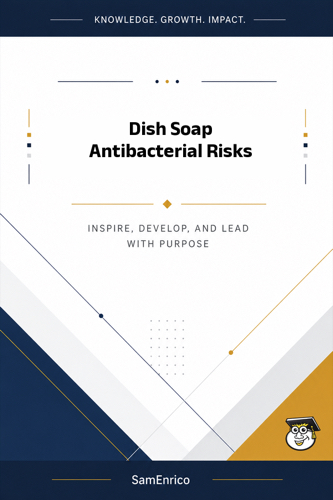
Dish Soap Antibacterial Risks eBook
Use regular dish soap without triclosan or benzalk
Use regular dish soap without triclosan or benzalkonium chloride.
Formats
Free sample
Chapter 1: The 99.9% Lie--–- The first lie arrives in a soft blue bottle. It sits on the grocery store shelf between the lemon-scented spray and the industrial-strength degreaser, its label screaming in bold sans-serif font: "Kills 99.9% of Bacteria." The bottle does not mention the 0.1%. It does not mention that the 99.9% figure was achieved in a sterile laboratory petri dish, not in your sink. It does not mention that the test lasted twenty-four hours, not the thirty seconds you will actually scrub your plates. And it most certainly does not mention that the chemical inside—triclosan, or its newer replacement benzalkonium chloride—is classified by the Environmental Protection Agency as a pesticide.
You are not buying dish soap. You are buying a pesticide in a pretty bottle, and you are paying extra for the privilege.This chapter is about that lie. It is about the history of how a perfectly adequate product—plain soap, which has cleaned dishes for thousands of years—was transformed into a fear-based commodity. It is about the marketing geniuses who realized that selling safety is infinitely more profitable than selling soap. And it is about the moment you, the consumer, were taught to fear your own kitchen.The Birth of Germ Panic To understand how we arrived at antibacterial dish soap, we must first understand a fundamental shift in human psychology that occurred in the late twentieth century.
For most of human history, germs were invisible and therefore largely ignored. People understood that spoiled food caused illness, and that washing with water and ash or lye soap reduced the risk. But they did not live in terror of microbes because they could not see them, and fear requires a visible enemy.That changed with the rise of television advertising in the 1950s and 1960s. Suddenly, companies could show you animated cartoons of menacing, spiky bacteria crawling across your countertops. They could zoom in on a kitchen sponge and reveal a teeming metropolis of fictionalized monsters.
They could make the invisible visible, and in doing so, they made the ordinary terrifying.The watershed moment came in the 1980s. Several high-profile bacterial scares—notably the E. coli outbreaks linked to fast-food hamburgers—dominated the evening news. For the first time, Americans saw healthy children hospitalized from contaminated food. The fear was real and justified.
But what marketers realized, with cold precision, was that fear could be bottled and sold back to the very people who had just been terrified.From Surgical Scrub to Kitchen Sink Triclosan, the original antibacterial agent that would eventually find its way into dish soaps, hand soaps, toothpaste, cutting boards, and even children's toys, began its life in a very different environment. It was developed in the 1970s as a surgical scrub for hospitals. In that context, it made sense. Operating rooms require extraordinary sterility. Patients with open incisions are vulnerable to infections that their immune systems cannot fight.
Hospitals are, by design, places where we temporarily suspend the normal rules of microbial coexistence.But somewhere along the way, a chemical engineer at a consumer goods company had an idea. If triclosan works in hospitals, why not put it in dish soap? Why not bring the operating room into the kitchen? The logic was seductive in its simplicity. If a little sterility is good, more must be better.
And if consumers could be convinced that their homes were teeming with dangerous bacteria, they would pay a premium for the solution.The first antibacterial dish soaps appeared on store shelves in the late 1980s and early 1990s. They were marketed not as better cleaners—because plain soap already cleaned perfectly well—but as necessary protectors. The advertising campaigns were masterclasses in psychological manipulation. One memorable commercial showed a mother serving dinner to her children, then cut to a microscopic view of a single plate teeming with "germs" that glowed an ominous red. The voiceover asked: "Are you really protecting your family?" The implied answer, delivered with a gentle but firm tone, was no.
Not unless you bought their specific blue bottle.The Hygiene Hypothesis: How Science Was Twisted There is a legitimate scientific theory called the hygiene hypothesis. Proposed by the British epidemiologist David Strachan in 1989, it suggests that early childhood exposure to microbes—dirt, pets, farm animals, siblings—helps train the developing immune system. Children who grow up in overly sterile environments, the theory goes, are more likely to develop allergies, asthma, and autoimmune disorders because their immune systems never learn to distinguish between genuine threats and harmless particles.This is a fascinating and well-supported area of research. But it says nothing about dish soap. It says nothing about washing your plates.
What it suggests is that children benefit from playing outside, having a dog, and not living in a bubble. It does not suggest that you should eat off dirty dishes.Nevertheless, antibacterial soap marketers seized on the hygiene hypothesis and twisted it into a weapon. They argued that because modern homes were too clean—and because their soap killed 99.9% of bacteria—they were protecting families from the supposed dangers of microbial exposure. This was, to put it charitably, a complete inversion of the science. The hygiene hypothesis warns against sterility.
Antibacterial soap promises sterility. The two are opposites.But consumers did not know that. They saw white lab coats in commercials and assumed science was on the side of the blue bottle. They heard the phrase "99.9% effective" and assumed the number came from rigorous testing in real-world conditions. They had no way of knowing that the statistic was generated in a petri dish with a single strain of non-harmous bacteria, under ideal conditions, over a full day.The 99.9% Statistic: A Number Built to Deceive Let us examine that number more closely, because it is the linchpin of the entire antibacterial marketing campaign.
"Kills 99.9% of bacteria" sounds definitive. It sounds like the kind of claim that would be illegal to make if it were not rigorously proven. Surely, you might think, the government would not allow a company to put a false statistic on a bottle of something that touches your food.Here is the truth. The 99.9% figure comes from a standardized laboratory test called the suspension test. In this test, a pure culture of a single bacterial species—usually E.
coli or Staphylococcus aureus—is suspended in a sterile liquid. The antibacterial agent is added. After a specific contact time, usually twenty-four hours, the remaining live bacteria are counted. If the chemical killed 99.9% of them, the product earns its claim.Notice what is missing from this test. First, there is no food residue.
Your dirty dishes are covered in grease, protein, carbohydrates, and salt—all of which can interfere with antibacterial chemicals. Second, there is no scrubbing. The test simply mixes the chemical with bacteria; no friction is involved. Third, the contact time is twenty-four hours. You do not wash your dishes for twenty-four hours.
You wash them for thirty seconds, maybe a minute if you are thorough.When researchers have tested antibacterial soaps under real-world conditions—with food residue, with typical dishwashing times, with actual scrubbing—the results are dramatically different. A landmark study published in the Journal of Food Protection in 2016 compared…
This is the end of the free sample. Get the eBook to keep going. Buy now
About this book
Details
- Author
- Cassidy Delma
- Publisher
- SamEnrico
- Language
- English
- Genre
- Non-Fiction, Health & Wellness
- Released
- 2026-06-10
- Pages (approx.)
- 119
- Available as
- eBook, Audiobook

Read better in the ZLOADR app
Your eBooks on your phone or tablet. Sign in with your SamEnrico account and start reading.
More by Cassidy Delma
 Meth Addiction Understanding and Action PlanCassidy Delma$11.99
 Bike Lane Advocate StoryCassidy Delma$11.99
 The Resilience Autoimmune ProtocolCassidy Delma$11.99
 Russian Organized Crime USACassidy Delma$11.99
 Remote Work Accountability SystemsCassidy Delma$11.99
 Middle Passage Nautical TechnologyCassidy Delma$11.99
 Success Without Burnout for DentistsCassidy Delma$11.99
 The Silk Road's Shadow War: How a Lost Empire's Spies Still Control the WorldCassidy Delma$11.99
 Blood and Veldt: The Siege of Ladysmith’s Forgotten HellCassidy Delma$11.99
 A Collector's Handbook to the Mg PbCassidy Delma$11.99
 Service Providers Guide to PET GroomingCassidy Delma$11.99
 How to Start a Core Sampling for Construction Business (Beginners Guide)Cassidy Delma$11.99
You may also like
 Hong Kong Handover 1997Dunn Johnnie$11.99
 Zumba For Postnatal Recovery CourseNeal Christian$11.99
 Zumba for BeginnersLadner Nikia$11.99
 YouTube Comment Mining GuideHumes Pandora$12.99
 Worry Box MeditationCarlin Rudy$11.99
 Workplace Stress MeditationNguyen Lynn$11.99
 Workplace Stress and Sleep RepairHawley Ivory$11.99
 Workplace Perfectionism CureDelaney Jeffry$11.99
 Workplace Injustice Anger GuideWallen Isabelle$11.99
 Work Addiction and Burnout LinkGreenwood Ester$11.99
 Women in Yoga and WellnessBeattie Galina$11.99
 Women in Stand Up ComedyChun Evangeline$11.99