
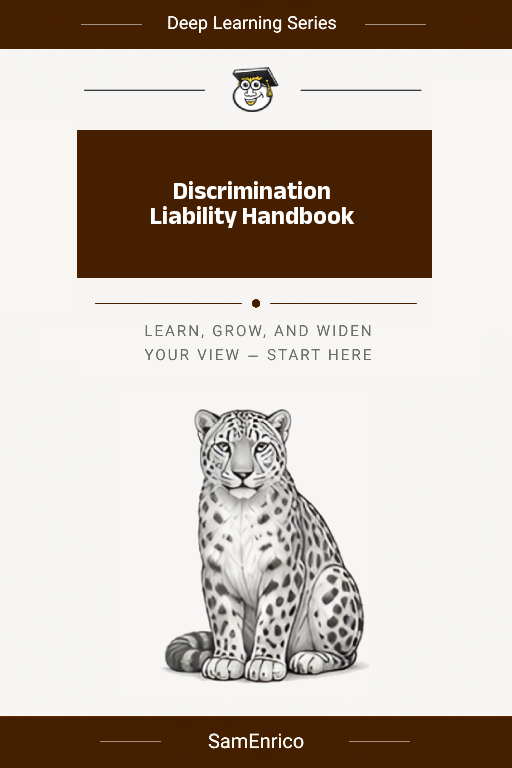
Non-FictionBusiness BriefDiscrimination
Discrimination Liability Handbook eBook
Avoid discrimination claims in hiring, promotion,
Avoid discrimination claims in hiring, promotion, and termination decisions.
Formats
Free sample
Chapter 1: The Ignorance Trap--–- In 2018, a regional manager at a national retail chain fired a 58-year-old employee named Carol. The official reason was “poor performance.” Carol had received “meets expectations” ratings for eleven consecutive years. Her manager had never issued her a single written warning. When Carol sued for age discrimination, the manager testified under oath, “I didn’t know the ADEA protected people over 40. I thought it was just for people near retirement age.” The federal judge presiding over the case did not hide her disbelief.
The jury awarded Carol $450,000. The manager’s ignorance cost the company more than his salary for the next decade.This true story illustrates what this book calls the Ignorance Trap: the deeply mistaken belief that “I didn’t know” is a valid defense against discrimination liability. It is not. Courts have repeatedly and emphatically held that ignorance of the law is no excuse, especially when the employer has provided any training whatsoever—and sometimes even when it has not. A manager who says “I didn’t know asking about childcare plans was sex discrimination” will lose a lawsuit just as badly as a manager who openly says “I don’t hire women.” The difference is that the first manager is often more dangerous because they believe they are doing nothing wrong, so they never seek help, never correct their behavior, and never alert HR to a potential problem until the lawsuit is already filed.This chapter establishes the foundational legal landscape that every manager, HR professional, and business owner must understand before making any hiring, promotion, or termination decision.
It is written specifically for non-lawyers—frontline supervisors, HR generalists, and small business owners—who need to know what the law requires without wading through hundreds of pages of dense legal citations and complex judicial opinions. By the end of this chapter, you will understand the major federal discrimination laws, the critical difference between intentional and unintentional discrimination, and most importantly, why “I didn’t know” will never save you from liability.The Seven Major Federal Laws You Cannot Afford to Misunderstand Employment discrimination law is not a single statute but a complex web of overlapping federal laws, each protecting different categories of people and prohibiting different types of conduct. Most employers with fifteen or more employees are covered by all of these laws simultaneously. The following seven laws form the core of any discrimination liability analysis. If you remember nothing else from this book, commit these to memory.Title VII of the Civil Rights Act of 1964Title VII is the cornerstone of American employment discrimination law.
It prohibits discrimination based on race, color, religion, sex, and national origin. It covers employers with fifteen or more employees, including federal, state, and local governments, as well as employment agencies and labor unions. For practical purposes, any business with fifteen or more employees must comply with Title VII in every employment decision.The term “sex” has expanded dramatically over time. Originally understood to mean biological sex at birth, the Supreme Court held in 2020’s landmark decision Bostock v. Clayton County that discrimination based on sexual orientation or gender identity is necessarily discrimination “because of sex.” The Court’s reasoning was elegantly simple: if you fire a man for being attracted to men but would not fire a woman for being attracted to women, sex is the reason for the difference.
That same logic applies to gender identity. Today, Title VII protects lesbian, gay, bisexual, transgender, and queer employees in every jurisdiction covered by federal law, regardless of whether state law provides those same protections.Title VII also prohibits discrimination based on pregnancy, childbirth, or related medical conditions through the Pregnancy Discrimination Act, which amended Title VII in 1978. An employer cannot fire, refuse to hire, demote, or take any other adverse action against a woman because she is pregnant or has recently given birth. Pregnant employees must be treated the same as any other temporarily disabled employee for purposes of leave, light duty assignments, and other accommodations.The Age Discrimination in Employment Act of 1967The ADEA protects individuals age forty and older from discrimination in hiring, promotion, termination, compensation, and all other terms and conditions of employment. Critically, the ADEA does not protect younger workers.
An employer can legally favor an older worker over a younger worker without violating the ADEA. However, the reverse is illegal. Favoring a younger worker over an older worker—even if the younger worker is also over forty—can violate the ADEA if age was a motivating factor.The ADEA covers employers with twenty or more employees. Unlike Title VII, the ADEA allows a “reasonable factors other than age” defense for employment practices that disproportionately harm older workers. For example, a policy of laying off the lowest-performing employees regardless of age is generally lawful, even if older workers are disproportionately affected, as long as the performance measurements are job-related, applied consistently, and not a pretext for age discrimination.However, the ADEA also contains a strict prohibition on mandatory retirement.
Employers cannot force or pressure older workers to retire based on their age, with very narrow exceptions for certain executives and public safety officers who are entitled to substantial non-forfeitable retirement benefits. For almost all employees, mandatory retirement ages are completely illegal.The Americans with Disabilities Act of 1990The ADA prohibits discrimination against qualified individuals with disabilities. It covers employers with fifteen or more employees. A “disability” is defined as a physical or mental impairment that substantially limits one or more major life activities, a record of such an impairment, or being regarded as having such an impairment.Major life activities include walking, seeing, hearing, speaking, breathing, learning, reading, concentrating, thinking, communicating, interacting with others, and major bodily functions such as immune system function and digestive function. The definition is intentionally broad.
Conditions such as epilepsy, diabetes, cancer, HIV and AIDS, depression, anxiety disorders, bipolar disorder, post-traumatic stress disorder, and many others can all qualify as disabilities depending on their severity and impact on the individual’s life.The ADA has two major components that every employer must understand. First, it prohibits discrimination against qualified individuals with disabilities in hiring, promotion, termination, and all other employment decisions. A “qualified individual” is someone who can perform the essential functions of the job with or without reasonable accommodation. Second, it requires employers to provide reasonable accommodations to qualified individuals with disabilities, unless doing so would cause undue hardship.The distinction between “essential functions” and “marginal functions” is critical. Essential functions are the fundamental duties of the position—the reason the job exists.
Marginal functions are tasks that are merely desirable or incidental to the role. An employer cannot refuse to accommodate a disability by arguing that the employee cannot perform marginal functions that are not truly essential to the job.The Genetic Information Nondiscrimination Act of 2008GINA prohibits employers from using genetic information in employment decisions and from requesting, requiring, or purchasing genetic information about employees or their family members. Genetic information includes family medical history, genetic test results, and requests for or receipt of genetic services.GINA covers employers with fifteen or more employees. A surprisingly common violation occurs when employers ask about family health…
This is the end of the free sample. Get the eBook to keep going. Buy now
About this book
Details
- Author
- Tisdale Keneth
- Publisher
- SamEnrico
- Language
- English
- Genre
- Non-Fiction, Business Brief, Discrimination
- Released
- 2026-06-01
- Pages (approx.)
- 150
- Available as
- eBook, Audiobook

Read better in the ZLOADR app
Your eBooks on your phone or tablet. Sign in with your SamEnrico account and start reading.
More by Tisdale Keneth
 Financial Goal PlanningTisdale Keneth$11.99
 The Distraction Proof Sales CallTisdale Keneth$11.99
 Dividend Portfolio RebalancingTisdale Keneth$11.99
 Corporate Finance to Nonprofit AccountingTisdale Keneth$11.99
 Opioid Vaccine GuideTisdale Keneth$11.99
 Procrastination For FreelancersTisdale Keneth$11.99
 Market Rate Research GuideTisdale Keneth$11.99
 Parent Loss JournalTisdale Keneth$11.99
 Suleiman the Magnificent: The Sultan Who Shaped an EmpireTisdale Keneth$11.99
 The Phoenix Protocol: A Double Agent in the Cold War’s ShadowTisdale Keneth$11.99
 How to Start a Metal Structures and Parts of Structures Business (Beginners Guide)Tisdale Keneth$11.99
 How to Produce Wood BrightenerTisdale Keneth$11.99
You may also like
 Hong Kong Handover 1997Dunn Johnnie$11.99
 Zumba For Postnatal Recovery CourseNeal Christian$11.99
 Zumba for BeginnersLadner Nikia$11.99
 YouTube Comment Mining GuideHumes Pandora$12.99
 Worry Box MeditationCarlin Rudy$11.99
 Workplace Stress MeditationNguyen Lynn$11.99
 Workplace Stress and Sleep RepairHawley Ivory$11.99
 Workplace Perfectionism CureDelaney Jeffry$11.99
 Workplace Injustice Anger GuideWallen Isabelle$11.99
 Work Addiction and Burnout LinkGreenwood Ester$11.99
 Women in Yoga and WellnessBeattie Galina$11.99
 Women in Stand Up ComedyChun Evangeline$11.99