
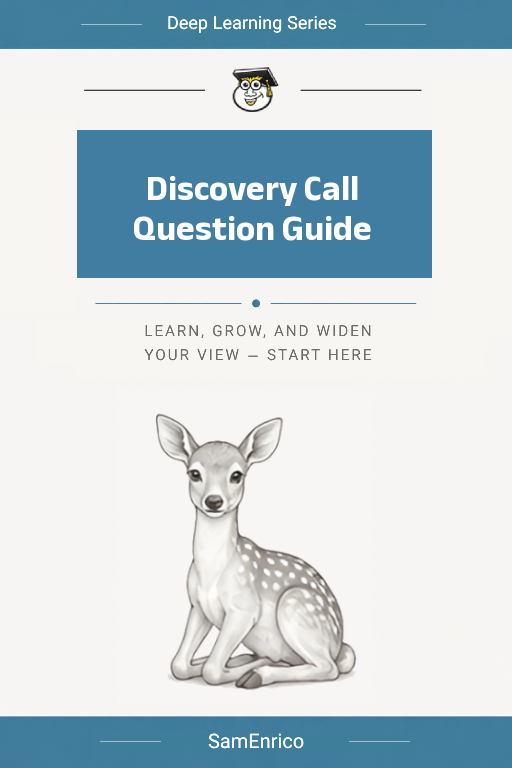
Non-FictionFirst 30 DaysSales TrainingQuestion Framework
Discovery Call Question Guide eBook
Master the qualification conversation with thirty
by Hagen Moira
Master the qualification conversation with thirty open-ended questions. Covers pain point identification, budget discovery, and decision-maker mapping in first client calls.
Formats
Free sample
Chapter 1: The Curiosity Trap--–- Most salespeople believe they are good at discovery. They are wrong. This chapter reframes the discovery call from a data-collection exercise to a commercial diagnosis. You will learn why asking “good questions” is not enough, how to distinguish information from leverage, and why the best discovery calls feel like conversations—not interrogations. By the end of this chapter, you will never mistake activity for progress again.The $40,000 Question That Wasn't Let me tell you about a call that still keeps a sales manager named Sarah up at night.Sarah had been selling enterprise software for six years.
She was polished. She was curious. She asked great questions—or so she thought. She landed a discovery call with the VP of Operations at a mid-sized logistics company. The VP was friendly, talkative, and seemed genuinely interested.
Sarah asked him about his role, his team, his challenges. He told her about inefficiencies in their route planning software. She asked follow-ups. He gave thoughtful answers.Forty-five minutes later, Sarah hung up feeling fantastic. She had asked seventeen questions.
She had notes on three pages. She scheduled a demo for the following week.The demo went beautifully. The VP brought in three of his direct reports. Everyone nodded along. Sarah left that call convinced she was two steps from a signed contract.Then silence.A week later, she followed up.
“Still thinking about it,” the VP said. Two weeks later: “Budget got frozen.” Three weeks later: ghosted.Sarah had done everything right—by her definition. She asked questions. She listened. She built rapport.
So what went wrong?She had mistaken curiosity for diagnosis.She asked seventeen questions. Not one of them was designed to uncover the commercial impact of the problem. She never asked what the inefficiency cost the company. She never asked what happened if they didn't fix it. She never asked who else needed to be involved.
She left the call with a notebook full of facts and zero leverage.The VP hadn't lied about the budget freeze. But that wasn't the real reason the deal died. The deal died because Sarah never gave the VP a reason to fight for the budget. She hadn't quantified the pain. She hadn't built a business case.
She had been professionally curious but commercially useless.That discovery call cost Sarah forty thousand dollars in commission. She never made that mistake again.This book exists so you don't have to learn that lesson the hard way.Why Most Discovery Calls Fail Before They Start Here is a truth that will make you uncomfortable: Most salespeople are terrible at discovery. Not because they are lazy or unintelligent. Because they confuse asking questions with doing discovery.Let me prove it to you.Think about the last five discovery calls you were on. Not the ones where you already knew the prospect was buying.
The real ones—the cold or warm calls where you had to figure out if there was a deal worth pursuing.Now answer these three questions honestly:Before each call, did you spend five minutes researching trigger events, or did you skim their Linked In profile and call it preparation?During the call, did you ask questions that could be answered with a yes or no, or did you ask questions that forced the prospect to reveal consequences?After the call, could you state the prospect's problem in one sentence and its financial impact in one number?If you hesitated on any of those, you are not doing discovery. You are having conversations and calling them discovery.The difference matters. A conversation makes you feel good. Discovery makes you money.The Two Types of Salespeople After studying thousands of discovery calls across dozens of industries, a clear pattern emerges. There are two types of salespeople: The Curious Collector and The Commercial Diagnostician.The Curious Collector The Curious Collector believes that asking questions is the goal.
They enter a call with a list of twenty questions—often the same twenty questions for every prospect—and they work through them like a checklist. They feel productive because their mouth is moving and their pen is writing.But here is what the Curious Collector actually collects: surface-level problems, vague frustrations, and false positives.“We're having some issues with efficiency.” (Collector writes: pain identified)“Budget is tight right now.” (Collector writes: budget objection)“Let me think about it.” (Collector writes: follow up in two weeks)The Collector leaves every call feeling curious. They leave every quarter missing quota.The Commercial Diagnostician The Commercial Diagnostician enters a call with a different mindset. They are not there to collect information. They are there to diagnose a business problem with enough precision to know three things:Is the problem real, or is it a symptom of something deeper?What is the financial consequence of leaving the problem unsolved?Who has the authority and motivation to fund a solution?The Diagnostician asks fewer questions—often half as many as the Collector.
But each question is designed to reveal leverage. They listen for numbers, consequences, and power dynamics. They leave every call knowing whether to advance, nurture, or disqualify.The difference between these two salespeople is not natural talent. It is a system.This book is that system.What the Best-Sellers Got Right (And Where They Stopped)Before we build the system, let me acknowledge the giants whose shoulders this book stands on. You do not need to have read these books to benefit from this one.
But understanding what they taught—and where they stopped—will help you see why this book exists.Gap Selling by Keenan What it got right: The seller's job is not to present features. It is to uncover the gap between the prospect's current state (painful reality) and desired state (solution). Questions without a gap are noise. This is a profound insight that changed how an entire generation of sellers thinks about discovery.Where it stopped: Gap Selling gives you the framework—the why. It does not give you the scripts.
Keenan tells you to find the gap. He does not give you the thirty specific questions to find it, call after call, without having to reinvent the wheel every time.This book adds: The exact wording of the questions that uncover the gap, organized into a repeatable sequence, with scripts for every twist and turn of the conversation.The Challenger Sale by Dixon and Adamson What it got right: Reps who “teach” first—offering insights the prospect hasn't considered—win more than those who merely “ask and listen.” Curiosity without insight is passive. The Challenger Sale proved that the best discovery calls are not neutral fact-finding missions. They are commercial conversations where the seller brings a point of view.Where it stopped: The Challenger Sale tells you to teach. It does not give you the diagnostic questions that uncover what to teach.
You cannot offer insight if you do not know what the prospect is missing.This book adds: The discovery questions that reveal the gaps in the prospect's thinking—so you know exactly what insight to offer and when.SPIN Selling by Neil Rackham What it got right: The most comprehensive research ever conducted…
This is the end of the free sample. Get the eBook to keep going. Buy now
About this book
Details
- Author
- Hagen Moira
- Publisher
- SamEnrico
- Language
- English
- Genre
- Non-Fiction, First 30 Days, Sales Training, Question Framework
- Released
- 2026-06-01
- Pages (approx.)
- 142
- Available as
- eBook, Audiobook

Read better in the ZLOADR app
Your eBooks on your phone or tablet. Sign in with your SamEnrico account and start reading.
More by Hagen Moira
 Parenting Stress In Blended FamiliesHagen Moira$11.99
 EMDR And Dreams GuideHagen Moira$11.99
 Behavioral Addiction in Call CentersHagen Moira$11.99
 Strategic Rest Recovery GuideHagen Moira$11.99
 The Swan and the Warrior: A Love Forged in the OtherworldHagen Moira$11.99
 The Last Druids of the Iron Age: Rediscovering the Picts of ScotlandHagen Moira$11.99
 American Foxhound BreedingHagen Moira$11.99
 Understanding Hereditary AmyloidosisHagen Moira$17.99
 How to Start a Hobby in ModelingHagen Moira$11.99
 Five Year Cloud Computing Market ForecastHagen Moira$12.99
You may also like
 Hong Kong Handover 1997Dunn Johnnie$11.99
 Zumba For Postnatal Recovery CourseNeal Christian$11.99
 Zumba for BeginnersLadner Nikia$11.99
 YouTube Comment Mining GuideHumes Pandora$12.99
 Worry Box MeditationCarlin Rudy$11.99
 Workplace Stress MeditationNguyen Lynn$11.99
 Workplace Stress and Sleep RepairHawley Ivory$11.99
 Workplace Perfectionism CureDelaney Jeffry$11.99
 Workplace Injustice Anger GuideWallen Isabelle$11.99
 Work Addiction and Burnout LinkGreenwood Ester$11.99
 Women in Yoga and WellnessBeattie Galina$11.99
 Women in Stand Up ComedyChun Evangeline$11.99