
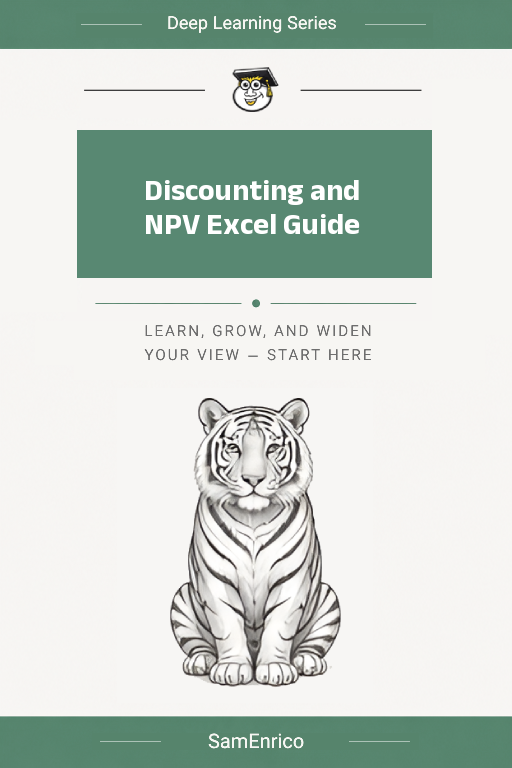
Discounting and NPV Excel Guide
Calculate present value and net present value usin
Calculate present value and net present value using Excel's NPV function, solving intertemporal choice exam problems.
Formats
About this book
Free sample
Chapter 1: The $100 Question--Let’s begin with a question that seems almost too simple. Would you rather have 100todayor100 today or 100todayor120 one year from today? Most people, when asked this, pause for a moment. Their intuition nudges them toward the immediate 100—thereissomethingsatisfyingaboutmoneyinhand.Butthemathematicianinthemcalculates:100—there is something satisfying about money in hand. But the mathematician in them calculates: 100—thereissomethingsatisfyingaboutmoneyinhand.Butthemathematicianinthemcalculates:120 is 20% more than 100.Unlessyoubelieveyoucanearnmorethan20100.
Unless you believe you can earn more than 20% on that 100.Unlessyoubelieveyoucanearnmorethan20100 over the next year, the future 120isthebetterdeal.Yeteventhatcalculationmissesadeepertruth.Thecorrectanswerdependsentirelyonsomethingcalledopportunitycost—thereturnyoucouldearnbytakingthe120 is the better deal. Yet even that calculation misses a deeper truth. The correct answer depends entirely on something called opportunity cost—the return you could earn by taking the 120isthebetterdeal.Yeteventhatcalculationmissesadeepertruth.Thecorrectanswerdependsentirelyonsomethingcalledopportunitycost—thereturnyoucouldearnbytakingthe100 today and investing it elsewhere. If you can earn 5% in a safe bank account, your 100becomes100 becomes 100becomes105 in a year, making the 120futurepaymentfarbetter.Ifyoucanearn25120 future payment far better. If you can earn 25% in a risky venture, your 120futurepaymentfarbetter.Ifyoucanearn25100 becomes 125,makingtheimmediatecashsuperior.Thesame125, making the immediate cash superior.
The same 125,makingtheimmediatecashsuperior.Thesame100 and the same $120 produce opposite answers simply by changing what you assume about the world. This is the first and most important insight of this book: money has a time dimension. A dollar is not just a dollar. Its value depends critically on when you receive it.This chapter introduces the foundational concept that underpins everything else in this book: the Time Value of Money, or TVM. TVM is the simple but profound observation that money available today is worth more than the same nominal amount of money in the future.
Why? First, because you can invest today's money and earn a return, turning 100todayintosomethinglargertomorrow.Second,becauseinflationerodespurchasingpower—100 today into something larger tomorrow. Second, because inflation erodes purchasing power—100todayintosomethinglargertomorrow.Second,becauseinflationerodespurchasingpower—100 tomorrow buys less than $100 today if prices rise. Third, because there is always risk: a promise of future payment might be broken, while cash in hand is certain. Collectively, these reasons mean that comparing money across time requires a framework.
That framework is what you will learn in this chapter and build upon for the rest of this book.The Universal…
This is the end of the free sample. Get the eBook to keep going. Buy now
Contents
- Chapter 1
- Chapter 2
- Chapter 3
- Chapter 4
- Chapter 5
- Chapter 6
- Chapter 7
- Chapter 8
- Chapter 9
- Chapter 10
- Chapter 11
- Chapter 12
Details
- Author
- Neil Stephania
- Publisher
- SamEnrico
- Language
- English
- Genre
- Non-Fiction, Student's Shortcut
- Released
- 2026-05-30
- Pages (approx.)
- 154
- Available as
- eBook, Audiobook

Read better in the ZLOADR app
Your eBooks on your phone or tablet. Sign in with your SamEnrico account and start reading.
More by Neil Stephania
 Meditation for Generalized AnxietyNeil Stephania$11.99
 The Rejection Sensitivity FixNeil Stephania$11.99
 Creative Outlet Recovery GuideNeil Stephania$11.99
 The Firefighter HostageNeil Stephania$11.99
 Startup Career PathNeil Stephania$11.99
 Event Planner Stress ManagementNeil Stephania$11.99
 School Counselor Visit GuideNeil Stephania$11.99
 Blake Mycoskie TOMSNeil Stephania$11.99
 Volcanoes and the Mind: Empedocles and the Birth of Western ScienceNeil Stephania$11.99
 Gawain’s Shadow: The Knight Who Walked with GhostsNeil Stephania$11.99
 Community Moderation and SafetyNeil Stephania$11.99
 Customer Validation One Page GuideNeil Stephania$12.99
You may also like
 Hong Kong Handover 1997Dunn Johnnie$11.99
 Zumba For Postnatal Recovery CourseNeal Christian$11.99
 Zumba for BeginnersLadner Nikia$11.99
 YouTube Comment Mining GuideHumes Pandora$12.99
 Worry Box MeditationCarlin Rudy$11.99
 Workplace Stress MeditationNguyen Lynn$11.99
 Workplace Stress and Sleep RepairHawley Ivory$11.99
 Workplace Perfectionism CureDelaney Jeffry$11.99
 Workplace Injustice Anger GuideWallen Isabelle$11.99
 Work Addiction and Burnout LinkGreenwood Ester$11.99
 Women in Yoga and WellnessBeattie Galina$11.99
 Women in Stand Up ComedyChun Evangeline$11.99