
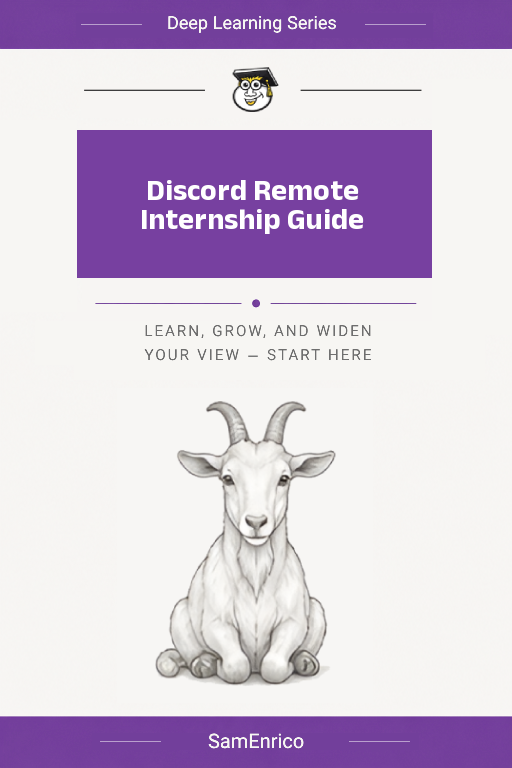
Non-FictionVirtual Work ExperienceCommunity Guide
Discord Remote Internship Guide eBook
Join Discord's virtual internship program. Communi
by Maestas Evia
Join Discord's virtual internship program. Community platforms, voice tech, and remote server management.
Formats
Free sample
Chapter 1: The Persistent Office--The meeting that could have been an email is a symptom. The video call that leaves you drained by 11 AM is a symptom. The Slack channel where nothing ever gets resolved because everyone is typing over each other in frantic, disjointed threads—that is also a symptom. The disease is not bad management or lazy colleagues. The disease is the assumption that remote work must mimic office work.
We have spent the last five years trying to force square pegs into round holes, using tools designed for scheduled, synchronous, face-to-face interaction to run organizations that are now distributed, asynchronous, and text-first. And it is failing.But here is what nobody is telling you: the solution is not a better Zoom alternative. The solution is not another productivity app. The solution is a platform built by and for a generation that never learned to separate their social lives from their work lives, their text messages from their project management, their voice chats from their watercooler conversations. That platform is Discord.
And if you are reading this book, you are about to learn not just how to use it, but how to build a career around it.This chapter makes three arguments, and it makes them forcefully because the rest of the book depends on you accepting them. First, the traditional remote work stack—Zoom, Slack, email, and project management tools like Asana or Trello—is fundamentally broken for the way humans actually communicate. Second, Discord solves this breakage not through any single feature but through its philosophy of persistent, low-friction, multi-modal presence. Third, and most provocatively, the skills required to manage a Discord server are not niche gaming skills. They are the exact skills that will define the next decade of work: community management, asynchronous leadership, voice moderation, and automated workflow design.
The internship you are about to learn about is not a consolation prize for people who cannot get "real" jobs. It is the canary in the coal mine for where all knowledge work is heading.Let us start with what is broken.The Zoom Hangover In March 2020, the world discovered Zoom. It was a miracle of convenience at a time of crisis. Companies that had never allowed remote work suddenly had no choice. Video calls became the default stand-in for being together.
And for the first six months, it worked well enough. But by 2022, the cracks were showing. "Zoom fatigue" entered the dictionary. Studies from Stanford University confirmed what millions of workers already knew: video calls are more exhausting than in-person meetings because our brains have to work harder to process non-verbal cues, maintain eye contact through a camera, and tolerate the constant mirror of our own faces.The problem is deeper than fatigue, though. Zoom and its cousins (Teams, Google Meet, Webex) are built on a specific model of communication: the meeting.
Meetings are scheduled, time-bound, and synchronous. They require everyone to stop what they are doing and pay attention at the same time. This model made sense when everyone worked in the same building and the only way to share information was to gather in a room. But remote work is not office work with a screen attached. Remote work is a fundamentally different way of organizing human effort.
It thrives on asynchronous communication—messages that can be sent and received at different times, that do not require everyone to be present simultaneously, that allow people to work when they are most productive rather than when a calendar invites them.Zoom does not do asynchronous. Zoom does not do persistent presence. Zoom does not do text-based collaboration. Zoom does one thing: it puts faces on a grid. That is not enough.The Slack Illusion If Zoom is the villain of the remote work story, Slack is the tragic hero.
Slack was supposed to save us from email. And for a while, it did. It introduced channels, threads, and integrations. It made communication searchable and organized. But Slack has a fatal flaw: it is built for short, rapid, interrupt-driven conversations.
Every notification demands attention. Every ping expects a response. The result is not deep work but shallow panic.Here is what happens on a typical Slack-heavy team. You start your day with 47 unread messages across 12 channels. You scan them quickly, reacting with emojis to acknowledge you have seen them.
You type a few replies. Then a direct message arrives from your manager asking for an update. You provide it. Then someone @s you in a channel about a project you are vaguely connected to. You spend ten minutes figuring out why you were mentioned.
Then another DM. Then a thread explodes into a debate about something that could have been solved in a two-minute voice call. By noon, you have responded to over a hundred messages and accomplished exactly nothing of substance. This is not collaboration. This is performative busyness.Slack's fundamental architecture—channels that anyone can create, threads that bury context, notifications that default to "on"—creates a culture of interruption.
The platform rewards the person who replies fastest, not the person who thinks deepest. It punishes focused work because every moment of focus is a moment when your unread count climbs higher. And because Slack is primarily text-based, it strips away tone, leaving misunderstandings to fester until someone snaps in a public channel.Discord shares some DNA with Slack. Both are chat platforms. Both have channels and direct messages.
But the similarities end there. Discord was built for a different use case: gaming communities where hundreds or thousands of people need to coexist, communicate, and collaborate without chaos. That origin story matters more than you think.The Discord Difference: Persistent Presence Discord's killer feature is not any single button or setting. It is a philosophy that the company baked into the product from day one: presence should be persistent, not scheduled. When you join a Discord server, you do not "enter a meeting." You arrive in a space that is always there.
Channels have purpose. Roles define access. Voice channels are rooms you can pop into and out of without a calendar invitation. The green dot next to someone's name does not mean they are available to interrupt; it means they are present in the workspace, the same way you might be present at your desk even when you have headphones on.This persistence changes everything. On Discord, you do not schedule a meeting to discuss a project; you create a dedicated text channel for that project and a voice channel for real-time discussions when needed.
You do not send a frantic email asking for a quick sync; you join a voice channel where your colleagues already are, or you leave a voice message in a thread. You do not lose context when someone is on vacation; you scroll up in the channel to see what happened while you were gone.The persistence also changes the psychology of work. On Zoom, every interaction feels like a performance. You are on camera. You are being watched.
The stakes feel high even for a routine check-in. On Discord, especially in text channels, the stakes are lower. You can think before you type. You can edit…
This is the end of the free sample. Get the eBook to keep going. Buy now
About this book
Details
- Author
- Maestas Evia
- Publisher
- SamEnrico
- Language
- English
- Genre
- Non-Fiction, Virtual Work Experience, Community Guide
- Released
- 2026-05-29
- Pages (approx.)
- 139
- Available as
- eBook, Audiobook

Read better in the ZLOADR app
Your eBooks on your phone or tablet. Sign in with your SamEnrico account and start reading.
More by Maestas Evia
 Pomodoro for Interview PrepMaestas Evia$11.99
 Walking Meditation For Chemo RecoveryMaestas Evia$11.99
 Affirmations For SeniorsMaestas Evia$11.99
 The Last Stand of the Samurai: Oda Nobunaga's Fire and SteelMaestas Evia$11.99
 Assertiveness for Teachers GuideMaestas Evia$11.99
 Understanding OnycholysisMaestas Evia$17.99
 Dynamic Pricing in High InflationMaestas Evia$12.99
 Housekeeping Room AttendantMaestas Evia$11.99
 How to Start a Pet Animal Feeds Produced From Slaughter Waste Business (Beginners Guide)Maestas Evia$11.99
You may also like
 Hong Kong Handover 1997Dunn Johnnie$11.99
 Zumba For Postnatal Recovery CourseNeal Christian$11.99
 Zumba for BeginnersLadner Nikia$11.99
 YouTube Comment Mining GuideHumes Pandora$12.99
 Worry Box MeditationCarlin Rudy$11.99
 Workplace Stress MeditationNguyen Lynn$11.99
 Workplace Stress and Sleep RepairHawley Ivory$11.99
 Workplace Perfectionism CureDelaney Jeffry$11.99
 Workplace Injustice Anger GuideWallen Isabelle$11.99
 Work Addiction and Burnout LinkGreenwood Ester$11.99
 Women in Yoga and WellnessBeattie Galina$11.99
 Women in Stand Up ComedyChun Evangeline$11.99