
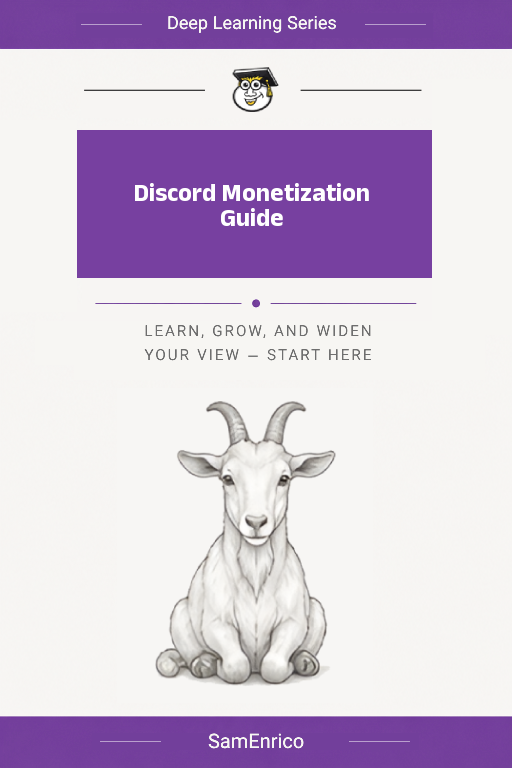
Non-FictionZero-to-One CreatorDiscord Monetization
Discord Monetization Guide eBook
Turn free Discord server into paid community using
Turn free Discord server into paid community using premium roles, channels, and subscription bots.
Formats
Free sample
Chapter 1: The Freemium Trap--In 2019, a crypto trader named Marcus built a Discord server that grew to 45,000 members in under eight months. He did everything right by conventional wisdom: he offered free trading signals, open voice chats with experienced traders, and a library of educational content. His server was vibrant, chaotic, and the center of his online identity. He spent six hours a day moderating, answering questions, and resolving disputes. His only reward was exhaustion.
When he finally tried to introduce a $9.99 monthly tier to cover server costs and compensate his time, the backlash was swift and brutal. Within two weeks, 90 percent of his members either left or went silent. The remaining 10 percent refused to pay. Marcus shut down the server three months later, blaming his community for being ungrateful. He was wrong.
The community didn’t betray him. His server architecture betrayed him.This chapter dismantles the most destructive misconception in community building: the belief that a free server must offer substantial value to attract and retain members. That assumption has killed more Discord monetization attempts than any technical failure or pricing mistake. The alternative is a counterintuitive but proven framework called the Premium Core Model, where the free tier functions not as a community but as a marketing funnel, and the most valuable content remains intentionally invisible to non-paying users.The Mathematics of Burnout Before discussing strategy, understand the arithmetic of failure. Every free member costs you something.
They consume bandwidth, generate notifications, require moderation, and create noise that buries valuable signals. A server with 10,000 free members typically requires at least five active moderators, one bot to manage spam, and several hours of daily attention from the owner. The direct financial costs—Discord boosting, bot subscriptions, server hosting for external tools—can easily exceed $300 per month. The indirect costs are far higher: opportunity cost, stress, and the gradual erosion of your willingness to create value.When you give away your best content for free, you train your audience to expect everything for nothing. This is the Freemium Trap.
The term “freemium” suggests a gentle on-ramp to paid upgrades, but in Discord, the reality is different. Unlike a mobile app where free users see ads or experience limited features, Discord servers offer no built-in friction for free members. They can lurk indefinitely, consume valuable discussions, and leave without any consequence. The trap is self-reinforcing: the more value you offer for free, the harder it becomes to ever charge for anything.Consider the behavioral economics at play. Psychologists have documented the endowment effect, where people overvalue what they already possess.
When a free member has enjoyed premium channels for six months, they do not see a paywall as a reasonable request. They see it as a theft of what is rightfully theirs. Your attempt to monetize becomes, in their eyes, a betrayal. This emotional response has nothing to do with the reasonableness of your pricing. It is a predictable cognitive bias that you must architect around from day one.The Premium Core Model Defined The Premium Core Model inverts the traditional community building logic.
Instead of offering maximum value to free members and hoping some will upgrade, you offer minimum viable value to free members and reserve all exceptional value for paid tiers. The free server becomes a marketing funnel, not a destination. Its purpose is not to satisfy but to tantalize. Its success metric is not retention but conversion rate to paid tiers.This model rests on three principles. First, invisibility over restriction.
Many server owners make the mistake of showing locked channels with a padlock icon. This tells free members exactly what they are missing, but it also normalizes the idea that premium content exists separately. A more powerful approach is making premium channels completely invisible to free members. They cannot see the channel names, the message previews, or the member activity. The server appears smaller, calmer, and less interesting.
When a member upgrades, the server visibly expands before their eyes. New channels appear. New conversations become visible. The psychological impact of discovery is far greater than the mild annoyance of seeing padlocked doors.Second, strategic scarcity. Free channels should offer just enough value to justify remaining in the server but not enough to satisfy any significant need.
A welcome channel, basic announcements, a public watercooler chat, and perhaps one low-value automated feed (such as a public RSS feed or a slow-moving discussion topic) constitute a complete free tier. Any free channel that generates excitement, teaches a valuable skill, or provides exclusive data is a mistake. That channel belongs behind the paywall.Third, the veil of content. This is the operational execution of the previous principles. The veil refers to the deliberate hiding of the server’s true value behind role-based permissions.
Free members should know that premium content exists—through occasional teasers, mentions in announcements, or visible member counts in hidden voice channels—but they should never experience it directly. The veil must be opaque enough to prevent free-riding but transparent enough to create desire.Case Study: Two Servers, Two Outcomes To understand the difference between failure and success, examine two real-world examples. Names and specific details have been anonymized, but the financial outcomes are documented.Server A: The Giver operated a free community for trading card game enthusiasts. The owner, a passionate collector, created detailed price guides, hosted weekly tournaments, and maintained a comprehensive database of card values. Every channel was open to all 25,000 members.
When the owner lost his job and tried to introduce a $5 monthly tier to keep the server running, the response was catastrophic. Long-time members accused him of greed. Several moderators resigned in protest. Within one month, activity dropped by 85 percent. The owner eventually sold the server for a fraction of its potential value.Server B: The Vault launched six months later in the same niche.
The owner, who had watched Server A’s collapse, took a radically different approach. From day one, only three channels were visible to free members: a welcome channel, a rules channel, and a general chat that limited each member to ten messages per hour. All price guides, tournament brackets, and the card database lived in invisible channels. To gain access, members had to pay 4.99permonth.Withinthreemonths,The Vaulthadonly2,000freemembersbut600paidmembers—a30percentconversionratethatgeneratedapproximately4.99 per month. Within three months, The Vault had only 2,000 free members but 600 paid members—a 30 percent conversion rate that generated approximately 4.99permonth.Withinthreemonths,The Vaulthadonly2,000freemembersbut600paidmembers—a30percentconversionratethatgeneratedapproximately3,000 monthly recurring revenue.
The server required minimal moderation because free members, restricted to ten messages per hour, could not generate significant spam. Paid members, who had invested money, self-regulated more effectively.The difference between these outcomes is not the quality of content. Both servers offered similar information. The difference is architecture. Server A trained its members to expect everything for free.
Server B trained its members from the first moment that value required payment.The Seven Deadly Free Channels Most server owners sabotage their monetization potential by offering specific channel types for free. These categories consistently kill conversion rates. Audit your server immediately for any of the following:The Educational Library is the most common offender. A collection of guides, tutorials, or recorded workshops seems like a generous…
This is the end of the free sample. Get the eBook to keep going. Buy now
About this book
Details
- Author
- Blanchard Zada
- Publisher
- SamEnrico
- Language
- English
- Genre
- Non-Fiction, Zero-to-One Creator, Discord Monetization
- Released
- 2026-05-29
- Pages (approx.)
- 119
- Available as
- eBook, Audiobook

Read better in the ZLOADR app
Your eBooks on your phone or tablet. Sign in with your SamEnrico account and start reading.
More by Blanchard Zada
 Parental Anger And Child TraumaBlanchard Zada$11.99
 Self Hypnosis Time Distortion GuideBlanchard Zada$11.99
 Partner Support WorkbookBlanchard Zada$11.99
 Perfect Prioritization HabitsBlanchard Zada$11.99
 Franchising Your Local Brand Across Borders Earn Out StructuresBlanchard Zada$11.99
 Understanding Davenport–donlan SyndromeBlanchard Zada$17.99
 The Last Broadcast: How a Radio Station Defied the Berlin WallBlanchard Zada$11.99
 How to Start a Hobby in Making DioramasBlanchard Zada$11.99
 Schedule A Filings GuideBlanchard Zada$12.99
 Energy ManagerBlanchard Zada$11.99
 The Deep-Sea Alchemists: Uncovering the Indian Ocean's Hidden TreasuresBlanchard Zada$11.99
You may also like
 Hong Kong Handover 1997Dunn Johnnie$11.99
 Zumba For Postnatal Recovery CourseNeal Christian$11.99
 Zumba for BeginnersLadner Nikia$11.99
 YouTube Comment Mining GuideHumes Pandora$12.99
 Worry Box MeditationCarlin Rudy$11.99
 Workplace Stress MeditationNguyen Lynn$11.99
 Workplace Stress and Sleep RepairHawley Ivory$11.99
 Workplace Perfectionism CureDelaney Jeffry$11.99
 Workplace Injustice Anger GuideWallen Isabelle$11.99
 Work Addiction and Burnout LinkGreenwood Ester$11.99
 Women in Yoga and WellnessBeattie Galina$11.99
 Women in Stand Up ComedyChun Evangeline$11.99