
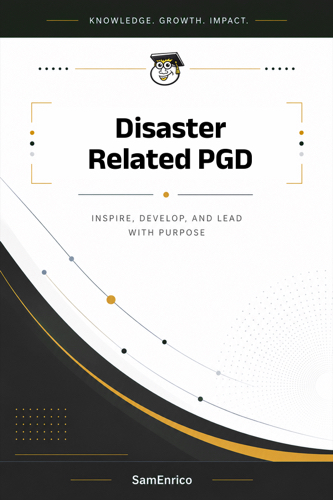
Non-FictionSelf-HelpDisaster Loss
Disaster Related PGD eBook
Prolonged grief from natural disaster death.
Prolonged grief from natural disaster death.
Formats
Free sample
Chapter 1: The Living Nightmare...--–- The tornado did not sound like a train. That is what everyone says—"like a freight train"—but Maria remembers only silence. One second she was lifting her four-year-old son, Leo Jr., into the bathtub, and the next second the pressure changed so violently that her ears popped and her vision blurred at the edges. Then her husband, Leo Sr., was screaming something she could not hear, though she saw his mouth moving. Then the roof peeled away like a tin can opening not with a bang but with a long, groaning tear that she felt in her teeth before she heard it.
Then nothing for three seconds—no sound, no color, just a white stillness that she would later learn was her brain protecting itself. Then Leo's hand, still warm, but no longer holding hers.That was November 8th, 2018, in Paradise, California. The Camp Fire killed eighty-five people, destroyed nearly nineteen thousand structures, and turned a town of twenty-six thousand into a ghost story. Maria survived. Leo Sr.
did not. Their son, Leo Jr., survived only because Maria had covered his body with hers in the bathtub, and when the firestorm passed, she lifted her head to find her husband gone. Not dead in front of her. Just gone. The wind had taken him.
She never found his body.This book is for Maria. And for everyone who has since learned that a disaster does not end when the winds stop or the waters recede. It ends—if it ever ends—one small, brutal, necessary breath at a time.If you are reading this because you lost someone to a flood, a fire, a quake, a landslide, or a storm, I have only one promise to make you: I will not tell you to move on. I will not offer you closure. I will not ask you to find the silver lining.
I will walk with you into the rubble and help you find one thing to hold onto. That is it. That is the whole book. Let us begin.The Difference No One Warned You About There is a specific kind of loneliness that comes with disaster bereavement. It is different from the grief that follows a terminal illness, different from the shock of a sudden heart attack, different even from the devastation of a car accident.
When someone dies of cancer, you have time—cruel, aching, necessary time. You say goodbye. You hold their hand. You whisper the things you need to whisper. The world knows how to gather around a hospital bed.
There are rituals for that kind of dying: flowers, vigils, obituaries, a funeral where everyone wears black and cries in designated seats.Disaster gives you none of that.The death comes without warning, without a goodbye, often without a body. The funeral—if there is one—is a mass grave or an empty casket or a memorial service where three hundred families share one gymnasium and the governor speaks and you cannot cry because the cameras are there. The rituals that have held grieving people for millennia—viewing the body, sitting shiva, holding a wake—are stripped away. You do not get to see them one last time. You do not get to dress them.
You do not get to light a candle beside their still face and say, "I will see you on the other side."What you get instead is a disaster zone. And that disaster zone becomes the cemetery.When Your Entire Town Becomes a Grave This is the first and most disorienting reality of disaster PGD: the external environment becomes a perpetual trigger for internal anguish. Unlike a cemetery, which you can choose to visit or avoid, your hometown becomes a mausoleum you cannot escape.Consider what Maria faced when she returned to Paradise—or what remained of it. The street where she had taught Leo Jr. to ride a bike was gone.
The park where she had married Leo Sr. was ash. The coffee shop where they had their first date was a concrete slab. Every landmark that had held a memory now held only absence. And worse than the absence was the presence of what remained: the charred frame of a neighbor's house, the melted mailbox, the smell of wet ash after the first rain.This is what I call the living nightmare—a state where the world around you becomes an enemy.
The sound of rain on a tin roof, which once meant comfort, now means the anniversary of the fire. The smell of smoke from a backyard barbecue, which once meant summer, now means running inside with your hands over your nose. The sight of a river rising, which once meant spring, now means the flood that took your daughter.Let me be specific about the triggers you may be experiencing, because naming them is the first step to understanding why you are not crazy.Sound triggers: Rain on any surface. Wind that picks up suddenly. Sirens.
The low rumble of thunder. A car backfiring that sounds like an earthquake. The crackle of a campfire. The beep of a weather alert on your phone.Smell triggers: Smoke. Wet earth after rain.
Mold. Mud. Ash. The chemical smell of melted plastic. The sweet-rot smell of standing water.
The particular ozone smell before a lightning strike.Visual triggers: A river that seems higher than usual. A tree swaying in wind. A road that is cracked or flooded. A hillside that looks unstable. The color of the sky before a storm.
A television screen showing disaster footage. A photograph of your town from before.Physical triggers: A drop in barometric pressure that you can feel in your joints. Wind on your skin. The ground shaking—even a truck passing by. Humidity that makes it hard to breathe.Maria told me that for two years after the fire, she could not light a candle.
Not because she was afraid of fire—though she was—but because the smell of a lit wick sent her straight back to the bathtub. Her husband's hand. The silence. Then nothing."If I close my eyes right now," she said, "I can still smell it. Not the fire itself.
The ash after. That wet ash smell that got into my hair and my clothes and my lungs. I used to love the smell of rain. Now rain means the ash turns to mud, and mud means I am back there."The Absence of Anticipatory Grief To understand why disaster PGD is different, you have to understand what you were denied. Psychologists call it anticipatory grief—the grieving that begins before a death occurs.
When someone is dying of a long illness, you start saying goodbye weeks or months in advance. You cry in the car on the way home from the hospital. You argue with God in the shower. You practice what life will look like without them. By the time the death comes, you are still devastated, but you have already done some of the work.Disaster steals anticipatory grief entirely.You did not get to hold their hand and say, "It's okay to go." You did not get to…
This is the end of the free sample. Get the eBook to keep going. Buy now
About this book
Details
- Author
- Gonzalez Randolph
- Publisher
- SamEnrico
- Language
- English
- Genre
- Non-Fiction, Self-Help, Disaster Loss
- Released
- 2026-06-09
- Pages (approx.)
- 140
- Available as
- eBook, Audiobook

Read better in the ZLOADR app
Your eBooks on your phone or tablet. Sign in with your SamEnrico account and start reading.
More by Gonzalez Randolph
 Pandemic Resilience GuideGonzalez Randolph$11.99
 Worry DecatastrophizingGonzalez Randolph$11.99
 Waterfall Cleansing GuideGonzalez Randolph$11.99
 Postpartum Anger GuideGonzalez Randolph$11.99
 Parenting Stress From Child StealingGonzalez Randolph$11.99
 Cave System DisappearancesGonzalez Randolph$11.99
 Transfer Pricing Documentation WorkbookGonzalez Randolph$11.99
 The Sculptors of Ife: Divine Artistry in Bronze and StoneGonzalez Randolph$11.99
 Thor’s Lost Hammer: The Thundergod’s Roman TrialGonzalez Randolph$11.99
 How to Start a Electronics Rental BusinessGonzalez Randolph$11.99
 Mastering The Art of ShippalgiGonzalez Randolph$11.99
 A Collector's Handbook to the Fiat 514aGonzalez Randolph$11.99
You may also like
 Hong Kong Handover 1997Dunn Johnnie$11.99
 Zumba For Postnatal Recovery CourseNeal Christian$11.99
 Zumba for BeginnersLadner Nikia$11.99
 YouTube Comment Mining GuideHumes Pandora$12.99
 Worry Box MeditationCarlin Rudy$11.99
 Workplace Stress MeditationNguyen Lynn$11.99
 Workplace Stress and Sleep RepairHawley Ivory$11.99
 Workplace Perfectionism CureDelaney Jeffry$11.99
 Workplace Injustice Anger GuideWallen Isabelle$11.99
 Work Addiction and Burnout LinkGreenwood Ester$11.99
 Women in Yoga and WellnessBeattie Galina$11.99
 Women in Stand Up ComedyChun Evangeline$11.99