
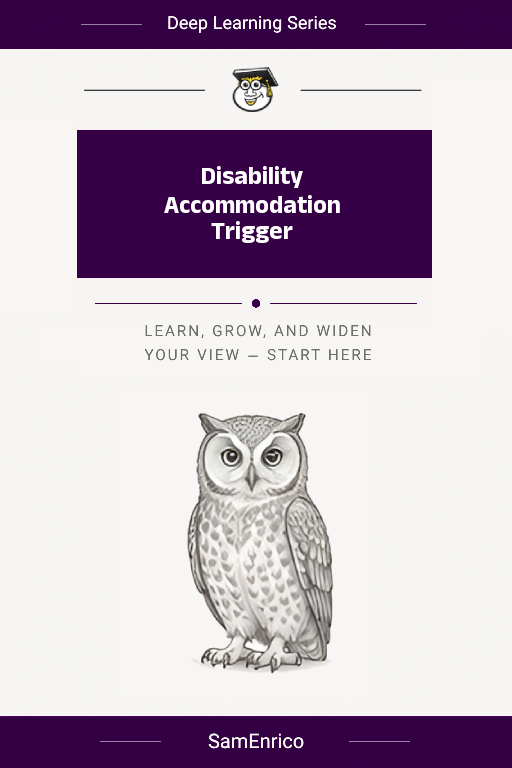
Disability Accommodation Trigger eBook
Engage in interactive process when disability beco
Engage in interactive process when disability becomes known. Reasonable accommodation may include schedule changes equipment or leave for first hires.
Formats
Free sample
Chapter 1: The $1 Million Silence--–- The fluorescent lights hummed in the conference room of a mid-sized logistics company in Ohio. Sarah, a 28-year-old new hire with a degree in supply chain management and three years of experience, sat across from her manager, David. She had been hired 12 days earlier as a logistics coordinator—a role that required her to track shipments, communicate with drivers, and complete detailed written reports. Sarah was brilliant at the first two tasks. The third, written reports, was quietly destroying her.Sarah has dyslexia.
She had never disclosed it during the interview because she had learned, through painful experience, that disclosure before a job offer was a career death sentence. She had developed elaborate coping mechanisms: voice-to-text software at home, double and triple checking every email, avoiding written communication whenever possible. But in her new role, the written reports were non-negotiable. They had to be filed by 2 PM daily, in a specific format, with zero errors.On day 12, Sarah made her third report error in two weeks. David pulled her into the conference room.
"Sarah, your tracking and driver communication are excellent, but these report errors are concerning. You're still in your probationary period. What's going on?"Sarah hesitated. Then she took a breath. "I have dyslexia.
It makes written reports harder for me. Is there a way I could use voice-to-text software or have an extra 30 minutes to review before submitting?"David's face went blank. He had never managed an employee with a disability before. He didn't know what he was allowed to ask, what he was required to do, or whether he could simply say no. So he said nothing for a long, uncomfortable moment.
Then he said, "I'll have to check with HR."He never checked. Over the next 77 days, Sarah continued to struggle with reports. Her errors decreased slightly—she had started using her personal phone to dictate notes—but she still missed the deadline twice. On day 89, one day before her probationary period would have ended, David fired her. The termination notice cited "failure to meet written report standards during probationary period."Sarah filed a charge with the Equal Employment Opportunity Commission.
The EEOC found reasonable cause to believe that the employer had failed to engage in the interactive process, failed to provide a reasonable accommodation (voice-to-text software costs less than 200),andterminatedherbecauseofdisability−relatedperformanceissues.Thecompanysettledfor200), and terminated her because of disability-related performance issues. The company settled for 200),andterminatedherbecauseofdisability−relatedperformanceissues.Thecompanysettledfor450,000 plus legal fees. David was fired. The company's HR director resigned.The 1millionsilence—1 million silence—1millionsilence—450,000 in settlement, 250,000inlegalfees,250,000 in legal fees, 250,000inlegalfees,300,000 in turnover and recruiting costs—all because no one knew how to respond to a six-word sentence: "I have dyslexia. Can you help me?"This chapter dismantles the single most expensive misconception in American employment law: that disability accommodation begins only when an employee uses formal legal language like "ADA" or "reasonable accommodation." It does not.
The trigger is any moment an employer knows—or should have known—about a disability. And that trigger, when mishandled, costs employers billions of dollars annually in litigation, turnover, and lost talent.The Anatomy of the Trigger The term "trigger" in this book is deliberate. In firearms, a trigger is a small mechanism that, when pulled, releases a sequence of events that cannot be undone. In disability accommodation, the trigger is any event or observation that puts an employer on notice that an employee may have a disability that requires accommodation. Once the trigger is pulled—once the employer knows or should have known—the interactive process must begin.
There is no pause button. There is no "let's wait until after the probationary period." There is no "let's see if they improve on their own."The trigger can take many forms. Sometimes it is explicit: "I need an accommodation for my anxiety." Sometimes it is implicit: "I keep missing deadlines because of a medical thing." Sometimes it is observational: a manager sees an employee falling asleep at their desk, struggling to lift boxes, or squinting at a computer screen. Sometimes it is third-party: a coworker reports that an employee is "acting strange" or "always seems exhausted."The common thread is knowledge. Not certainty.
Not a medical diagnosis. Not a signed form. Knowledge. And once knowledge exists, the employer's duty to engage in the interactive process is activated.The Two Doctrines That Change Everything Two legal doctrines, both well-established but widely misunderstood, define the trigger moment.Doctrine #1: The "Magic Words" Myth The most dangerous belief held by managers and HR professionals is that an employee must say specific words—"ADA," "reasonable accommodation," "disability"—to trigger the employer's duty. This is false.
The ADA does not require magic words. It requires knowledge.Consider this statement from an employee: "I've been having panic attacks at work. I can't be in the open office anymore." No mention of "ADA" or "reasonable accommodation." Yet the EEOC and every federal court would treat this as a clear request for accommodation. The magic words myth is a trap that employers set for themselves. By waiting for formal legal language, employers miss the trigger entirely and often terminate employees for performance issues that were actually disability symptoms.Doctrine #2: Constructive Knowledge Even if no employee speaks a single word, an employer can be deemed to "know" about a disability through observation alone.
This is called constructive knowledge. The standard is simple: if a reasonable manager would have recognized that an employee was struggling due to a medical condition, the employer has knowledge.Examples of constructive knowledge from actual court cases include:A warehouse employee who was observed falling asleep while standing up, later diagnosed with narcolepsy. The court held that the employer "should have known" after the third observed episode.A customer service representative who repeatedly asked coworkers to repeat instructions, later diagnosed with auditory processing disorder. The employer "should have known" after two months of observed struggle.A delivery driver who had two minor accidents in six weeks, later diagnosed with a seizure disorder. The employer "should have known" after the first accident when the employee said "I don't know what happened."Constructive knowledge is the most dangerous doctrine for employers because it requires no disclosure at all.
The trigger can be pulled entirely by what managers see, hear, and observe.Obvious vs. Hidden Disabilities: The Visibility Spectrum Not all triggers look the same. The nature of the disability—and how it becomes known—varies dramatically across what this book calls the Visibility Spectrum.Obvious Disabilities (High Visibility)At one end of the spectrum are disabilities that are immediately apparent: a wheelchair user, an employee with a guide dog, a person with a visible mobility device, a missing limb, facial disfigurement. For obvious disabilities, the trigger is instantaneous upon observation. The employer knows—or should know—that the employee has a disability without any disclosure.However, obvious disabilities carry their own trap: assumptions.
Many employers assume that if a disability is visible, they already know what accommodations are needed. This is almost always wrong. A wheelchair user may need a desk height adjustment, but may also need schedule flexibility for medical appointments, or leave for recurring treatments, or software accommodations for…
This is the end of the free sample. Get the eBook to keep going. Buy now
About this book
Details
- Author
- Fernandez Kevin
- Publisher
- SamEnrico
- Language
- English
- Genre
- Non-Fiction, Business Brief, ADA Accommodation
- Released
- 2026-05-30
- Pages (approx.)
- 159
- Available as
- eBook, Audiobook

Read better in the ZLOADR app
Your eBooks on your phone or tablet. Sign in with your SamEnrico account and start reading.
More by Fernandez Kevin
 Breath for Mass ShootingsFernandez Kevin$11.99
 Transcendental Meditation vs MindfulnessFernandez Kevin$11.99
 Productivity Porn Comparison GuideFernandez Kevin$11.99
 Childrens Environmental Toxin GuideFernandez Kevin$11.99
 Bipolar Spectrum GuideFernandez Kevin$11.99
 Bomb Squad Technician StressFernandez Kevin$11.99
 Vaping Aerosol Exposure GuideFernandez Kevin$11.99
 Chemical Peel Wrinkle Reduction WorkbookFernandez Kevin$11.99
 Arthritis Home ModificationsFernandez Kevin$11.99
 The Butcher of Boston: A Mind UnraveledFernandez Kevin$11.99
 The Bone Orchard Rebellion: When Women Turned the Tides of WarFernandez Kevin$11.99
 Golden Arches of Atlantis: The Fast Food Empire That DrownedFernandez Kevin$11.99