
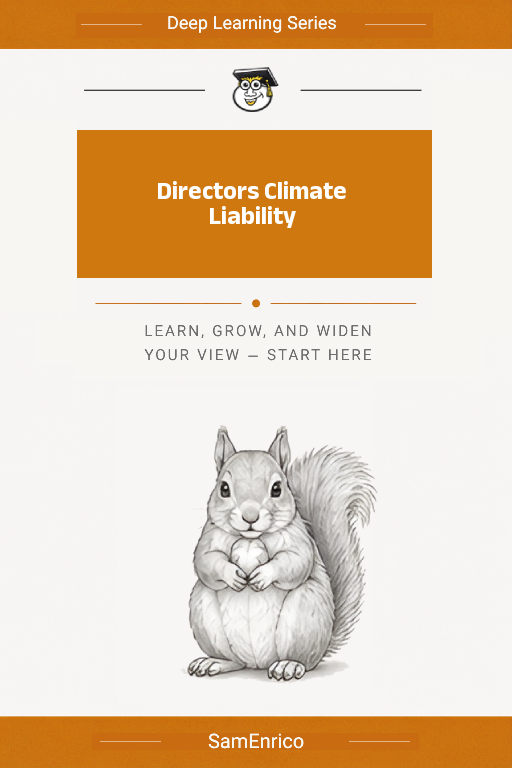
Non-FictionBusiness BriefResilience Planning
Directors Climate Liability eBook
Insure directors against climate-related lawsuits.
by Currie Ray
Insure directors against climate-related lawsuits. Breach of fiduciary duty and disclosure failures.
Formats
Free sample
Chapter 1: The Trap Is Set--–- On a Tuesday morning in March 2024, a board member of a European energy company opened an email that would change the way he thought about his role. It was not a resignation request. It was not a regulatory fine. It was a letter from a shareholder law firm, demanding that the board produce all minutes, climate risk assessments, and emissions data from the previous five years. The letter cited a single legal theory: breach of fiduciary duty for failure to oversee climate risk.
The director had twenty-one days to respond. His D&O insurance broker, when called, admitted they had never seen a claim like this before. The policy’s pollution exclusion, the broker explained, might apply. Or it might not. No one knew.
The director sat in silence for a long moment. He had served on boards for twenty years. He had never once worried about personal liability for a corporate risk. That Tuesday morning, that changed.This is not a hypothetical. It is a composite of real events now unfolding across multiple jurisdictions.
The purpose of this chapter is not to frighten directors into resignation. It is to establish, with absolute clarity, a foundational truth that the rest of this book will build upon: climate change has moved from a voluntary ESG metric to a mandatory fiduciary consideration, and directors who ignore this shift do so at the peril of their personal assets, their reputations, and their insurers’ willingness to pay.The Great Transition: From Nice-to-Have to Must-Have For most of the past two decades, corporate climate action was framed as a matter of corporate social responsibility, public relations, or investor preference. A company could choose to publish a sustainability report or not. It could set a net-zero target or not. It could disclose Scope 3 emissions or not.
These were voluntary acts, rewarded by some investors and ignored by others, but never—until recently—treated as legal requirements.That era is over.The shift began quietly in accounting standards. In 2020, the Sustainability Accounting Standards Board (SASB) merged with the International Integrated Reporting Council to form the Value Reporting Foundation, which was subsequently consolidated into the International Financial Reporting Standards (IFRS) Foundation. The result was the International Sustainability Standards Board (ISSB), which in 2023 issued its first two standards: IFRS S1 (general requirements for disclosure of sustainability-related financial information) and IFRS S2 (climate-related disclosures). These standards explicitly treat climate risk as a material financial risk under existing accounting frameworks.What does that mean in plain English? Under IFRS and GAAP, a risk is "material" if its omission from financial statements would influence the economic decisions of investors.
For decades, climate risk was deemed immaterial by most companies—too distant, too uncertain, too speculative. The ISSB standards, along with parallel rulemaking from the US Securities and Exchange Commission (SEC) and the European Union’s Corporate Sustainability Reporting Directive (CSRD), have effectively reversed that presumption. Today, for most publicly traded companies of any significant size, climate risk is presumptively material. The burden of proof has shifted: a company that excludes climate risk from its financial disclosures must now justify that exclusion, not the other way around.This accounting shift is the quiet foundation upon which everything else rests. Because once a risk is deemed "material" under accounting standards, it becomes a fiduciary obligation.
Directors have a duty to inform themselves about material risks. They have a duty to monitor those risks. They have a duty to disclose them accurately. And they have a duty to act in the long-term best interest of the corporation, which increasingly means taking climate risk seriously.The Three Landmark Cases That Changed Everything Theory is useful. Lawsuits are better.
This section dissects three cases that, together, established the legal precedent that climate risk is a fiduciary issue. Each case comes from a different jurisdiction, each involves a different legal theory, and each offers a different lesson. But together, they form the tripwire that directors now ignore at their peril.Case One: Mc Veigh v. Retail Employees Superannuation Trust (Australia, 2021)Mark Mc Veigh was a twenty-four-year-old university student and a member of Australia’s largest pension fund, Retail Employees Superannuation Trust (REST). He sued REST not for a breach of environmental law, but for a breach of trust law.
His argument was simple: as a trustee, REST had a fiduciary duty to manage his retirement savings in his best interest. Climate change posed a material financial risk to the global economy. Therefore, REST had a duty to consider and manage that risk as part of its investment strategy.The case never went to a full trial. Instead, the parties settled, and as part of the settlement, REST made a series of binding public commitments. It would publish a climate risk assessment.
It would set a net-zero target. It would engage with portfolio companies on climate governance. And most importantly, it conceded—implicitly but unmistakably—that climate risk falls within the scope of fiduciary duties.Why does this matter for directors? Because if a pension trustee has a duty to consider climate risk when investing other people’s money, it follows logically that corporate directors have a duty to consider climate risk when managing shareholders’ money. The same fiduciary principles apply.
The Mc Veigh case established that climate risk is not an optional extra; it is a core consideration for any fiduciary managing long-term assets.Case Two: Client Earth v. Shell (United Kingdom, 2022–2023)While Mc Veigh targeted a pension trustee, Client Earth went directly after corporate directors. Client Earth, an environmental law nonprofit, brought a derivative action against the board of Shell plc. A derivative action is a lawsuit brought by a shareholder on behalf of the corporation, alleging that the directors have breached their duties and that the corporation itself has been harmed. In this case, Client Earth alleged that Shell’s board had breached its duties under UK company law by failing to adopt a climate strategy aligned with the Paris Agreement’s goal of limiting warming to 1.5°C.The case was dismissed on procedural grounds—the court found that Client Earth had not provided sufficient evidence that the board’s strategy was so unreasonable as to constitute a breach.
But the dismissal was narrow. The court did not hold that climate risk is irrelevant to fiduciary duties. To the contrary, the judgment acknowledged that climate risk is a legitimate and serious consideration for boards. The failure was evidentiary, not conceptual.The practical impact of Client Earth v. Shell was immediate and lasting.
Within months of the lawsuit, several other oil majors and large emitters received similar demand letters from shareholders. Board minutes began to include explicit discussions of climate scenarios. Climate risk committees became more common. And the insurance market began to take notice: D&O underwriters started asking specific questions about climate governance on renewal applications.The lesson of Shell is not that climate fiduciary duty cases are easy to win. They are not.
The lesson is that the procedural barriers are eroding, and that the mere threat of a derivative action—with its attendant defense costs, reputational damage, and distraction—is enough to change board behavior. You do not need…
This is the end of the free sample. Get the eBook to keep going. Buy now
About this book
Details
- Author
- Currie Ray
- Publisher
- SamEnrico
- Language
- English
- Genre
- Non-Fiction, Business Brief, Resilience Planning
- Released
- 2026-05-29
- Pages (approx.)
- 156
- Available as
- eBook, Audiobook

Read better in the ZLOADR app
Your eBooks on your phone or tablet. Sign in with your SamEnrico account and start reading.
More by Currie Ray
 Snorkel Technology ImpactCurrie Ray$11.99
 Gratitude Practice For SeniorsCurrie Ray$11.99
 The College Student Gaming GuideCurrie Ray$11.99
 Community Legacy GuideCurrie Ray$11.99
 The Twitter Success Showdown GuideCurrie Ray$11.99
 The Siege of Sarajevo: A City Under FireCurrie Ray$11.99
 Understanding Spherophakia Brachymorphia SyndromeCurrie Ray$17.99
 How to Start a Civil Engineering Construction Business (Beginners Guide)Currie Ray$11.99
 Bonus Depreciation Phase OutCurrie Ray$12.99
 Utility Knife Blade ChangingCurrie Ray$11.99
You may also like
 Hong Kong Handover 1997Dunn Johnnie$11.99
 Zumba For Postnatal Recovery CourseNeal Christian$11.99
 Zumba for BeginnersLadner Nikia$11.99
 YouTube Comment Mining GuideHumes Pandora$12.99
 Worry Box MeditationCarlin Rudy$11.99
 Workplace Stress MeditationNguyen Lynn$11.99
 Workplace Stress and Sleep RepairHawley Ivory$11.99
 Workplace Perfectionism CureDelaney Jeffry$11.99
 Workplace Injustice Anger GuideWallen Isabelle$11.99
 Work Addiction and Burnout LinkGreenwood Ester$11.99
 Women in Yoga and WellnessBeattie Galina$11.99
 Women in Stand Up ComedyChun Evangeline$11.99