
Non-FictionCompliance & Risk ArchiveBrokerage
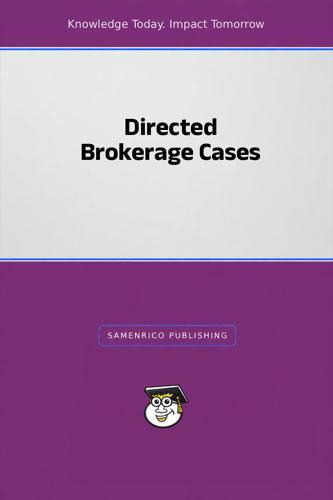
Directed Brokerage Cases eBook
Enforcement against improper commission arrangemen
Enforcement against improper commission arrangements.
Formats
Free sample
Chapter 1: The Broken Handshake...--The envelope arrived on a Friday afternoon, as bad news always does. Inside was a subpoena from the Securities and Exchange Commission, and for the general counsel of a mid-sized investment adviser, the weekend was suddenly ruined. The inquiry was brief but devastating: "Provide all documents relating to brokerage commission allocations from 2015 to the present, including any communications with broker-dealers who also sold shares of your advised funds."The general counsel knew what they were looking for. Every compliance officer, every in-house attorney, and every fund board member who has lived through the past twenty-five years knows the shape of this investigation. It is the ghost that haunts the mutual fund industry—the quiet understanding that brokerage commissions, which belong to fund shareholders, were sometimes used to pay for something else entirely.
Something like distribution. Something like sales. Something like a quiet handshake that redirected millions of dollars of shareholder assets to reward brokers who sold fund shares.This book is about that handshake. About how it became broken. About the regulators who hunted it.
About the executives who went to prison, the firms that paid billions in fines, and the compliance professionals who now spend their lives making sure it never happens again.The Core Legal Problem Stated Simply Before we dive into the history, the schemes, and the enforcement actions, we must understand one fundamental truth that underpins every case in this book: brokerage commissions are fund assets, not adviser property.When a mutual fund buys or sells a security, it pays a brokerage commission. That money belongs to the fund's shareholders. The investment adviser, who makes trading decisions on the fund's behalf, has a fiduciary duty to execute those trades in the best interest of the fund—seeking the best price, the fastest execution, and the most favorable terms reasonably available.What the adviser cannot do is use those commission dollars as a personal checking account. The adviser cannot direct trades to a particular broker because that broker sold a lot of fund shares last quarter. The adviser cannot reward a broker for steering clients into the fund by sending that broker trades.
And the adviser certainly cannot hide these arrangements from the fund's board of directors or from the shareholders who ultimately pay the commissions.This seems obvious today. It was not always obvious.Defining the Terms: Step Outs, Soft Dollars, and Shelf Space To understand how directed brokerage went from an accepted industry practice to a regulatory nightmare, we must first define the technical terms that appear throughout this book and the enforcement actions that follow.A "step out" transaction is the mechanical tool that made directed brokerage possible. Imagine a trade: a mutual fund wants to buy one million shares of Apple stock. The adviser selects Broker A to execute the trade. Broker A charges a commission of $10,000.
But instead of keeping the entire $10,000, Broker A "steps out" of the trade and sends a portion of that commission—say, $4,000—to Broker B. Why would Broker A do this? Because Broker B sold $50 million of the fund's shares last year, and the adviser has agreed to reward Broker B with trade flow. The step out is the mechanism that transfers value from the fund's commission dollars to the broker who sold fund shares."Soft dollars" are a related but distinct concept. Soft dollars refer to commission dollars that are used to purchase research or other services for the fund, rather than being kept by the executing broker as pure profit.
Soft dollars are legal under Section 28(e) of the Securities Exchange Act of 1934, provided the services received are lawful and appropriate for the fund. The problem arises when soft dollars are used to pay for distribution—that is, to reward brokers for selling fund shares. The SEC has long taken the position that distribution is not a permissible use of soft dollars."Shelf space" is the industry slang for what directed brokerage actually bought: the privilege of being featured on a broker-dealer's list of recommended funds, or being included in a sales presentation, or simply not being ignored when brokers decided which funds to push. In the 1990s and early 2000s, shelf space was everything. A mutual fund could have the best performance in its category, but if it was not on the preferred list at Merrill Lynch or Morgan Stanley, it might as well have been invisible.
Directed brokerage was the currency used to buy that shelf space.The Fiduciary Duty: Best Execution Defined At the heart of every directed brokerage enforcement action is the duty of best execution. Because this concept appears in nearly every chapter that follows, we must define it clearly here.Best execution is the fiduciary duty to seek the most favorable terms reasonably available for a client's transaction. The SEC has articulated five factors that advisers must consider: price, speed of execution, likelihood of execution, settlement capabilities, and the overall cost of the transaction. Price is not the only factor—a slightly higher price might be justified by faster execution or greater certainty—but price is the primary factor, and any deviation from best price must be documented and justified.Directed brokerage violates best execution when an adviser chooses a broker based on anything other than these five factors. If the adviser chooses Broker B because Broker B sold fund shares, that is a breach of fiduciary duty.
If the adviser pays a higher commission to Broker B than Broker A would have charged, that is a direct harm to the fund's shareholders. And if the adviser conceals this arrangement from the fund's board, that is fraud.The SEC's 1981 "Green Light" and Its Reversal The history of directed brokerage enforcement is a story of regulators slowly waking up to a problem they had once dismissed.In 1981, the SEC issued a release that many in the industry interpreted as a green light for directed brokerage. The release addressed the use of fund commissions to pay for distribution, and the SEC's language was cautious but permissive: such arrangements were not automatically prohibited, provided they were disclosed to the fund's board and the board approved them. The industry heard what it wanted to hear. Directed brokerage exploded.By the late 1990s, the SEC had changed its tune.
In a series of speeches, enforcement actions, and rulemaking proposals, the agency declared that directed brokerage had "gotten out of hand." What had once been a fringe practice of steering a few trades to reward top-selling brokers had become a systematic program of paying for shelf space. The SEC began to question whether disclosure alone was sufficient. Perhaps, the agency suggested, some payments were simply illegal regardless of disclosure.This shift culminated in the 2004 reforms to FINRA Rule 2830, which explicitly barred arrangements where brokerage was "conditioned upon" sales of fund shares. But by then, the damage was done. The 1990s had seen a massive transfer of wealth from fund shareholders to broker-dealers, all hidden behind the fiction that directed brokerage was just a normal part of doing business.The Complete Fleet Investment Advisors Case Study No case better illustrates the evolution of directed brokerage from accepted practice to enforcement priority than…
This is the end of the free sample. Get the eBook to keep going. Buy now
About this book
Details
- Author
- Irvine Jeannine
- Publisher
- SamEnrico
- Language
- English
- Genre
- Non-Fiction, Compliance & Risk Archive, Brokerage
- Released
- 2026-06-08
- Pages (approx.)
- 128
- Available as
- eBook, Audiobook

Read better in the ZLOADR app
Your eBooks on your phone or tablet. Sign in with your SamEnrico account and start reading.
More by Irvine Jeannine
 The Heat Acclimation TranceIrvine Jeannine$11.99
 Zumba Choreography Variation ManualIrvine Jeannine$11.99
 Anger De escalation TrainingIrvine Jeannine$11.99
 Meditation for Parkinson PainIrvine Jeannine$11.99
 The Last Broadcast: The Night the DJs Saved RadioIrvine Jeannine$11.99
 The Frozen Autopsy: A Doctor’s Race Against Death in AntarcticaIrvine Jeannine$11.99
 Understanding Diplopia, BinocularIrvine Jeannine$17.99
 Barley HarvestingIrvine Jeannine$11.99
 Icelandic Work Permit GuideIrvine Jeannine$12.99
 Document Legalization ArgentinaIrvine Jeannine$12.99
 How to Become a Mold LaminatorIrvine Jeannine$11.99
You may also like
 Hong Kong Handover 1997Dunn Johnnie$11.99
 Zumba For Postnatal Recovery CourseNeal Christian$11.99
 Zumba for BeginnersLadner Nikia$11.99
 YouTube Comment Mining GuideHumes Pandora$12.99
 Worry Box MeditationCarlin Rudy$11.99
 Workplace Stress MeditationNguyen Lynn$11.99
 Workplace Stress and Sleep RepairHawley Ivory$11.99
 Workplace Perfectionism CureDelaney Jeffry$11.99
 Workplace Injustice Anger GuideWallen Isabelle$11.99
 Work Addiction and Burnout LinkGreenwood Ester$11.99
 Women in Yoga and WellnessBeattie Galina$11.99
 Women in Stand Up ComedyChun Evangeline$11.99