
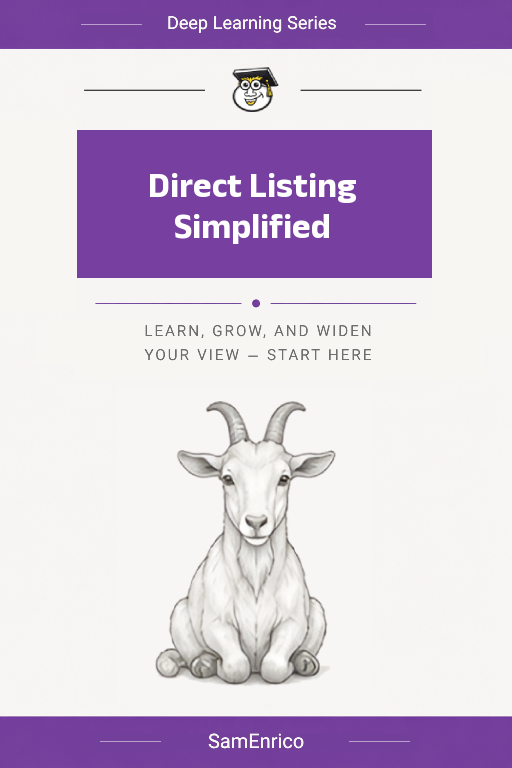
Non-FictionStartup GuideAlternative Public
Direct Listing Simplified eBook
Go public without raising new capital via direct l
by Cook Shane
Go public without raising new capital via direct listing. This brief compares traditional IPOs with this alternative path for well known private companies.
Formats
Free sample
Chapter 1: The Three Doors--Every founder remembers the moment the board asks the question. The conference room is quiet. The slide deck has been clicked to the final page. Someone leans forward and says, “So when do we go public?”If you are reading this book, you have probably heard that question. Or you will hear it soon.
And if you are like most founders, your answer defaults to the only path you have ever heard about: the traditional Initial Public Offering. Call the bankers. File the S-1. Do the roadshow. Ring the bell.
Watch the stock pop. Wait six months for your employees to sell. This is the script. It has been the script for fifty years.But here is the truth that the banks do not want you to know. That script is not the only way.
And for a growing number of well-known private companies, it is not even the best way.Welcome to the three doors. Behind Door Number One is the Traditional IPO. It is the familiar path, the default setting, the option that every investment banker will recommend because it pays them the most money. Behind Door Number Two is the SPAC. It had a brief, noisy moment in the spotlight before collapsing under the weight of its own excess.
Behind Door Number Three is the Direct Listing. It is the quietest option, the least understood, and for the right company, the most powerful.This book exists because Door Number Three deserves your attention.The Map of the Modern Capital Markets Before we can understand why the Direct Listing matters, we need to understand the landscape. As of 2025-2026, a private company seeking to become public has three structural paths. We will cover two in detail. The third we will mention only to set aside.Let me be clear about what this chapter does and does not do.
This chapter gives you the high-level map. It names the doors. It explains the core trade-offs. But it does not give you the full cost analysis, the detailed mechanics, or the decision framework. Those come in later chapters.
Specifically, Chapter 2 dives deep into the IPO dilemma. Chapter 3 defines the Direct Listing in full. Chapter 8 explains the lock-up advantage. Chapter 10 gives you the complete decision matrix with costs. Chapter 12 provides your final checklist.
Think of this chapter as the lobby. You are looking at the doors. You will walk through them one by one in the chapters that follow.Door Number One: The Traditional IPOThe Traditional IPO is the oldest and most familiar path. In a nutshell, a company hires investment banks to underwrite the offering. The banks buy shares from the company at a discounted price and then sell those shares to institutional investors at a slightly higher price.
The difference is their fee, typically five to seven percent of the proceeds. The banks also help set the price through a process called book building, where they solicit indications of interest from large investors.The company raises cash. The banks make money. The stock begins trading on an exchange. Everyone goes home.Except that is not the whole story.
The Traditional IPO has hidden costs that most founders never fully appreciate until it is too late. The first hidden cost is underpricing. Banks deliberately set the IPO price lower than what the market will bear. Why? To ensure a first-day "pop" that makes their institutional clients happy.
Those clients get shares at the IPO price, sell them hours later for a profit, and remember which bank made them rich. The company, meanwhile, leaves millions or even billions of dollars on the table. Airbnb left over a billion. Uber left even more. This is not an accident.
It is a feature of the system.The second hidden cost is the lock-up period. After an IPO, employees and early investors are typically prohibited from selling their shares for one hundred eighty days. Imagine working at a company for eight years, watching the stock rise through private rounds, finally reaching the public markets, and then being told you cannot sell for six months. Meanwhile, the stock could crash. Or it could soar and you miss the peak.
Either way, you are trapped. This is not a technical requirement of going public. It is a demand from the banks, who want to prevent a flood of insider selling from depressing the price.The third hidden cost is dilution. When a company issues new shares in an IPO, every existing shareholder owns a smaller percentage of the company. Founders who have spent a decade building ownership see their stake diluted.
Employees see their option pools diluted. The company gets cash, but everyone else pays a price.These costs are real. They are substantial. And they are baked into the IPO model because the IPO model was designed for one purpose: to help companies raise large amounts of cash quickly, while making banks very wealthy in the process. If your primary goal is raising cash, the IPO works.
But if your primary goal is providing liquidity to existing shareholders, controlling your ownership percentage, and minimizing fees, the IPO is a terrible fit.We will explore the IPO dilemma in brutal detail in Chapter 2, including a full case study of Facebook's 2012 IPO and a stakeholder table showing exactly who loses from the first-day pop.Door Number Two: The SPAC (Set Aside)The Special Purpose Acquisition Company, or SPAC, is a shell company that raises money from investors with the sole purpose of acquiring a private company, thereby taking it public. For a brief period between 2020 and 2022, SPACs were everywhere. Celebrities launched them. Billionaires promoted them. The media called it a revolution.It was not a revolution.
It was a bubble.The vast majority of SPAC mergers have underperformed the market. Many have lost more than half their value. Shareholder lawsuits are common. The founders of SPACs often walk away with tens of millions of dollars regardless of whether the merged company succeeds. The incentives are misaligned.
The structure is flawed. And the long-term track record is terrible.This book will not treat SPACs as a serious alternative to the Traditional IPO or the Direct Listing. They are mentioned here only for completeness, and because you will hear people mention them in boardrooms and on conference panels. When you do, remember the data. SPACs have failed the market test.A brief note on scope: Because SPACs have proven to be a poor long-term bet, they are excluded from the decision matrices and detailed comparisons later in this book.
Chapter 10 compares only IPOs and Direct Listings. The remaining chapters focus exclusively on those two paths. If you are considering a SPAC, this is not the book for you.Door Number Three: The Direct Listing The Direct Listing is the youngest path and the least understood. In a Direct Listing, a company files a registration statement with the SEC, just like an IPO. But instead of issuing new shares, existing shareholders register their existing shares for resale to the public.
The company does not raise cash in a Pure Direct Listing. It simply becomes public. The shares begin trading on an exchange via an opening auction, which…
This is the end of the free sample. Get the eBook to keep going. Buy now
About this book
Details
- Author
- Cook Shane
- Publisher
- SamEnrico
- Language
- English
- Genre
- Non-Fiction, Startup Guide, Alternative Public
- Released
- 2026-05-29
- Pages (approx.)
- 145
- Available as
- eBook, Audiobook

Read better in the ZLOADR app
Your eBooks on your phone or tablet. Sign in with your SamEnrico account and start reading.
More by Cook Shane
 Nicotine Detox Journal PromptsCook Shane$11.99
 Retirement Assets Advisor GuideCook Shane$11.99
 Requesting Time Off GuideCook Shane$11.99
 High Pressure Job Survival KitCook Shane$11.99
 Zinc Magnesium HGH BoostCook Shane$11.99
 Dream to Action MethodCook Shane$11.99
 Emergency Response LociCook Shane$11.99
 Fasting And Growth HormoneCook Shane$11.99
 Cognitive Behavioral Therapy PMSCook Shane$11.99
 The Trolley Problem 2.0: When AI Decides Who Lives and Who DiesCook Shane$11.99
 Charlemagne: The Hammer of the Dark AgesCook Shane$11.99
 The Ballot That Broke the Internet: Florida 2000’s Hanging ChadsCook Shane$11.99
You may also like
 Hong Kong Handover 1997Dunn Johnnie$11.99
 Zumba For Postnatal Recovery CourseNeal Christian$11.99
 Zumba for BeginnersLadner Nikia$11.99
 YouTube Comment Mining GuideHumes Pandora$12.99
 Worry Box MeditationCarlin Rudy$11.99
 Workplace Stress MeditationNguyen Lynn$11.99
 Workplace Stress and Sleep RepairHawley Ivory$11.99
 Workplace Perfectionism CureDelaney Jeffry$11.99
 Workplace Injustice Anger GuideWallen Isabelle$11.99
 Work Addiction and Burnout LinkGreenwood Ester$11.99
 Women in Yoga and WellnessBeattie Galina$11.99
 Women in Stand Up ComedyChun Evangeline$11.99