
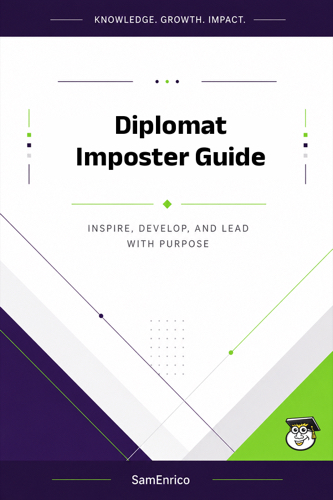
Diplomat Imposter Guide eBook
Helps foreign service officers feel legitimate.
Helps foreign service officers feel legitimate.
Formats
Free sample
Chapter 1: The Mask You Breathe With...--–- The first time it happened, you probably didn’t even notice.You were standing in an embassy hallway, coffee in hand, nodding along as a more senior officer explained a complex political situation you were expected to understand by tomorrow. You smiled. You asked a reasonable question. You looked, by all external measures, exactly like a diplomat.And then you walked back to your office, closed the door, and thought: Any minute now, someone is going to ask for my real ID.Not a driver’s license. Not a passport.
Something deeper. Something that proves you actually belong here, in this building, in this country, at this table where decisions are made that affect the lives of millions. Because somewhere beneath the tailored suit and the practiced nod and the carefully neutral tone of voice, you are absolutely certain that you are faking it.Welcome to the imposter phenomenon. Not low self-esteem. Not depression.
Not burnout—though those can certainly follow. This is the specific, chronic, often secret fear of being exposed as a fraud despite objective evidence of success. And if you are a Foreign Service officer, you are not broken for feeling this way. You are responding normally to an abnormal job.This book is not going to tell you to “just be more confident.” It is not going to offer platitudes about how you deserve your seat at the table. You already know you deserve it—intellectually.
The problem is that knowing and feeling are different systems, and they are currently at war. This chapter will name the enemy, map the terrain, and give you a tool to distinguish between productive humility (which keeps you learning) and paralyzing fraudulence (which keeps you small).The Geography of Fraudulence Let us begin with a story. Not a hypothetical, but a composite drawn from dozens of conversations with officers across cones and continents.A second-tour political officer—let us call her Maya—is assigned to a large embassy in a country experiencing a sudden political crisis. The host government has detained an American citizen on dubious charges. The Ambassador needs a factsheet by morning.
Maya works through the night, pulling from intelligence reports, legal memos, and local press. She writes a four-page cable that is clear, cautious, and actionable. The Ambassador sends it to Washington with minimal edits.Maya’s boss tells her: “Good work.”That night, Maya lies awake replaying a single sentence in the fourth paragraph. She used “allegedly” twice in one sentence. She is certain that someone in Washington read that and thought: Who wrote this?
She is certain that her career is over, that she will be found out, that the only reason she passed the Oral Assessment was because the panel was tired and she happened to smile at the right moment.She negotiated a citizen’s release. She wrote a cable that went to the Secretary’s inbox. And all she can see is a grammatical tic.This is the imposter phenomenon in its pure form: a profound disconnect between external reality and internal experience. Maya is objectively successful. She feels subjectively fraudulent.
And the gap between those two truths is where the suffering lives.Why Diplomacy Is a Breeding Ground Most imposter syndrome literature focuses on corporate CEOs or academics. Those are useful frameworks, but they miss something essential about the Foreign Service. A CEO has quarterly earnings. A professor has publications and peer review. An engineer has a bridge that does not fall down.
These are visible, measurable, verifiable proofs of competence.What does a diplomat have?A war you prevented looks like nothing happened. A hostage you freed is classified. A trade deal you negotiated took three years of incremental conversations that no one will ever read about. A relationship you built with a hostile minister might pay off after you have already left post. Your successes are invisible.
Your failures—if they happen—are spectacularly public.This is not a complaint about the State Department. It is a structural feature of the work. Diplomacy is the art of preventing bad things from happening, and prevention is, by definition, the absence of evidence. There is no trophy for the crisis that did not occur. There is no plaque for the visa that you correctly denied because the applicant had terrorist ties but presented a perfect story.
There is no medal for the cable you wrote that shifted policy but was never attributed to you.Add to this the fluid, unstructured nature of diplomatic work. Unlike a factory line or a law firm with billable hours, your days are unpredictable. You might spend a morning writing a demarche, an afternoon at a host-nation ministry arguing about a trade dispute, and an evening at a reception where you must remember the names of fifty people while eating canapés and smiling. There is no script. There is no rubric.
There is only your judgment, and the terrifying awareness that judgment is all you have.Embassies during a coup. Consular sections processing five hundred visas a day. A last-minute rewrite of UN speech after the host country changes its position overnight. These are not exceptions. They are the job.
And they are environments where imposter syndrome thrives because there is no time to reflect, no feedback loop to reassure you, and no external metric to tell you that you are doing it right.The “As-If” Personality: A Neutral Tool Clinical psychology has a term for the capacity to act in a role before you feel fully qualified for it: the “as-if” personality. First described in the psychoanalytic literature, it refers to individuals who can perform social roles with apparent confidence while internally feeling disconnected, inauthentic, or fraudulent.Here is what matters: The “as-if” personality is not a disorder. It is a neutral tool.Every diplomat uses it. Every single one. You walked into your first embassy and acted “as if” you belonged there.
You sat across from a foreign minister and acted “as if” you had the full weight of the United States behind you. You wrote a cable in language that was not your own—bureaucratic, careful, loaded with acronyms—and acted “as if” you had been doing it for years.The “as-if” tool is what allows you to function in a role that no training can fully prepare you for. There is no school for handling a coup. There is no simulator for the moment a host-country official asks you a question you are not authorized to answer. You learn by doing, and while you are doing, you are acting “as if” you know what you are doing.The problem is not the tool.
The problem is what happens when the tool runs unconsciously.When you act “as if” without awareness, without intention, without a way to turn it off, the gap between your performance and your internal state widens. You start to feel like a fraud because you are performing a version of yourself that you do not recognize as authentic. The mask that was supposed to protect you becomes a prison. You cannot take it off because you are not sure there is…
This is the end of the free sample. Get the eBook to keep going. Buy now
About this book
Details
- Author
- Knapp Millicent
- Publisher
- SamEnrico
- Language
- English
- Genre
- Non-Fiction, Self-Help, Diplomacy
- Released
- 2026-06-07
- Pages (approx.)
- 128
- Available as
- eBook, Audiobook

Read better in the ZLOADR app
Your eBooks on your phone or tablet. Sign in with your SamEnrico account and start reading.
More by Knapp Millicent
 Housing Market ComparisonKnapp Millicent$11.99
 Luxury Morning BlueprintKnapp Millicent$11.99
 Amazon Listing Optimization GuideKnapp Millicent$12.99
 Home HIIT Quick WorkoutsKnapp Millicent$11.99
 Weekend Off Recovery GuideKnapp Millicent$11.99
 The CAB Approach GuideKnapp Millicent$11.99
 Burn Aloe Vera UseKnapp Millicent$11.99
 Influence For Financial AdvisorsKnapp Millicent$11.99
 The Siege of Antioch: Blood and Betrayal in the Holy LandKnapp Millicent$11.99
 The Celestial Architects of Nubia: The Star-Mapping Kings of KushKnapp Millicent$11.99
 How to Produce SaunasKnapp Millicent$11.99Amazon Listing Optimization GuideKnapp Millicent$12.99
You may also like
 Hong Kong Handover 1997Dunn Johnnie$11.99
 Zumba For Postnatal Recovery CourseNeal Christian$11.99
 Zumba for BeginnersLadner Nikia$11.99
 YouTube Comment Mining GuideHumes Pandora$12.99
 Worry Box MeditationCarlin Rudy$11.99
 Workplace Stress MeditationNguyen Lynn$11.99
 Workplace Stress and Sleep RepairHawley Ivory$11.99
 Workplace Perfectionism CureDelaney Jeffry$11.99
 Workplace Injustice Anger GuideWallen Isabelle$11.99
 Work Addiction and Burnout LinkGreenwood Ester$11.99
 Women in Yoga and WellnessBeattie Galina$11.99
 Women in Stand Up ComedyChun Evangeline$11.99