
Non-FictionHealth & WellnessOutbreak Control
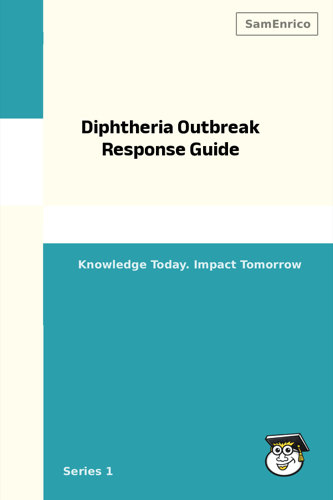
Diphtheria Outbreak Response Guide eBook
Mass immunization during respiratory diphtheria cl
Mass immunization during respiratory diphtheria clusters.
Formats
Free sample
Chapter 1: The Forgotten Fire...--–- In the winter of 2017, in the overcrowded Rohingya refugee camps of Cox’s Bazar, Bangladesh, a young child began to cough. Not the dry, barking cough of croup, nor the paroxysmal whoop of pertussis, but something older—a low, muffled sound, as if something were physically filling the child’s throat. Within forty-eight hours, a grayish-white membrane had spread across both tonsils and into the nasopharynx. A local health worker, trained only in measles and cholera, stared at the child’s neck, which had begun to swell like a bullfrog’s throat. “I have never seen this,” she whispered.
But the bacteria had seen her. Corynebacterium diphtheriae had returned to a place where immunity had faded, where the cold chain had fractured, and where the collective memory of the disease had been erased by war and displacement. By the time the outbreak ended, dozens were dead—not because the treatment was unknown, but because the response came too late, the antitoxin stockpile was two weeks away, and no one had recognized the forgotten fire.This is the central tragedy of diphtheria in the twenty-first century. The disease is not a mystery. The vaccine is not experimental.
The antitoxin is not a speculative therapy. And yet, every few years, somewhere in the world—in the former Soviet Union in the 1990s, in Nigeria in 2023, in Indonesia in 2024—diphtheria explodes into a cluster of preventable deaths, shocking health systems that thought they had moved on. The problem is not a lack of knowledge. The problem is a failure of memory, of preparation, and of the specific, relentless application of mass immunization in the narrow window when it can still stop transmission. This book exists to close that gap.
And it begins, as all outbreak responses must, by understanding exactly what we are fighting and why it keeps coming back.The Misguided Comfort of Historical Distance Ask most physicians under the age of forty what they know about diphtheria, and they will likely recall a single fact from medical school: it causes a pseudomembrane. Ask them to describe the progression from mild pharyngitis to fatal airway obstruction, or the way the toxin silently binds to cardiac myocytes and causes myocarditis weeks after the patient seemed to recover, and the answer becomes vague. Diphtheria has become a textbook disease, a board exam question, a curiosity of the pre-antibiotic era. This is a dangerous luxury.The last major resurgence in the developed world occurred in the former Soviet Union between 1990 and 1998, when more than 157,000 cases and 5,000 deaths were reported. The cause was not a new strain or a vaccine failure.
It was the collapse of public health infrastructure, the waning of immunity in adults who had not received boosters since childhood, and the movement of susceptible populations across newly porous borders. Since then, diphtheria has continued to smolder in low-resource settings, with large outbreaks in India, Venezuela, Yemen, Haiti, and multiple African nations. In 2023, Nigeria reported over 20,000 suspected cases and more than 800 confirmed deaths. In 2024, Indonesia grappled with a cluster in East Java that overwhelmed pediatric intensive care units. These are not isolated events.
They are predictable, cyclical reminders that diphtheria is not extinct—it is merely waiting for immunity to drop.The critical lesson is that diphtheria behaves differently from vaccine-preventable diseases like measles or polio. Measles, with its extremely high basic reproduction number (R₀ of 12–18), spreads so efficiently that it finds every susceptible individual within a community within weeks. Diphtheria is stealthier. Its R₀ is lower—typically 6 to 7—but its clinical presentation is variable. A substantial proportion of infections are asymptomatic or produce only mild pharyngitis, indistinguishable from viral sore throats.
This means that diphtheria can circulate silently for months before a single classic case with a visible pseudomembrane arrives at a hospital. By then, the fire has already spread beneath the floorboards.The Specific Conditions That Allow Diphtheria to Resurge For a diphtheria outbreak to ignite, three conditions must align. Understanding these conditions is not academic; it is the foundation of every decision about surveillance, stockpiling, and response speed.Condition One: A Pool of Susceptible Individuals Exceeds the Herd Immunity Threshold Diphtheria herd immunity requires 90 to 95 percent of a population to have protective antitoxin levels (≥0.1 IU/m L). Below this threshold, the bacteria can establish chains of transmission that grow exponentially. The susceptible pool is not static.
It expands through three mechanisms: waning immunity (vaccine-induced protection declines after 10 to 20 years), gaps in routine childhood immunization (zero-dose children who never received the primary series), and population displacement (migrants, refugees, and internally displaced persons who may have been vaccinated in one system but are not tracked in another).The age shift is critical to understand. In high-income countries with robust childhood vaccination, diphtheria now primarily affects adults over 40 whose last booster was in adolescence. In low-income settings with intermittent vaccine supply, outbreaks often affect both unvaccinated children and adults who received a single dose but never completed the series. In humanitarian emergencies, the susceptible pool becomes an age-transgressive mix: children whose campaigns were interrupted, adolescents whose boosters were missed during displacement, and older adults from regions with historically low coverage. Any outbreak response that assumes a single target age group will fail.Condition Two: Disruption to Routine Vaccination Services Diphtheria does not require a complete collapse of health services to resurge.
It only requires a sustained gap—six months or more—in the administration of diphtheria-toxoid-containing vaccines. This gap can occur during armed conflict (when vaccination teams cannot reach contested zones), during pandemics (when health workers are redeployed to COVID-19 or Ebola response), or during vaccine shortages (when global supply chains fail). The 2023 Nigerian outbreak, for example, was amplified by a two-year interruption of routine immunization in several northern states following a healthcare worker strike and a subsequent measles outbreak that consumed all available cold chain capacity.The danger of disruption is that it creates a hidden cohort of susceptibles. A child who misses her third dose of DTP at 9 months of age is not obviously different from a fully vaccinated child—until she is exposed at age four or five, when she has already entered school and become an amplifier for transmission. Disruption also affects the vaccine's effectiveness indirectly: when the cold chain breaks during a disruption, vaccines that have been exposed to freezing or excessive heat may be administered without anyone knowing they are impotent.
This leads to a particularly insidious scenario—high reported coverage but low effective immunity—which confounds outbreak investigations and delays appropriate response.Condition Three: A Transmission-Amplifying Environment Even with a susceptible population and disrupted services, diphtheria requires close, prolonged contact to spread efficiently. The bacteria are transmitted via respiratory droplets and direct contact with respiratory secretions or contaminated surfaces. Fomites (shared utensils, drinking cups, clothing) can transmit, but airborne transmission over distances is rare. This means that diphtheria clusters occur in environments where people share air and objects in confined spaces: households with multiple generations living under one roof, schools with overcrowded classrooms, prisons, military barracks, homeless shelters, and healthcare facilities where respiratory isolation is inadequate.The amplification environment explains why diphtheria outbreaks often appear to "skip" entire villages and then explode in a single…
This is the end of the free sample. Get the eBook to keep going. Buy now
About this book
Details
- Author
- Salcedo Jacqui
- Publisher
- SamEnrico
- Language
- English
- Genre
- Non-Fiction, Health & Wellness, Outbreak Control
- Released
- 2026-06-07
- Pages (approx.)
- 144
- Available as
- eBook, Audiobook

Read better in the ZLOADR app
Your eBooks on your phone or tablet. Sign in with your SamEnrico account and start reading.
More by Salcedo Jacqui
 Self Hypnosis for Fear of PainSalcedo Jacqui$11.99
 TM for Fibromyalgia GuideSalcedo Jacqui$11.99
 Burke's 911 WhisperSalcedo Jacqui$11.99
 Personal Branding Visual IdentitySalcedo Jacqui$11.99
 Family Portrait TornSalcedo Jacqui$11.99
 Emotional Eating and ADHDSalcedo Jacqui$11.99
 Vision Protection NutrientsSalcedo Jacqui$11.99
 The Language Kings of Mali: The Multilingual Scholars of TimbuktuSalcedo Jacqui$11.99
 How to Setup and Launch a Corporate EventSalcedo Jacqui$11.99
 A Collector's Handbook to the Berkeley Sports Sa322Salcedo Jacqui$11.99
 Spending Guilt Origins WorkbookSalcedo Jacqui$12.99
 Referral Programs for English TutorsSalcedo Jacqui$12.99
You may also like
 Hong Kong Handover 1997Dunn Johnnie$11.99
 Zumba For Postnatal Recovery CourseNeal Christian$11.99
 Zumba for BeginnersLadner Nikia$11.99
 YouTube Comment Mining GuideHumes Pandora$12.99
 Worry Box MeditationCarlin Rudy$11.99
 Workplace Stress MeditationNguyen Lynn$11.99
 Workplace Stress and Sleep RepairHawley Ivory$11.99
 Workplace Perfectionism CureDelaney Jeffry$11.99
 Workplace Injustice Anger GuideWallen Isabelle$11.99
 Work Addiction and Burnout LinkGreenwood Ester$11.99
 Women in Yoga and WellnessBeattie Galina$11.99
 Women in Stand Up ComedyChun Evangeline$11.99