
Non-FictionHealth & WellnessPersistent Pollutants
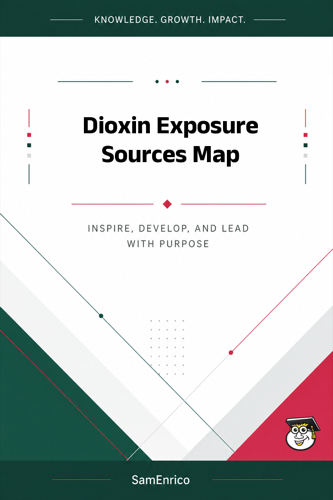
Dioxin Exposure Sources Map eBook
Traces dioxins from waste burning, bleached paper,
Traces dioxins from waste burning, bleached paper, and animal fats to body burden reduction.
Formats
Free sample
Chapter 1: The Poison Invisible--The first thing you need to understand about dioxin is that you cannot see it, smell it, taste it, or feel it. It does not burn your skin on contact. It does not make the water turn yellow. It does not announce itself with a sulfurous stench or a warning label. This is precisely why it has been called the most toxic man-made chemical on Earth—not because it kills quickly, but because it kills slowly, quietly, and inside nearly every living creature on the planet, while no one is looking.In the spring of 1976, the people of Seveso, Italy, learned this lesson in the most horrifying way imaginable.
They did not learn it from a cloud they could see. They learned it from the animals.The Chemical Cloud That Nobody Saw Coming On Saturday, July 10, 1976, a reactor at the Icmesa chemical plant, located in the small town of Meda just north of Milan, overheated. The plant produced trichlorophenol, an intermediate chemical used in herbicides and antiseptics. The reaction that day went out of control. A safety valve burst.
A white cloud—later identified as a mixture of sodium hydroxide, ethylene glycol, and 2,3,7,8-tetrachlorodibenzo-p-dioxin, the most toxic congener of the dioxin family—rose into the air and drifted southeast.The cloud was invisible within minutes. Workers at the plant felt no immediate effects. Residents in nearby towns saw nothing unusual. The plant operators did not sound any alarms because they did not fully understand what had happened. For the next several days, life continued normally in Seveso, Meda, Cesano Maderno, and Desio.
Children played outside. Families ate meals in their gardens. No one knew that a poison had settled onto their soil, their crops, their homes, and their children's skin like a ghost.Then the rabbits began to die.Within two weeks, thousands of small animals—rabbits, chickens, and wild birds—lay dead across the contaminated zone. The deaths were not subtle. The animals did not simply stop eating and waste away.
They developed large, weeping sores on their faces and bodies. Their skin erupted in cysts and blackheads so severe that their own features became unrecognizable. Veterinarians called it chloracne, a rare skin condition they had only seen in textbooks about industrial chemical exposures. But they had never seen it on this scale.By August, the first human cases appeared. Children who had played in gardens downwind of the plant developed the same disfiguring skin lesions.
Parents who had worked in their vegetable plots found their faces covered in painful, pus-filled cysts that would not respond to any treatment. The condition did not look like typical teenage acne. It looked like something from a medical horror film: dense clusters of blackheads and yellow cysts, often arranged in symmetrical patterns on the cheeks, behind the ears, and across the chest and back. Some victims developed these lesions on their genitals and buttocks.The Italian government eventually evacuated over 3,000 people from the most heavily contaminated areas. They cordoned off Zone A, a 108-hectare area where soil concentrations of TCDD reached as high as 54,000 parts per trillion.
For context, the standard background level in uncontaminated soil is less than one part per trillion. The people of Seveso were living on ground that was fifty thousand times more contaminated than the natural baseline.But the evacuation came too late for many. The cloud had settled. The poison had already entered bodies, gardens, and the food chain. And the people of Seveso would spend the next four decades learning that the half-life of dioxin in the human body is not measured in months or even years.
It is measured in decades.Love Canal: When Community Becomes Contamination On the other side of the Atlantic Ocean, a similar tragedy was unfolding in a working-class neighborhood in Niagara Falls, New York. Unlike Seveso, Love Canal was not a sudden accident. It was a slow-burning disaster that took thirty years to fully ignite.Between 1942 and 1953, the Hooker Chemical Company used the abandoned Love Canal—a failed industrial waterway—as a dumping ground for approximately 21,000 tons of chemical waste, much of it containing dioxin and other chlorinated hydrocarbons. The waste was buried in steel drums covered with clay and soil. When Hooker sold the land to the Niagara Falls Board of Education in 1953 for the sum of one dollar, the deed included a warning about the buried chemicals and a disclaimer of liability.
The warning was largely ignored.The board built an elementary school directly on the site. Developers built hundreds of homes surrounding it. Families moved in, planted gardens, and raised children. And for twenty-five years, they had no idea that their backyards, basements, and playgrounds sat above a subterranean lake of poison.The first signs of trouble appeared in the 1970s. Residents reported strange odors in their basements.
Trees and gardens failed to thrive. Black, oily liquid seeped through sump pumps and into creeks. Children played in puddles of contaminated water. The incidence of birth defects, miscarriages, and rare cancers among Love Canal residents began to climb far above statistical norms.A housewife named Lois Gibbs, whose son attended the elementary school, began knocking on doors and taking notes. She collected health histories from neighbors.
She mapped every case of cancer, every miscarriage, every birth defect. When she presented her findings to government officials, they dismissed her as an emotional housewife. But her map told a story that could not be ignored: the clusters of illness were not random. They were centered precisely on the old Hooker Chemical dump site.The Gibbs map—later known as the Love Canal Homeowners Association map—became the template for environmental epidemiology. It showed, in stark visual terms, that the poison buried beneath the community had risen to the surface and entered the bodies of the people living above it.
In 1978, New York State declared a health emergency. President Jimmy Carter declared a federal emergency in 1980. Ultimately, over 800 families were permanently relocated from Love Canal.But the lesson was the same as Seveso: by the time the poison announces itself, it is already inside you.What Is Dioxin, Anyway?If you take nothing else from this book, understand this one fact: dioxin is not a single chemical. It is a family of chemically related compounds—seventy-five of them, by the strictest definition, or 210 if you count the larger family that includes furans and PCBs. Environmental scientists refer to them collectively as "dioxins and dioxin-like compounds." For the purposes of this book, we will call them by their common name: dioxin.The family tree works like this.
At the center of every dioxin molecule is a pair of benzene rings connected by two oxygen bridges—a structure called a dibenzo-p-dioxin. The toxicity comes from what attaches to the rings: chlorine atoms. Depending on where and how many chlorine atoms attach to the carbon atoms on the rings, you get different congeners, or chemical cousins. The most toxic, the one that caused the Seveso disaster, is called 2,3,7,8-tetrachlorodibenzo-p-dioxin. For convenience, scientists call it TCDD.
You can call it the worst of the bunch.The pattern matters. When chlorine atoms attach at the 2,3,7, and 8 positions—think of them as the…
This is the end of the free sample. Get the eBook to keep going. Buy now
About this book
Details
- Author
- Abbott Willard
- Publisher
- SamEnrico
- Language
- English
- Genre
- Non-Fiction, Health & Wellness, Persistent Pollutants
- Released
- 2026-06-10
- Pages (approx.)
- 136
- Available as
- eBook, Audiobook

Read better in the ZLOADR app
Your eBooks on your phone or tablet. Sign in with your SamEnrico account and start reading.
More by Abbott Willard
 Antwerp Heist Untold Phone CallsAbbott Willard$11.99
 Escobar Plane Crash CashAbbott Willard$11.99
 Grade Anxiety Toolkit HandbookAbbott Willard$11.99
 Stress and Night Sweats GuideAbbott Willard$11.99
 The Great Bitcoin Heist: How a Rogue Developer Stole $500 MillionAbbott Willard$11.99
 Lost in the Azure: The Enigma of the Bermuda Triangle’s Forgotten HavenAbbott Willard$11.99
 Understanding Ferlini–ragno–calzolari SyndromeAbbott Willard$17.99
 Strategy Meeting Formulas for Strategic Planning OffsitesAbbott Willard$12.99
 Remote Feedback Conflict GuideAbbott Willard$12.99
 Ultimate Handbook Guide to Samara : (Russia) Travel GuideAbbott Willard$11.99
 Servicenow Technical ConsultantAbbott Willard$11.99
You may also like
 Hong Kong Handover 1997Dunn Johnnie$11.99
 Zumba For Postnatal Recovery CourseNeal Christian$11.99
 Zumba for BeginnersLadner Nikia$11.99
 YouTube Comment Mining GuideHumes Pandora$12.99
 Worry Box MeditationCarlin Rudy$11.99
 Workplace Stress MeditationNguyen Lynn$11.99
 Workplace Stress and Sleep RepairHawley Ivory$11.99
 Workplace Perfectionism CureDelaney Jeffry$11.99
 Workplace Injustice Anger GuideWallen Isabelle$11.99
 Work Addiction and Burnout LinkGreenwood Ester$11.99
 Women in Yoga and WellnessBeattie Galina$11.99
 Women in Stand Up ComedyChun Evangeline$11.99