
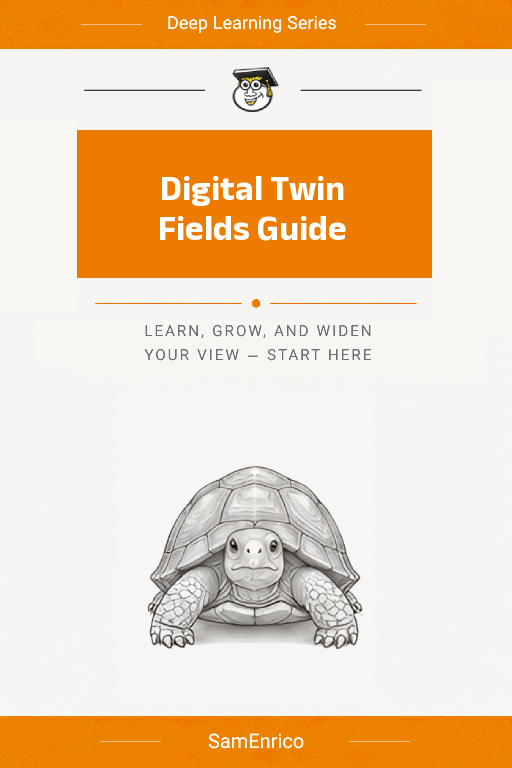
Non-FictionForecast & OutlookDigital Twin
Digital Twin Fields Guide eBook
Discover virtual replicas of farms for simulating
Discover virtual replicas of farms for simulating scenarios, optimizing inputs, and predicting outcomes.
Formats
Free sample
Chapter 1: The Digital Seed...--–- Maria Valdez leaned against the tailgate of her pickup truck, scanning the tomato field that had been in her family for three generations. The afternoon sun baked the California Central Valley, and the irrigation system clicked rhythmically behind her. She had just returned from her neighbor's farm, where Carlos showed her something on his tablet that kept her awake the night before. A map of his field—not the static Google Earth kind, but a living, breathing replica that told him exactly which plants needed water, which were stressed, and which would likely develop blight in the next five days. Carlos had reduced his water bill by nearly thirty percent last season without losing a single pound of yield.
Maria didn't own a tablet. She didn't trust "farm tech" after the GPS steering disaster of 2019. But her well was running drier each summer, and her input costs kept climbing. For the first time in twenty-two years, she wondered if her father's methods—the ones that had always worked—were finally failing her.This book is for Maria. It is also for you, whether you farm ten acres or ten thousand, whether you grow corn in Iowa, olives in Spain, or lettuce in a vertical warehouse in Chicago.
This is a guide to building a digital twin of your farm—a virtual replica that learns from your land, predicts your future, and helps you make better decisions before you spend a dollar or waste a drop of water.But before we build anything, we need to be brutally honest about what a digital twin is not. It is not a map. It is not a spreadsheet. It is not a drone photo or a weather app or a fancy dashboard that looks impressive but offers no actionable advice. Too many farmers have been burned by "solutions" that promised the moon and delivered a confusing interface and a monthly subscription fee.
This book will not do that to you. Instead, we will start with a clear definition, then walk through exactly how to build a twin at the level that matches your farm, your budget, and your comfort with technology.The Anatomy of a Digital Twin Let us begin with a definition so clear that you can explain it to your teenager, your banker, or your skeptical parent over dinner. A digital twin is a virtual representation of your physical farm that is connected to the real world through a continuous flow of data. That data flows in two directions.Direction one: from the farm to the twin. Sensors in your soil measure moisture and temperature.
Drones capture images that reveal plant stress invisible to the human eye. Weather stations log wind, humidity, and solar radiation. This information flows into your digital twin, updating it constantly so that the virtual farm mirrors the real one.Direction two: from the twin to the farm. This is the critical piece that separates a digital twin from a simple monitoring system. After analyzing the incoming data, your twin can send commands back to the physical farm.
It can open an irrigation valve precisely when and where water is needed. It can adjust a greenhouse vent to maintain optimal temperature. It can tell a variable-rate spreader to apply more fertilizer in one section of a field and less in another. The twin does not just watch—it acts.This bi-directional flow creates a closed loop: sense, analyze, act, learn, repeat. Every action generates new data, which improves the twin, which leads to better actions.
Over time, the twin becomes more accurate, more predictive, and more valuable.Consider the difference between a weather forecast and a thermostat. A weather forecast tells you it will be hot tomorrow. That is information. A thermostat measures the current temperature, compares it to your desired temperature, and turns on the air conditioner automatically. That is a closed-loop system.
A digital twin is the agricultural equivalent of a thermostat—but applied to hundreds of variables simultaneously: soil moisture, pest pressure, nutrient availability, plant growth rates, equipment health, and market prices.What a Digital Twin Is Not Before we go further, let us clear away the confusion that technology vendors often exploit. A farm map, no matter how detailed or how beautiful, is not a digital twin. A map is static. It shows you what the land looked like last week when the drone flew or last year when the satellite passed overhead. A digital twin is dynamic.
It changes as your farm changes.A data dashboard is not a digital twin. Dashboards display historical information: rainfall totals, average temperatures, yield per acre. These are useful for reflection but useless for prediction. A dashboard tells you what happened. A digital twin tells you what will happen if you take a specific action tomorrow.A 3D model of your farm, even one you can walk through in virtual reality, is not a digital twin unless it is connected to live data.
A pretty visualization without real-time sensor inputs is just a video game. It might be useful for training or planning, but it cannot predict, optimize, or control.Finally, a spreadsheet is not a digital twin, although a very simple spreadsheet can serve as the foundation for a Level 1 twin (we will explain the three levels in Chapter 2). A spreadsheet becomes a twin only when it is automatically updated by sensors and when its calculations lead to actions on the farm.The distinction matters because vendors have discovered that "digital twin" sounds impressive. They slap the label on products that are merely maps with nicer colors. You deserve better.
You deserve a tool that actually helps you farm smarter, not a marketing buzzword that empties your wallet.From Industry 4.0 to Agriculture 5.0The concept of digital twins originated in manufacturing. Companies like General Electric and Siemens built virtual replicas of jet engines, factory assembly lines, and wind turbines. These industrial twins are extraordinarily precise because factories are controlled environments. The laws of physics are consistent. The materials are uniform.
The variables are limited.Your farm is not a factory.Farms are open systems. Weather is unpredictable. Soil varies from one meter to the next. Pests evolve. Plants grow differently based on thousands of interacting factors.
A factory twin can achieve 99.9% accuracy because a bolt is always a bolt. An agricultural twin that achieves 90% accuracy is considered excellent because biology is messy.This difference is why we cannot simply copy-paste industrial solutions onto farms. The engineers who build factory twins often fail when they enter agriculture because they underestimate variability and overestimate the availability of clean data. They assume that every field has high-speed internet, that every farmer owns a drone, that every plant behaves identically. These assumptions are wrong.Agriculture 5.0 is the emerging discipline that adapts Industry 4.0 tools to the specific challenges of farming.
It acknowledges uncertainty. It works with intermittent connectivity. It tolerates imperfect data. It respects that the person making decisions is a farmer who needs to sleep at night, not a data scientist who can debug code at 2 AM.The good news is that the tools have finally caught up to the vision. Ten years ago…
This is the end of the free sample. Get the eBook to keep going. Buy now
About this book
Details
- Author
- Borden Suzann
- Publisher
- SamEnrico
- Language
- English
- Genre
- Non-Fiction, Forecast & Outlook, Digital Twin
- Released
- 2026-06-01
- Pages (approx.)
- 160
- Available as
- eBook, Audiobook

Read better in the ZLOADR app
Your eBooks on your phone or tablet. Sign in with your SamEnrico account and start reading.
More by Borden Suzann
 Parenting Partner Self EsteemBorden Suzann$11.99
 Neural Frames Animation GuideBorden Suzann$11.99
 Facebook Dating ComparisonBorden Suzann$11.99
 OKRs for Parenthood TransitionBorden Suzann$11.99
 Women Alcohol and the Pressure to DrinkBorden Suzann$11.99
 The Frozen Frontier: Nansen’s Arctic OdysseyBorden Suzann$11.99
 StatisticianBorden Suzann$11.99
 How to Start a Briquette Solid Fuel Production Business (Beginners Guide)Borden Suzann$11.99
 Indoor Air Quality Standard PrimerBorden Suzann$12.99
 Understanding Ilyina–amoashy–grygory SyndromeBorden Suzann$17.99
You may also like
 Hong Kong Handover 1997Dunn Johnnie$11.99
 Zumba For Postnatal Recovery CourseNeal Christian$11.99
 Zumba for BeginnersLadner Nikia$11.99
 YouTube Comment Mining GuideHumes Pandora$12.99
 Worry Box MeditationCarlin Rudy$11.99
 Workplace Stress MeditationNguyen Lynn$11.99
 Workplace Stress and Sleep RepairHawley Ivory$11.99
 Workplace Perfectionism CureDelaney Jeffry$11.99
 Workplace Injustice Anger GuideWallen Isabelle$11.99
 Work Addiction and Burnout LinkGreenwood Ester$11.99
 Women in Yoga and WellnessBeattie Galina$11.99
 Women in Stand Up ComedyChun Evangeline$11.99