
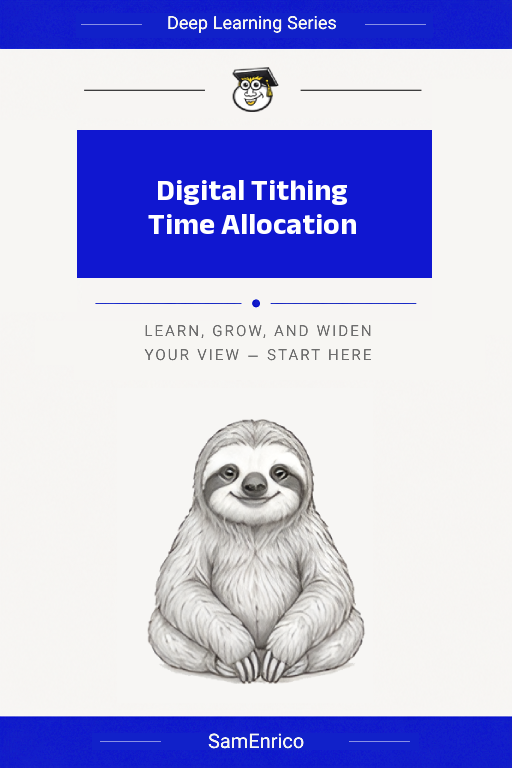
Non-FictionMental WealthTime Management
Digital Tithing Time Allocation eBook
Reserve one tenth of your work week for completely
Reserve one tenth of your work week for completely screen free thinking and strategic reflection.
Formats
Free sample
Chapter 1: The False God--–- The email arrived at 7:14 AM. I was still in bed. My phone buzzed against the wooden nightstand—that specific vibration that means "this might be important" but is actually programmed to mean "drop everything and look at me." I picked it up. It was a Slack notification about a calendar invite for a meeting about a document that summarized a previous meeting about a potential project that might begin next quarter. I scrolled past it, opened Instagram for "just a second," and emerged forty-three minutes later having watched a stranger install a stone patio in Wales.This is not a confession of weakness.
This is the normal morning of the modern knowledge worker.By 9:00 AM, I had checked email four times, responded to twelve messages that could have waited until afternoon, switched between six different browser tabs, answered two Slack threads, and approved a document I had not fully read. By 11:00 AM, I had attended a Zoom call where everyone's camera was off and everyone was clearly answering other emails. By 1:00 PM, I could not remember a single decision I had made all morning. By 5:00 PM, I had worked nine hours and felt exhausted, hollow, and vaguely ashamed—not because I had been lazy, but because I had been busy and produced almost nothing of strategic value.This is not a productivity problem. This is an addiction, and the substance is the screen.The Dopamine Loop That Owns You Every digital tool you use—email, Slack, Teams, Asana, Jira, Instagram, Linked In, Twitter, even your calendar—has been engineered by thousands of the world's smartest engineers to exploit a single neurological vulnerability: the dopamine loop.Here is how it works.
Dopamine is not, as popular culture tells you, the "pleasure chemical." It is the anticipation chemical. It is released not when you receive a reward, but when you expect a reward. The slot machine does not make you happy when you win; it makes you addicted during the half-second between pulling the lever and seeing the result. That half-second is the dopamine loop.Your phone is a slot machine in your pocket.Every notification is a lever pull. Every "unread" badge is a promise.
Every buzz, ding, or red dot creates a tiny spike of anticipation: Maybe this is important. Maybe this is the message that changes everything. Maybe someone needs me. Maybe someone praised me. Maybe I am about to learn something crucial.Then you check.
Usually, it is nothing. A sale at a store you never visit. A like on a photo from someone you barely know. A reply to a thread you forgot about. The reward is almost always smaller than the anticipation.
But the anticipation itself is addictive. And because the reward arrives sometimes—the important email, the praise from a boss, the funny meme from a friend—the loop becomes what psychologists call "variable ratio reinforcement." This is the same mechanism that makes gambling addictive. The unpredictability is the feature, not the bug.Nir Eyal, in his book Indistractable, calls this the "happiness trap." We chase the anticipation, not the reward. Johann Hari, in Stolen Focus, goes further: the largest technology companies have effectively declared war on human attention, and they are winning because they have deployed armies of neuroscientists and behavioral psychologists against your brain's ancient reward system.The result is that you are not weak. You are outmatched.But knowing the mechanism does not, by itself, break the loop.
You need a structural intervention, not more willpower. And that structural intervention is the subject of this book.Urgent vs. Important: The Matrix You Keep Ignoring In 1954, Dwight D. Eisenhower—then President of the United States, former Supreme Commander of Allied Forces in Europe—gave a speech that inadvertently created the most useful productivity framework in history. He said: "I have two kinds of problems, the urgent and the important.
The urgent are not important, and the important are never urgent."This distinction was later popularized by Stephen Covey in The 7 Habits of Highly Effective People as the Eisenhower Matrix, a four-quadrant grid:Urgent Not Urgent Important Quadrant I: Crises, deadlines, emergencies Quadrant II: Strategy, planning, relationships, deep work Not Important Quadrant III: Interruptions, some emails, some meetings Quadrant IV: Distractions, time-wasters, doomscrolling Here is the brutal truth about your screen: it is a Quadrant III and Quadrant IV machine, but it feels like Quadrant I.The ding of an email feels urgent. The buzz of a Slack message feels like a crisis. The red notification badge on your calendar app feels like a deadline. But almost none of it is actually important. Most emails are information, not action.
Most Slack messages are questions that could have been answered by a search. Most calendar alerts are meetings that could have been emails, and most of those emails could have been nothing.Gary Keller, in The One Thing, pushes the distinction further. He asks a single question that most knowledge workers never ask themselves: "What is the one thing I can do such that by doing it everything else will be easier or unnecessary?"If you ask yourself that question at 9:00 AM on a Monday morning, you will get an answer. It might be: "Finish the quarterly strategy document." Or "Call the client who is considering leaving." Or "Spend two hours thinking about why our last product launch failed."But you cannot ask that question while your phone is buzzing. You cannot answer it while Slack is demanding attention.
You cannot act on it while your calendar is sliced into fifteen-minute increments. The urgent has colonized your day, and the important has been evicted.The Zero Percent Problem Let me state the central problem of this book as bluntly as possible:Most knowledge workers spend zero percent of their work week on pure, uninterrupted, screen-free strategic reflection.Not 10 percent. Not 5 percent. Not 1 percent. Zero.I have asked this question in workshops with over three thousand professionals across technology, finance, healthcare, education, and nonprofit sectors.
I have asked it in one-on-one coaching sessions with senior executives at Fortune 500 companies. I have asked it in anonymous surveys distributed through Linked In and Twitter.The answer is always the same. When I ask, "In the last seven days, how many hours have you spent with no screens—no phone, no laptop, no tablet, no television—engaged in strategic thinking about your work?" the average answer is zero. The median answer is zero. The mode is zero.A small number of people report one or two hours.
Almost no one reports four or more.Let that land. You work forty, fifty, or sixty hours per week. You are paid to think strategically, solve complex problems, and make decisions that affect your team, your company, and your career. And you allocate exactly zero hours per week to the one activity that produces strategic thinking, complex problem-solving, and high-quality decisions.This is not a personal failing. This is a structural failure of the modern workplace, enabled by technology and normalized by culture.Busyness as a Proxy for Productivity Here is the deeper pathology: we have begun to confuse busyness with productivity.
They are not the same thing.Busyness is activity. Productivity is output. Busyness is checking email. Productivity is writing the proposal…
This is the end of the free sample. Get the eBook to keep going. Buy now
About this book
Details
- Author
- Spellman Rosalva
- Publisher
- SamEnrico
- Language
- English
- Genre
- Non-Fiction, Mental Wealth, Time Management
- Released
- 2026-05-29
- Pages (approx.)
- 145
- Available as
- eBook, Audiobook

Read better in the ZLOADR app
Your eBooks on your phone or tablet. Sign in with your SamEnrico account and start reading.
More by Spellman Rosalva
 Cognitive Diversity GuideSpellman Rosalva$11.99
 Outsourcing for Church LeadersSpellman Rosalva$11.99
 The SMART for Business GuideSpellman Rosalva$11.99
 Growth Mindset In RelationshipsSpellman Rosalva$11.99
 The Investment Loss GuideSpellman Rosalva$11.99
 Flow Journal WorkbookSpellman Rosalva$11.99
 Financial Self Compassion GuideSpellman Rosalva$11.99
 Five Minute Mindfulness PracticeSpellman Rosalva$11.99
 The Man Who Invented the Modern Navy: John Philip Holland and the Birth of the SubmarineSpellman Rosalva$11.99
 Operation Blackout: The Fall of the Sinaloa Cyber CartelSpellman Rosalva$11.99
 The Essential Guide to Alternative RapSpellman Rosalva$11.99
 How to Produce Punching and Training BagsSpellman Rosalva$11.99
You may also like
 Hong Kong Handover 1997Dunn Johnnie$11.99
 Zumba For Postnatal Recovery CourseNeal Christian$11.99
 Zumba for BeginnersLadner Nikia$11.99
 YouTube Comment Mining GuideHumes Pandora$12.99
 Worry Box MeditationCarlin Rudy$11.99
 Workplace Stress MeditationNguyen Lynn$11.99
 Workplace Stress and Sleep RepairHawley Ivory$11.99
 Workplace Perfectionism CureDelaney Jeffry$11.99
 Workplace Injustice Anger GuideWallen Isabelle$11.99
 Work Addiction and Burnout LinkGreenwood Ester$11.99
 Women in Yoga and WellnessBeattie Galina$11.99
 Women in Stand Up ComedyChun Evangeline$11.99