
Non-FictionInformativeEducational
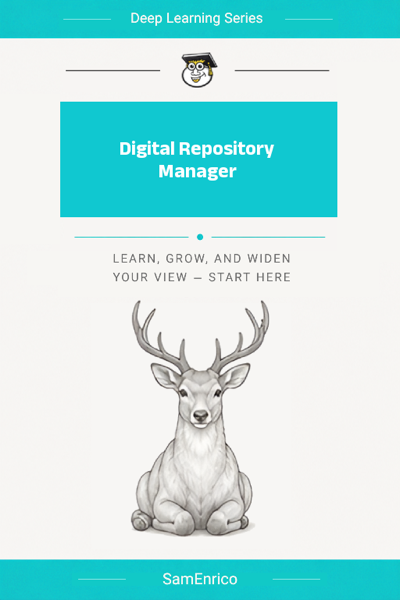
Digital Repository Manager eBook
A Coursebook on Digital Repository Manager
by Mills Latoya
A Coursebook on Digital Repository Manager
Formats
Free sample
Chapter 1: The Repository Trap--–- Melissa hadn’t slept well in three months. As the newly appointed Digital Repository Manager at a mid-sized research university, she had inherited a platform that faculty refused to use, a backlog of 12,000 unpublished theses, a copyright lawsuit threat from a publisher, and a budget that assumed “the repository runs itself.” Her predecessor had quit after eighteen months, leaving behind a tangle of Perl scripts, a half-written preservation policy, and a sticky note that read: “Good luck. You’ll need it.”Melissa’s story is not unusual. Across the world, hundreds of digital repository managers find themselves trapped between rising expectations and crumbling infrastructure, between faculty demands for open access and institutional reluctance to provide resources, between the promise of digital preservation and the reality of corrupted files and outdated formats. They are hired as librarians or IT specialists but expected to be lawyers, marketers, project managers, data curators, and diplomats.
They are told to “make the repository successful” but rarely given a definition of what success means, let alone the authority or budget to achieve it.This chapter is about why that trap exists and how to escape it. It reframes the role of the digital repository manager (DRM) not as a technical caretaker of software, but as a strategic leader who builds a service ecosystem. If you take only one idea from this chapter, let it be this: Your repository is not the platform. Your repository is the trust, the workflows, the policies, and the relationships that make the platform useful. A poorly chosen platform with excellent governance and advocacy will succeed.
The best platform in the world with no depositors, no clear policies, and no preservation plan will fail. This chapter gives you the conceptual foundation to become the kind of DRM who builds the former, not the latter.The Four Competencies of the Modern DRMBefore you can manage a repository, you must understand the breadth of what “management” actually requires. Most job descriptions for DRMs focus on technical skills—familiarity with DSpace, metadata schemas, or OAI-PMH. But successful DRMs discover quickly that technical expertise is necessary but insufficient. Based on an analysis of over two hundred job postings and interviews with forty practicing DRMs, the role breaks down into four competency domains.
Throughout this book, each domain receives dedicated chapters, but here we map the entire territory.Technical Literacy (Not Necessarily Coding)The first domain is technical literacy. Notice the word “literacy,” not “mastery.” You do not need to be a professional software engineer to manage a digital repository effectively. However, you do need to understand what is possible, what is difficult, and what is impossible. You need to be able to speak the language of your IT department without being condescending or confused. You need to read an API documentation page and understand whether it supports the batch operations your workflows require.
You may never write a line of Python, but you should be able to tell a developer, “I need a script that checks the MD5 checksum of every file in this folder and reports mismatches.”Technical literacy includes understanding metadata schemas (Dublin Core, MODS, PREMIS, Data Cite) well enough to know which fields are mandatory and which are optional. It includes grasping the difference between bit-level preservation (keeping the ones and zeros intact) and functional preservation (ensuring a file still opens and behaves as intended). It includes familiarity with persistent identifiers—DOIs, Handles, ARKs—and why they matter for citation and discovery. It includes knowing what OAI-PMH does (harvests metadata) and what it does not do (transfer large files). And it includes a working knowledge of fixity checking, checksums, and audit trails.Throughout this book, we mark technical depth with skill-level indicators: 🟢 Foundation (every DRM must know), 🟡 Technical Literacy (you should understand the concept even if you don’t execute it), and 🔴 Advanced Implementation (optional for DRMs in larger institutions or those with coding backgrounds).
This chapter, like all foundation chapters, is marked 🟢. You do not need to be a programmer to succeed as a DRM. You do need to be technically literate enough to ask the right questions, set the right requirements, and know when to call for help.Managerial and Operational Acumen The second domain is managerial. A repository is a living system with workflows, staff, budgets, and service level agreements. Someone must design the ingest workflow that moves a submission from a faculty member’s desktop to public access.
Someone must decide whether deposits will be self-service (faculty upload their own work) or mediated (library staff upload on their behalf). Someone must manage version control when a researcher deposits a corrected dataset. Someone must track which items are under embargo and ensure those embargoes expire correctly. Someone must schedule fixity checks and document when they run.These are not technical problems. They are operational design problems.
And they require a manager who can map processes, identify bottlenecks, assign responsibilities, and measure outcomes. You do not need an MBA, but you do need to think systematically. The best technical platform will fail if the workflow around it is confusing, slow, or error-prone. Conversely, a modest platform with a well-designed workflow and clear staff roles can deliver excellent service.Managerial acumen also includes governance. Who decides what content belongs in the repository?
Who decides when to withdraw an item? Who handles a takedown request? Who signs off on a preservation policy? These are governance questions, and they require you to work with steering committees, library administration, faculty senates, and sometimes legal counsel. You are not a lone operator.
You are a coordinator of stakeholders, and your ability to facilitate decisions is as important as your ability to configure software.Legal and Ethical Awareness The third domain is legal and ethical awareness. Digital repositories exist in a thicket of copyright law, licensing agreements, privacy regulations, and ethical protocols. A single misstep—posting a journal article whose copyright was not cleared, depositing a thesis that contains identifiable minors without parental consent, hosting indigenous cultural materials without proper authorization—can trigger legal action, damage institutional reputation, and erode the trust that repositories depend upon.You do not need to become a lawyer. But you must know enough to recognize when a legal question needs a lawyer. That means understanding the basics of copyright in your jurisdiction (for US readers, Title 17 of the US Code), knowing how to check publisher policies using tools like SHERPA/Ro MEO, distinguishing between Creative Commons licenses (CC BY, CC BY-NC, CC BY-SA, etc.), and recognizing when a deposit contains sensitive data that falls under GDPR, FERPA, or HIPAA.Ethical awareness goes beyond legal compliance.
Indigenous communities have developed the CARE Principles (Collective Benefit, Authority to Control, Responsibility, Ethics) as a counterpoint to the FAIR principles, emphasizing that indigenous data should be governed by indigenous communities, not simply made open by default. Cultural heritage materials may have restrictions based on sacred or ceremonial status. Medical data may require de-identification beyond what the law minimally requires. A good DRM navigates these complexities with humility, consultation, and a willingness to say “no” to a deposit when the ethical risks are too high.Outreach, Advocacy, and Community Engagement The fourth…
This is the end of the free sample. Get the eBook to keep going. Buy now
About this book
Details
- Author
- Mills Latoya
- Publisher
- SamEnrico
- Language
- English
- Genre
- Non-Fiction, Informative, Educational
- Released
- 2026-05-06
- Pages (approx.)
- 160
- Available as
- eBook, Audiobook

Read better in the ZLOADR app
Your eBooks on your phone or tablet. Sign in with your SamEnrico account and start reading.
More by Mills Latoya
 Active Listening For SiblingsMills Latoya$11.99
 HIV And MAT GuideMills Latoya$11.99
 Influencer Marketing AvoidanceMills Latoya$11.99
 The Growth Hacking PlaybookMills Latoya$11.99
 The Cape Town Stock Exchange Scandal: A Victorian-Era Insider Trading ConspiracyMills Latoya$11.99
 Learn to Play the Alto SarrusophoneMills Latoya$11.99
 How to Start a Needlework Store BusinessMills Latoya$11.99
 AI for Email Follow-Up RemindersMills Latoya$12.99
You may also like
 Hong Kong Handover 1997Dunn Johnnie$11.99
 Zumba For Postnatal Recovery CourseNeal Christian$11.99
 Zumba for BeginnersLadner Nikia$11.99
 YouTube Comment Mining GuideHumes Pandora$12.99
 Worry Box MeditationCarlin Rudy$11.99
 Workplace Stress MeditationNguyen Lynn$11.99
 Workplace Stress and Sleep RepairHawley Ivory$11.99
 Workplace Perfectionism CureDelaney Jeffry$11.99
 Workplace Injustice Anger GuideWallen Isabelle$11.99
 Work Addiction and Burnout LinkGreenwood Ester$11.99
 Women in Yoga and WellnessBeattie Galina$11.99
 Women in Stand Up ComedyChun Evangeline$11.99