
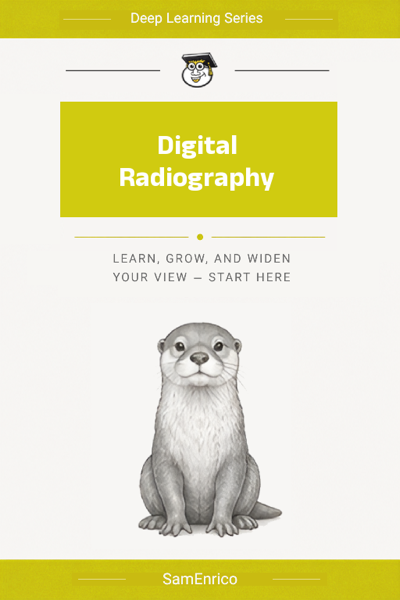
Non-FictionInformativeEducational
Digital Radiography Audiobook
A Coursebook on Digital Radiography
A Coursebook on Digital Radiography
Formats
Free sample
Chapter 1: The Invisible Revolution--–- The X-ray room smelled of aged vinyl and antiseptic. The technologist, Sarah, had just placed a cassette behind a patient’s chest when her phone buzzed. A trauma was five minutes out. In the film era, she would have already begun praying to the gods of chemistry and exposure. One underexposed image meant a repeat.
One repeat meant a twenty-minute delay. But today, Sarah glanced at the flat-panel detector built into the table, touched a screen, and thought, I get one chance. But now, one chance is enough. She pressed the button. Two seconds later, a perfect lung field appeared on her monitor.
No darkroom. No chemical baths. No retake. The invisible revolution had already happened, and she was standing in the middle of it.This book is about that revolution. It is about how a technology born in a physics laboratory, nurtured by computer scientists, and perfected by radiologic technologists transformed a profession that had remained essentially unchanged for nearly a century.
From Wilhelm Roentgen’s discovery of X-rays in 1895 until the late 1980s, medical imaging was a film-based, chemistry-dependent, darkroom-bound discipline. Today, it is a digital, networked, post-processable, and nearly instantaneous art. But understanding the present requires understanding the past—and more importantly, understanding why the past had to die.The World Before Digital: A Love Story with Limitations To appreciate digital radiography, one must first understand what it replaced: screen-film radiography. This system, refined over nearly one hundred years, used a cassette containing an intensifying screen (coated with phosphors) and a double-emulsion film. When X-rays struck the screen, the phosphors emitted visible light, which exposed the film.
The film was then processed in a series of chemical tanks: developer, fixer, wash, and dryer. The entire process took between ninety seconds and twenty minutes, depending on the processor and the era.The analogy that best captures screen-film radiography is that of a analog audio cassette tape. Just as a tape had a fixed dynamic range—too quiet and you heard only hiss, too loud and the music distorted—screen-film had a fixed exposure latitude. Underexpose by 50% and the image was too light (technically, too low in density). Overexpose by 100% and the image was too dark (too high in density).
There was no "fix it in post." What you exposed was what you developed. If the radiologist said, "The mediastinum is too white," you…
This is the end of the free sample. Get the Audiobook to keep going. Buy now
About this book
Details
- Author
- Partridge Luci
- Publisher
- SamEnrico
- Language
- English
- Genre
- Non-Fiction, Informative, Educational
- Released
- 2026-05-07
- Pages (approx.)
- 157
- Available as
- eBook, Audiobook

Listen in the VoxFlicks app
Audiobooks and audio dramas wherever you go. Sign in with your SamEnrico account and press play.
More by Partridge Luci
 Kigali Healthtech InnovationPartridge Luci$11.99
 March on Washington LegacyPartridge Luci$11.99
 Relationship Self Worth GuidePartridge Luci$11.99
 The Calorie Tracking for PregnancyPartridge Luci$11.99
 Co worker Anger TriggersPartridge Luci$11.99
 Shadows Over Salamanca: Wellington's Secret WarPartridge Luci$11.99
 Understanding Proximal Myotonic MyopathyPartridge Luci$17.99
 How to Become a Laundry LaborerPartridge Luci$11.99
 ZoomInfo GuidePartridge Luci$12.99
 Employee Handbook First HirePartridge Luci$12.99
You may also like
 Hong Kong Handover 1997Dunn Johnnie$11.99
 Zumba For Postnatal Recovery CourseNeal Christian$11.99
 Zumba for BeginnersLadner Nikia$11.99
 YouTube Comment Mining GuideHumes Pandora$12.99
 Worry Box MeditationCarlin Rudy$11.99
 Workplace Stress MeditationNguyen Lynn$11.99
 Workplace Stress and Sleep RepairHawley Ivory$11.99
 Workplace Perfectionism CureDelaney Jeffry$11.99
 Workplace Injustice Anger GuideWallen Isabelle$11.99
 Work Addiction and Burnout LinkGreenwood Ester$11.99
 Women in Yoga and WellnessBeattie Galina$11.99
 Women in Stand Up ComedyChun Evangeline$11.99