
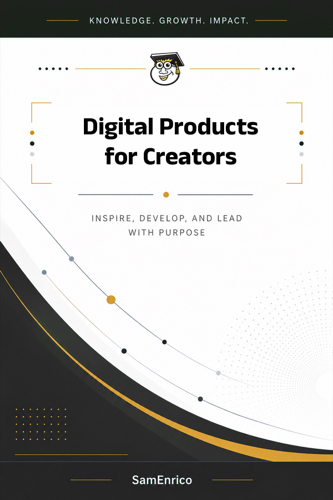
Digital Products for Creators eBook
Create and sell templates, presets, ebooks and cou
Create and sell templates, presets, ebooks and courses to stabilize creator income.
Formats
Free sample
Chapter 1: Leverage Sleep Equity--Most creators discover the problem of income instability the same way: they celebrate a win while already dreading the silence that follows.You just landed a $5,000 brand deal. You posted the sponsored Reel. The money hit your account. You feel relief for exactly one evening. Then, at 2 a.m., the familiar dread creeps in.
The deal is done. The brand has moved on. Your analytics are back to baseline. And you have no idea when the next $5,000 is coming.This is the feast-or-famine cycle. It is not a personal failing.
It is a structural flaw in how most creators build their businesses.For the past several years, the creator economy has sold a seductive promise: do what you love, build an audience, and the money will follow. But the money that follows usually comes in three unstable forms. Brand deals pay well but require constant pitching, negotiation, and platform dependency. Affiliate income feels passive but demands constant traffic and dies when algorithms change. One-on-one services pay the bills but trade hours for dollars, leaving you exhausted and no further ahead than when you started.Each of these models shares a fatal weakness: they reset to zero every month.
You wake up on the first of the month and your income counter reads zero. Every. Single. Month.This book exists because that model is broken. And more importantly, a better model exists.The Scene That Started Everything I want to tell you about a photographer named Maya.
Her name and some details have been changed, but her story is real, and it is the reason this book exists.Maya had built a respectable following on Instagram. She posted consistently, engaged with her community, and landed regular brand deals with camera equipment companies. By all external measures, she was a successful creator. She had fifty thousand followers, a beautiful portfolio, and a calendar full of client shoots.But Maya was exhausted.She calculated her hourly rate one Tuesday afternoon when she could not get out of bed. Between shooting, editing, pitching brands, negotiating contracts, invoicing, following up on late payments, and answering DMs, she was working sixty hours per week.
Her average hourly rate? Eleven dollars. Less than minimum wage in her city.The brand deals looked impressive on paper: $2,000 here, $3,000 there. But each deal required ten to fifteen hours of negotiation, content creation, and revision. Her one-on-one photography clients paid $500 per session, but each session required four hours of shooting, six hours of editing, and two hours of client communication.
That is $500 for twelve hours of work. Forty-one dollars per hour before taxes, software subscriptions, and equipment costs.Maya was not failing. She was trapped in an economy that rewards activity over assets.She came to me with a simple question: "How do I make money while I sleep?"At the time, I did not have a good answer. I had been trapped in the same cycle myself. But over the following year, Maya and I experimented with a different approach.
Instead of trading time for money, she started creating Lightroom presets based on the exact editing workflows her clients kept asking about. She turned her client onboarding process into a template. She recorded a ninety-minute workshop on how to price photography services.Within six months, Maya had sold over two thousand digital products. Her income no longer reset to zero on the first of the month. She still did brand deals when she wanted to, but she no longer needed them.
She still took one-on-one clients, but only the ones she genuinely enjoyed.Maya did not work harder. She worked differently. She stopped trading time for money and started building what I call sleep equity.The Four Types of Leverage To understand why digital products change everything, you need to understand leverage.Naval Ravikant, the investor and philosopher behind Angel List and a generation of startup thinking, famously broke down the four types of leverage available to human beings. Understanding these categories is the single most important mental model in this entire book. Once you see leverage, you cannot unsee it.
And once you see that most creators are using the hardest forms of leverage while ignoring the easiest, you will never go back.Leverage Type 1: Labor This is other people working for you. You hire employees, contractors, or freelancers to do work that you would otherwise do yourself. Labor leverage is powerful but difficult to access. It requires management skills, legal compliance, and enough cash flow to pay people before you collect revenue from their work. You also have to recruit, train, and retain those people.
Most creators cannot afford labor leverage until they already have significant income, which means it solves a problem they no longer have.Leverage Type 2: Capital This is money working for you. You invest savings, borrow funds, or raise investment to amplify your returns. Capital leverage is even more difficult to access than labor. It requires either existing wealth or the ability to convince others to trust you with their money. Even then, capital leverage comes with expectations of returns, reporting, and risk.
Most creators will never access capital leverage in any meaningful way. It is not designed for them.Leverage Type 3: Code This is software working for you. You write a program once, and it runs indefinitely without additional input. A script that resizes images, a bot that schedules posts, a tool that generates contracts, a filter that applies your signature editing style to hundreds of photos at once—these are all forms of code leverage. Code is permissionless.
Anyone can learn to write it. Code is asymmetric. The work happens once, the value flows forever. You do not need a computer science degree to use code leverage. You need a willingness to learn basic tools and a problem that repeats.Leverage Type 4: Media This is content working for you.
You create a video, a podcast episode, a blog post, or a digital product once, and it continues to generate value long after you finish creating it. Media is also permissionless and asymmetric. A You Tube tutorial you filmed three years ago can still bring you customers today. An ebook you wrote last year can still generate royalties this year. A template you designed in an afternoon can sell hundreds of copies while you sleep.Here is the problem that most creators never realize: they rely exclusively on labor and capital leverage that they do not actually control.Brand deals are labor leverage.
You are trading your creative labor for money. But the brand controls the relationship. They can end the deal at any time. They can demand revisions. They can negotiate your rate down.
You are not the owner of that leverage. You are the employee.Affiliate income is a form of capital leverage. Money flows in exchange for traffic. But the platform controls the algorithm. A single update can halve your income overnight.
You are not the owner of that leverage. You are a renter on someone else's land.One-on-one services are pure labor leverage with no scale. You trade an hour of your life for an hour of payment. There is no asymmetry. There is no permissionlessness.
There is just you, your time, and a hard ceiling on how much you can earn.Code and media leverage are…
This is the end of the free sample. Get the eBook to keep going. Buy now
About this book
Details
- Author
- Evers Armanda
- Publisher
- SamEnrico
- Language
- English
- Genre
- Non-Fiction, Non-Obvious Career, Digital Commerce
- Released
- 2026-06-12
- Pages (approx.)
- 141
- Available as
- eBook, Audiobook

Read better in the ZLOADR app
Your eBooks on your phone or tablet. Sign in with your SamEnrico account and start reading.
More by Evers Armanda
 Stuttering Before PresentationsEvers Armanda$11.99
 Naloxone Vending Machine GuideEvers Armanda$11.99
 The Workplace Rejection ResilienceEvers Armanda$11.99
 Ovahimba Figurative ArtEvers Armanda$11.99
 The Lioness of the Nile: Queen Tiye and the Golden Age of EgyptEvers Armanda$11.99
 How to Become a Dredge Operator SupervisorEvers Armanda$11.99
 Search Console Performance ReportEvers Armanda$12.99
 Furniture Retail PricingEvers Armanda$12.99
 Cloud Security EngineerEvers Armanda$11.99