
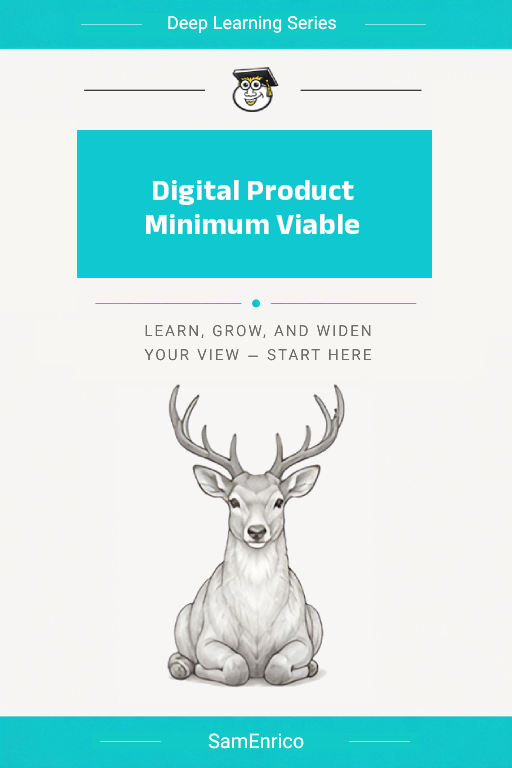
Non-FictionFirst 30 DaysMinimum Viable
Digital Product Minimum Viable eBook
Launch simplest version of digital product that so
Launch simplest version of digital product that solves one problem for one customer type.
Formats
Free sample
Chapter 1: The MVP Graveyard--You have already failed.Not tomorrow. Not after you launch. Not after your first hundred users complain about the buggy interface and missing features. You failed the moment you opened your code editor and started building something that you thought “users might want someday.”This is the dirty secret of the digital product industry. Ninety percent of minimum viable products are not viable at all.
They are not minimum. And they certainly do not solve a problem. They are bloated, directionless, feature-heavy zombies that stumble into the world, confuse everyone who touches them, and die quietly in the graveyard of good intentions.I have walked through that graveyard more times than I care to admit.Early in my career, I spent six months building a dashboard for social media managers. It had everything. Real-time analytics.
Custom report generation. Team collaboration tools. A dark mode toggle that I was particularly proud of. I launched with a hundred features, a thousand lines of code, and the absolute certainty that I had built something important.Thirty days later, exactly three people were using it. One of them was my mother.
One was my co-founder. The third was a consultant who logged in once, said “this is overwhelming,” and never came back.I had built a monument to my own assumptions. And I was not alone.The Great Misunderstanding of MVPThe term “minimum viable product” was coined by Frank Robinson and popularized by Eric Ries in The Lean Startup. Ries defined it as “that version of a new product which allows a team to collect the maximum amount of validated learning about customers with the least amount of effort.”Notice what that definition does not say. It does not say “the version with the most features.” It does not say “the version that pleases everyone.” It does not say “the version that looks finished.”The word “minimum” means the smallest possible thing that can work.
The word “viable” means capable of solving a real problem for a real person. Put them together, and you get something that most builders fundamentally misunderstand. An MVP is not a small version of a big product. It is a completely different category of thing.A small version of a big product still tries to do many things, just poorly. A true MVP tries to do exactly one thing, just well enough to learn whether that one thing matters.This distinction is everything.The Just-in-Case Feature Trap Here is how most products actually get built.
Someone has an idea. They imagine a user sitting at a computer, trying to accomplish something. Then they imagine all the things that could go wrong. What if the user needs help? What if the user wants to share their results?
What if the user forgets their password? What if the user wants to export to PDF? What if the user wants to collaborate with a team? What if the user wants to compare different time periods?Each “what if” becomes a feature. Each feature becomes a task.
Each task becomes a week of work. And before you know it, you have spent six months building a dashboard that no one asked for.I call these “just-in-case” features. You build them not because a specific customer has demanded them, but because you are afraid. You are afraid that if you launch without them, someone will call your product incomplete. You are afraid that a competitor will add them and look more sophisticated.
You are afraid that you will look lazy or naive.The just-in-case feature is the single biggest killer of MVPs.Let me give you a concrete example. A few years ago, I consulted for a B2B analytics startup. They had raised two million dollars. They had hired twelve engineers. They had built a dashboard with thirty-seven different charts.
When I asked why they had built thirty-seven charts, the CEO said, “Enterprise clients expect options.”I asked to see their customer list. They had one paying customer. A small marketing agency with four employees. I asked to see that customer’s usage logs. The agency used exactly three charts.
The same three charts. Every single day.The other thirty-four charts had never been opened. Not once.But those thirty-four charts cost the company something. They cost development time. They introduced bugs.
They confused new users who signed up for trials and immediately felt lost. They made the product harder to navigate. They created a maintenance burden that consumed half the engineering team’s capacity.When the agency eventually left because the three charts they actually used were buggy, the startup died. They had spent all their resources on features that no one wanted, leaving the features that mattered broken.The just-in-case features killed the product. Not the missing features.
Not the competition. Not pricing. The features they added out of fear.The Feature Factory Trap Melissa Perri, in her essential book Escaping the Build Trap, describes a phenomenon she calls the “feature factory.” In a feature factory, teams measure their success by output. How many features did we ship this quarter? How many tickets did we close?
How many lines of code did we write?Notice what is missing from those measurements. Outcomes. Did the customer’s problem get solved? Did the customer’s life get better? Did the customer’s pain decrease from a nine out of ten to a two out of ten?The feature factory is seductive because output is easy to measure.
You can count features. You cannot count “solved problems” as easily. But counting features is like measuring the success of a restaurant by how many plates it washes. Yes, plates must be washed. But the goal is not clean plates.
The goal is fed customers.When you are trapped in a feature factory, every request becomes a feature. A customer says “it would be nice if…” and you add it to the roadmap. A salesperson says “Prospect X asked for…” and you prioritize it. An investor says “competitor Y has…” and you build it.Soon, your roadmap is a long list of disconnected features that have no relationship to a coherent problem. You are building in all directions simultaneously, which means you are moving in none.Waste and the Lean Mindset Eric Ries borrowed the concept of “waste” from lean manufacturing.
In manufacturing, waste is anything that does not add value to the customer. In product development, waste is anything that does not contribute to learning about the customer.Most MVPs are eighty percent waste. Let me say that again. Eighty percent of what you build in your first version will not help you learn anything important about your customer.Think about that for a moment. If you spend six months building your MVP, four point eight of those months are wasted.
If you spend a hundred thousand dollars, eighty thousand dollars are wasted. If you work sixty hours a week, forty eight of those hours are wasted.This is not a productivity problem. This is a philosophical problem. You are wasting time and money because you are guessing instead of learning. You are building features that seem like good ideas instead of testing…
This is the end of the free sample. Get the eBook to keep going. Buy now
About this book
Details
- Author
- Concepcion Ling
- Publisher
- SamEnrico
- Language
- English
- Genre
- Non-Fiction, First 30 Days, Minimum Viable
- Released
- 2026-06-01
- Pages (approx.)
- 127
- Available as
- eBook, Audiobook

Read better in the ZLOADR app
Your eBooks on your phone or tablet. Sign in with your SamEnrico account and start reading.
More by Concepcion Ling
 Workaholic Morning Routine RethinkConcepcion Ling$11.99
 Hospitality Burnout GuideConcepcion Ling$11.99
 The Agency Lead Generation GuideConcepcion Ling$11.99
 Nick Faldo Method Life StoryConcepcion Ling$11.99
 Phone Call Scripts for Data LeaksConcepcion Ling$11.99
 The Yellow Fever War: Eradicating a Killer in the AmazonConcepcion Ling$11.99
 Furby Frenzy: The Rise and Fall of the World's Most Talkative ToyConcepcion Ling$11.99
 How to Start a Hobby in Rocking AIDS BabiesConcepcion Ling$11.99
 Canva Business Plan Design GuideConcepcion Ling$12.99
 Food Co WorkerConcepcion Ling$11.99
 Understanding Chronic Renal FailureConcepcion Ling$17.99
You may also like
 Hong Kong Handover 1997Dunn Johnnie$11.99
 Zumba For Postnatal Recovery CourseNeal Christian$11.99
 Zumba for BeginnersLadner Nikia$11.99
 YouTube Comment Mining GuideHumes Pandora$12.99
 Worry Box MeditationCarlin Rudy$11.99
 Workplace Stress MeditationNguyen Lynn$11.99
 Workplace Stress and Sleep RepairHawley Ivory$11.99
 Workplace Perfectionism CureDelaney Jeffry$11.99
 Workplace Injustice Anger GuideWallen Isabelle$11.99
 Work Addiction and Burnout LinkGreenwood Ester$11.99
 Women in Yoga and WellnessBeattie Galina$11.99
 Women in Stand Up ComedyChun Evangeline$11.99