
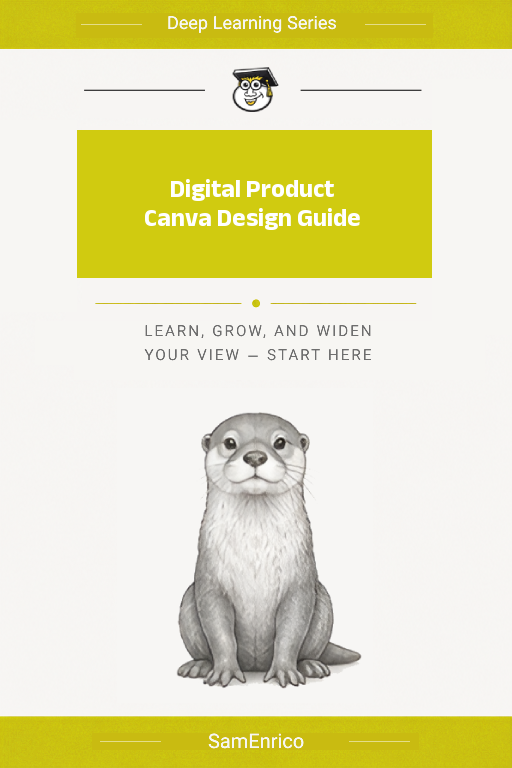
Digital Product Canva Design Guide eBook
Design professional covers and interiors using Can
by Durr Glynda
Design professional covers and interiors using Canva templates in hours.
Formats
Free sample
Chapter 1: The Template Myth--–- It starts with a blank page and a racing heart.You open Canva. The cursor blinks on a pure white canvas. You have a brilliant idea for a book—a journal, a guide, a coloring book, a planner that could change lives. But there it sits. That white void.
Staring back at you like an accusation.Where do I start?What if it looks amateur?What if I waste ten hours and still end up with something ugly?If you have felt any of these fears, you are not alone. In fact, you are in the company of nearly every first-time book designer who ever opened design software. The blank page is not a technical problem. It is a psychological one. And the solution is not more talent, more software, or more time.
The solution is understanding what professional designers have known for centuries: templates are not cheating. They are the secret.This chapter will dismantle the single biggest barrier to creating professional book covers and interiors with Canva: the myth that using a template makes you less of a designer. By the time you finish reading, you will not only embrace templates as your primary tool—you will learn how to reverse-engineer best-selling books, extract their "template logic," and make that logic your own. And you will do it in hours, not weeks.The Lie You Have Been Told Let us name the lie out loud.Somewhere along the way—probably from well-meaning artists, gatekeeping designers, or your own perfectionism—you absorbed the belief that "real designers" start from scratch. That a blank canvas is a test of worth.
That using a pre-made layout is lazy, generic, or somehow less authentic.This is nonsense. And it is expensive nonsense.Professional architects do not reinvent the wheel for every house. They use blueprints. Professional chefs do not invent new knives for every dish. They use recipes.
Professional writers do not invent new grammar for every novel. They use sentences. Designers are no different. Every working designer—from the art director at Penguin Random House to the freelancer charging $500 for a book cover—maintains a library of templates, master pages, and style guides. They just call them different names.Jesse Stay, author of Canva For Dummies, puts it bluntly: "Templates are frameworks for excellence, not shortcuts for laziness." The world's most creative designs almost always begin with a known structure.
The Eiffel Tower begins with a truss. A symphony begins with a key signature. A best-selling book cover begins with a template.The difference between an amateur and a professional is not whether you use a template. The difference is how you use it. Amateurs use templates as a crutch—they pick the first pretty thing they see, change the words, and call it done.
Professionals use templates as a springboard—they analyze why the template works, then customize it until it becomes uniquely theirs.This book is written for the second group.What Actually Happens in a Professional Designer's Brain Before we open Canva, let us look inside the mind of a professional book cover designer. Her name is Sarah. She has designed forty covers for a major publishing house. You have probably seen her work on Amazon best-seller lists without knowing it.When Sarah sits down to design a new romance novel cover, she does not start with a blank canvas. She starts with a folder on her computer labeled "Romance Templates." Inside are ten master files she has built and refined over five years.
Each one represents a successful cover from a past project, stripped of its specific text and images but retaining the underlying structure.Sarah knows, for example, that romance covers almost always follow one of three structural templates:Template A: Large title across the top third. Author name below the title. A single central image of a couple embracing. Decorative script font for the word "A Novel" or a series name.Template B: Title centered in the middle. Author name at the bottom.
An atmospheric image (beach, sunset, city street) covering the whole background. Small subtitle above the title.Template C: Title stacked vertically on the left side. Image of a single object (flower, letter, key) on the right. Author name at the bottom right.Sarah does not invent these structures from thin air. She extracted them by looking at the top fifty romance novels on Amazon, noticing patterns, and saving those patterns as reusable templates.
When a new client comes to her with a manuscript, Sarah's first question is not "What font should I use?" It is "Which of my three templates fits this story best?"That is the professional workflow. It takes minutes, not hours. And you are about to learn exactly how to build your own library of templates using nothing but Canva and a sharp eye for patterns.The Squint Test: Your New Best Friend Before we go any further, I need to teach you a single skill that will change how you look at every book cover forever. I call it The Squint Test.Here is how it works. Find a book cover—any book cover.
It could be on your shelf, on Amazon, or in a store. Now squint your eyes until everything goes slightly blurry. Do not close your eyes. Just soften your focus until you lose the fine details.What do you see?If the cover is well-designed, you will still see three things clearly:The title (or at least its shape and position)The main image (or its silhouette and placement)The contrast between the text and the background If the cover is poorly designed, you will see nothing but a muddy gray blur. The title will disappear into the background.
The image will have no distinct shape. You will not be able to tell where your eye is supposed to go.The Squint Test works because it strips away the decorative noise and reveals the underlying structure. It shows you the template hiding beneath the surface.Let me give you a concrete example. Go to Amazon and look up the best-selling book in any non-fiction category—say, self-help or business. Squint at the cover.
You will almost certainly see a massive title in the top third, a bold author name at the bottom, and either a photograph of the author or a simple icon in the middle. That is not a coincidence. That is a template that has been proven to sell.Now look up a best-selling romance novel. Squint again. You will likely see the title in the center, the author name at the bottom, and a couple embracing in the background.
Different template. Same logic.The Squint Test is the first tool in your template-dissection kit. You will use it constantly. And by the end of this chapter, you will use it not just to look at covers, but to steal their structure ethically and effectively.How to Reverse-Engineer a Best-Selling Cover (Step-by-Step)Now we get to the practical work. I am going to walk you through a five-step process for taking any best-selling book cover and extracting its "template logic"—the underlying structure that you can recreate in Canva in minutes.Step…
This is the end of the free sample. Get the eBook to keep going. Buy now
About this book
Details
- Author
- Durr Glynda
- Publisher
- SamEnrico
- Language
- English
- Genre
- Non-Fiction, First 30 Days
- Released
- 2026-05-30
- Pages (approx.)
- 155
- Available as
- eBook, Audiobook

Read better in the ZLOADR app
Your eBooks on your phone or tablet. Sign in with your SamEnrico account and start reading.
More by Durr Glynda
 Senior Housing Tax DeductionsDurr Glynda$11.99
 Parenting Trigger ManagementDurr Glynda$11.99
 Sam Sheppard Death And MysteryDurr Glynda$11.99
 Hookah and Shisha Toxin GuideDurr Glynda$11.99
 Neurotech Investment MapDurr Glynda$11.99
 The Elevator Pitch BlueprintDurr Glynda$11.99
 Tinnitus Hypnosis ScriptsDurr Glynda$11.99
 Theme Days SchedulingDurr Glynda$11.99
 Customer Service AngerDurr Glynda$11.99
 Gold, Guns, and Ghosts: The Cursed 1968 Mexico City OlympicsDurr Glynda$11.99
 Steel and Secrets: The Golden Spike ConspiracyDurr Glynda$11.99
 Quetzalcoatl's Feathers: The Serpent's Divine FlightDurr Glynda$11.99
You may also like
 Hong Kong Handover 1997Dunn Johnnie$11.99
 Zumba For Postnatal Recovery CourseNeal Christian$11.99
 Zumba for BeginnersLadner Nikia$11.99
 YouTube Comment Mining GuideHumes Pandora$12.99
 Worry Box MeditationCarlin Rudy$11.99
 Workplace Stress MeditationNguyen Lynn$11.99
 Workplace Stress and Sleep RepairHawley Ivory$11.99
 Workplace Perfectionism CureDelaney Jeffry$11.99
 Workplace Injustice Anger GuideWallen Isabelle$11.99
 Work Addiction and Burnout LinkGreenwood Ester$11.99
 Women in Yoga and WellnessBeattie Galina$11.99
 Women in Stand Up ComedyChun Evangeline$11.99