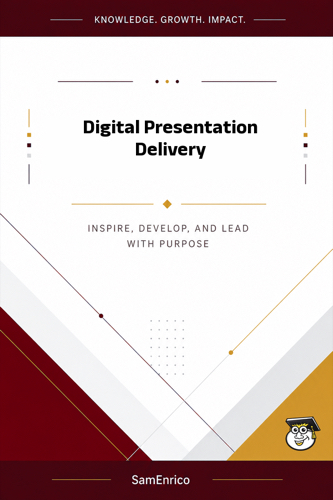
Digital Presentation Delivery eBook
Engages remote audiences during screen shares.
Engages remote audiences during screen shares.
Formats
Free sample
Chapter 1: The Invisible Graveyard...–- You have already lost them. You just don’t know it yet.The meeting invite said “Q3 Strategy Review — Mandatory.” Thirty-one people clicked the link. Sixteen cameras are on. Fifteen are off. One person is visibly eating a sandwich.
Three initials have not moved in four minutes — they are almost certainly answering email. Two participants joined from their phones, which means they are probably walking, driving, or lying down. One person’s camera is angled so that only their forehead and a houseplant are visible.And you haven’t even shared your screen yet.This is not a failure of your content. It is not a failure of your charisma. It is not even a failure of your audience’s work ethic.
This is the reality of presenting to a remote audience: you are no longer competing with other people for attention. You are competing with email, Slack, laundry, Door Dash, children, roommates, the television playing in the next room, and the quiet existential hum of a browser with forty-seven open tabs.In a physical room, social pressure keeps people seated and at least partially attentive. The CEO is three feet away. The peer who might judge your slides is making eye contact. The fire alarm is not a click away.
There is a shared physical space, and within that space, there are norms: you do not check your email during a presentation. You do not stand up and walk away. You do not open a second window and start shopping for winter coats.On a screen, all of those norms evaporate.The viewer is the god of their own attention. They can mute you. They can turn off their camera.
They can drag your window to a secondary monitor and forget you exist while they answer the email that just arrived. They can — and this happens more often than any presenter wants to admit — simply walk away from their desk and never come back, leaving their initials frozen on your screen like a tiny digital tombstone.You are presenting to a graveyard. And the corpses are still typing.This chapter is not about making you feel bad. It is about making you see clearly. Because once you understand how the remote audience actually behaves — not how you wish they would behave, not how they behave in a boardroom, but how they behave right now, in their living rooms and home offices and shared coworking spaces — you can stop fighting against human nature and start designing for it.The first step is accepting a brutal fact: before you share a single slide, before you say your name, before you even open your mouth, your audience has already decided whether they will stay or leave.
And they make that decision in less time than it takes to brew a cup of coffee.The 7-Second Decision Rule Let us run a small experiment.Think about the last time you joined a webinar, a team meeting, or a client presentation remotely. How long did you give the presenter before you decided whether this was worth your full attention or a background tab? Be honest. Were you fully engaged during the welcome slide? Did you listen to the agenda?
Or did you immediately open your email, scan your Slack messages, and start a grocery list?The research on digital attention spans is sobering. While a live, in-person audience will typically give a presenter thirty to forty-five seconds of grace before mentally checking out, a remote audience makes a decision in approximately seven seconds. Seven seconds. That is the time it takes to say “Good morning, everyone, thank you for joining” and take a breath.In seven seconds, the remote viewer answers three questions, usually unconsciously:Is this relevant to me? (Does this content touch my work, my goals, or my problems?)Is this worth my time?
(Is the presenter moving with purpose, or are they rambling?)Is this going to be painful? (Is the slide dense? Is the audio bad? Is the presenter reading bullet points?)If the answer to any of these questions is “no” or even “maybe not,” the viewer does not leave the meeting. That would be rude.
Instead, they do something far more dangerous: they stay, but they stop listening. They drag your window to the side. They turn down your volume. They become what we call a ghost attendee — present in name only, their initials frozen on your grid, their attention elsewhere.And here is the cruelest part: you will never know. They will not tell you.
Their camera is off. Their mute button is on. They will sit through your entire forty-minute presentation, and at the end, when you ask “Any questions?” they will say nothing. Not because they agree. Because they were never there.The 7-Second Decision Rule is not a theory.
It is a law of remote attention. You have approximately seven seconds from the moment you begin speaking — not from the moment the meeting starts, but from the moment you open your mouth — to convince each viewer that staying is worth more than leaving. After that window closes, you are not presenting to an audience. You are performing for the ghosts.Distraction Proximity: Why Your Biggest Enemy Is Already Open The 7-Second Rule explains when you lose them. But to understand why, we need to talk about what Andrew Brodsky, in his research on digital communication psychology, calls Distraction Proximity.Distraction Proximity is the measure of how close the viewer is — physically and psychologically — to an alternative activity.
Think of it as a distance scale. At zero feet away is the viewer who has joined from a dedicated workspace, closed all other applications, put their phone in another room, and is leaning toward their screen with a notebook. These people exist. They are rare. They are also not your problem.At the other end of the scale, at three inches away, is the viewer who has Slack open on one monitor, email on another, their phone in their hand, and your presentation in a small window in the corner of their screen.
This viewer is not distracted despite your presentation. They are distracted because your presentation has not yet given them a reason to close the other tabs.Most remote viewers live somewhere in the middle. They are not malicious. They are not lazy. They are simply efficient.
Their job does not stop because you started talking. Their inbox does not pause because you shared a slide. They are constantly evaluating: “Is what this person is saying more important than the email I am currently ignoring?” And unless you answer that question immediately, the email wins.Distraction Proximity has three components:1. Physical Proximity. How many clicks does it take for the viewer to reach a distraction?
If Slack is one Alt+Tab away, the proximity is high. If the viewer is on a phone and a text message notification just appeared, the proximity is critical. You cannot eliminate physical proximity — you are not in their home — but you can acknowledge it. The worst thing you can do is pretend it does not exist.2. Psychological Proximity.
How emotionally urgent are the distractions? A viewer who is waiting for an email from their boss about a performance…
This is the end of the free sample. Get the eBook to keep going. Buy now
About this book
Details
- Author
- Strauss Roxanna
- Publisher
- SamEnrico
- Language
- English
- Genre
- Non-Fiction, Self-Help, Presentations
- Released
- 2026-06-05
- Pages (approx.)
- 138
- Available as
- eBook, Audiobook

Read better in the ZLOADR app
Your eBooks on your phone or tablet. Sign in with your SamEnrico account and start reading.
More by Strauss Roxanna
 Senior Vision Loss GuideStrauss Roxanna$11.99
 Gymnast Hypnosis WorkbookStrauss Roxanna$11.99
 Acupuncture for GoutStrauss Roxanna$11.99
 Collaborative Storyboarding GuideStrauss Roxanna$11.99
 Entomophobia Insect FearStrauss Roxanna$11.99
 LinkedIn Banner CanvaStrauss Roxanna$11.99
 Self Hypnosis for Cluster HeadacheStrauss Roxanna$11.99
 The Unbreakable Streak: How Joe DiMaggio Defied the Odds in 1941Strauss Roxanna$11.99
 The Golden Quill: Medieval African Illustrators Who Shaped Children's StoriesStrauss Roxanna$11.99
 How to Produce Ping Pong Paddles and SetsStrauss Roxanna$11.99
 How to Produce Desk and Shelf ClocksStrauss Roxanna$11.99
 Business EIN vs VAT vs Income TaxStrauss Roxanna$12.99