
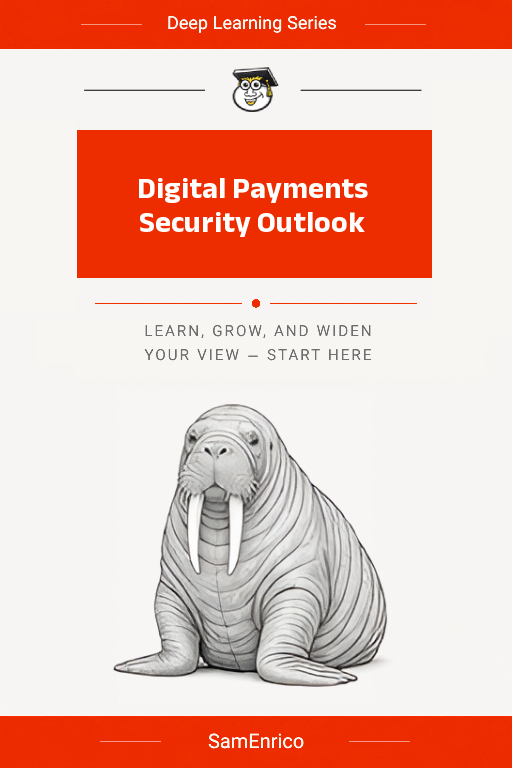
Non-FictionForecast & OutlookPayment Security
Digital Payments Security Outlook eBook
Forecast tokenization adoption, 3D Secure evolutio
Forecast tokenization adoption, 3D Secure evolution, biometric authentication, and fraud rate trends through 2030.
Formats
Free sample
Chapter 1: The Fraud Multiplier...--The math does not work. For every dollar of legitimate e-commerce growth, fraudsters capture roughly two cents. But that two cents is not static—it compounds. A 100billionfraudmarketby2029doesnotmeanfraudstersarestealing2100 billion fraud market by 2029 does not mean fraudsters are stealing 2% of 100billionfraudmarketby2029doesnotmeanfraudstersarestealing25 trillion in transactions. It means they have found leverage.
They have discovered that the same infrastructure that makes digital payments instant, global, and convenient also makes them fragile. This chapter unpacks that leverage. It answers a single question: why is digital payments security so hard, and why is it getting harder despite billions spent on solutions?The Exponential Curve No One Talks About Global e-commerce sales are projected to reach 8.5trillionby2030.Thatisacompoundannualgrowthrateofapproximately98.5 trillion by 2030. That is a compound annual growth rate of approximately 9% from 2025. Impressive, but not shocking.
What is shocking is the trajectory of fraud. According to data from Juniper Research, Aite-Novarica, and the 2024 Global Fraud and Identity Report, e-commerce fraud losses are forecast to more than double from 8.5trillionby2030.Thatisacompoundannualgrowthrateofapproximately940 billion in 2024 to over 100billionby2029,withcontinuedgrowthto100 billion by 2029, with continued growth to 100billionby2029,withcontinuedgrowthto115–120 billion by 2030 depending on the scenario. Fraud is growing at roughly 16% CAGR—nearly twice the rate of e-commerce itself.This is the fraud multiplier effect. Each new channel, each new payment method, each new market creates not just a linear increase in fraud opportunity but an exponential one. Why?
Because fraudsters do not need to invent new techniques. They need only to find the lowest-security channel in a given payment flow and exploit it until it is patched, then move to the next. This is not a war of attrition. It is a game of whack-a-mole played at machine speed.The Two Fraud Families: Technical vs. Manipulated To understand why fraud is accelerating, we must abandon the outdated notion that all fraud is hacking.
The industry has long categorized fraud by method—card skimming, phishing, account takeover, synthetic identity—but these categories obscure a more useful distinction. There are two fundamental families of fraud, and they are diverging at an alarming rate.Technical fraud encompasses breaches, malware, card skimming, and credential stuffing. This is fraud that breaks something. It exploits vulnerabilities in code, networks, or hardware. The good news is that technical fraud is declining as a percentage of all fraud.
Better endpoint security, encryption, tokenization, and behavioral analytics have made it harder to simply steal credentials and use them. From 2020 to 2024, the share of fraud attributed to pure technical attacks dropped from approximately 45% to 28%, according to the 2025 Fraud Intelligence Report from the Merchant Risk Council.Manipulated fraud is the opposite. It does not break anything. It persuades. Social engineering, deepfakes, romance scams, CEO fraud, investment scams, and authorized push payment (APP) fraud all fall into this category.
The fraudster does not need your password. They need you to type it yourself. They do not need to bypass multi-factor authentication. They need you to approve the push notification. Manipulated fraud is rising at three times the rate of technical fraud.
By 2028, over 60% of all fraud across e-commerce, banking, and instant payments will involve some form of social manipulation.Consider the 2025 deepfake CEO scam that cost a multinational corporation $25 million. The fraudster did not hack the company's servers. They did not steal credentials. They used an AI voice deepfake to call the CFO, impersonating the CEO's vocal patterns, accent, and cadence. The call lasted twelve minutes.
The CFO authorized a wire transfer to what appeared to be a legitimate vendor account. The money left the company's account via an instant payment rail and was dispersed across thirty-seven crypto wallets within ninety minutes. No amount of traditional MFA would have stopped this. The authorized user was the authorized user.The False Positive Tax If fraud were simply a matter of catching bad actors, the problem would be solvable. The complication is that security friction also catches good actors.
And merchants pay a hidden tax that dwarfs fraud losses themselves: the false positive tax.A false positive occurs when a legitimate transaction is incorrectly flagged as fraudulent and declined. The industry average false positive rate for rules-based fraud detection systems is approximately 2–5%. That sounds small. At scale, it is devastating. For a merchant processing 500millioninannualonlinerevenuewitha2500 million in annual online revenue with a 2% false positive rate, 500millioninannualonlinerevenuewitha210 million in legitimate transactions are declined every year.
Assuming an average order value of $100, that is 100,000 lost customers. Assuming half of those customers never return, the lifetime value loss is catastrophic.But false positives have another cost: cart abandonment. The average shopping cart abandonment rate due to security friction—forced password resets, OTP challenges, 3DS pop-ups, declined cards—is 8–12%. For cross-border transactions, it can reach 15–18%. Merchants lose twenty times more revenue from false declines and friction-induced abandonment than from actual fraud.
This is the central economic reality of payments security: the cost of saying no to a good customer is far higher than the cost of saying yes to a bad one.This asymmetry is what fraudsters exploit. They know that merchants and banks are terrified of false positives. They know that risk engines are tuned to let borderline transactions through rather than risk losing a customer. And they know exactly where the thresholds are.The Payment Channel Proliferation Problem Ten years ago, the typical online merchant accepted credit cards and perhaps Pay Pal. Today, the average mid-tier merchant accepts credit cards (Visa, Mastercard, Amex, Discover), digital wallets (Apple Pay, Google Pay, Pay Pal, Amazon Pay), buy now pay later (Klarna, Afterpay, Affirm), account-to-account payments (ACH, direct debit), instant bank transfers (PIX in Brazil, UPI in India, Faster Payments in the UK, Fed Now in the US), and cryptocurrency in some markets.Each new payment channel is a new vector.
Not because each channel is inherently insecure, but because each channel has a different risk profile, different settlement timing, different reversal rules, and different data availability. Fraudsters do not attack the strongest channel. They find the weakest.Consider instant payments. Credit cards allow chargebacks up to 120 days post-transaction, giving merchants and issuers time to detect and reverse fraud. Instant payments settle in seconds and are final.
No chargeback. No reversal. Once money leaves an instant payment system, it is gone. Fraudsters have learned this. From 2023 to 2025, instant payment fraud on platforms like Zelle, UPI, and Faster Payments grew at an annual rate of 40%, far outpacing card fraud growth.Consider buy now pay later.
BNPL providers often approve transactions with minimal authentication—no CVV, no 3DS, sometimes no address verification—in exchange for higher conversion. Fraudsters have responded by opening hundreds of synthetic accounts, making small purchases to build trust, then maxing out credit lines across dozens of merchants before disappearing. BNPL fraud losses grew 65% in 2024 alone.Consider cryptocurrency. Irreversible by design, pseudonymous, and global. Crypto scam payment values increased 250% in 2025, according to Chainalysis.
Approval phishing—where scammers trick users into signing a malicious smart contract granting unlimited spending authority—has become a $500 million annual crime.The pattern is consistent. Each new channel creates a window of vulnerability during the first 12–24 months before fraud detection matures. Fraudsters exploit that window, then move to the next new channel. The security industry is always playing catch-up.Why Rules-Based Systems Are…
This is the end of the free sample. Get the eBook to keep going. Buy now
About this book
Details
- Author
- Faulkner Ileen
- Publisher
- SamEnrico
- Language
- English
- Genre
- Non-Fiction, Forecast & Outlook, Payment Security
- Released
- 2026-05-29
- Pages (approx.)
- 128
- Available as
- eBook, Audiobook

Read better in the ZLOADR app
Your eBooks on your phone or tablet. Sign in with your SamEnrico account and start reading.
More by Faulkner Ileen
 Harvard Extension On-Campus OptionFaulkner Ileen$11.99
 The Missing 411 InternationalFaulkner Ileen$11.99
 IBS And SIBO Connection GuideFaulkner Ileen$11.99
 Porn Induced Erectile DysfunctionFaulkner Ileen$11.99
 The Opium King of MandalayFaulkner Ileen$11.99
 The Atlantic Crossings: Prehistoric Voyagers and the Birth of Ocean ExplorationFaulkner Ileen$11.99
 Redtop HarvestingFaulkner Ileen$11.99
 Understanding Humeroradial SynostosisFaulkner Ileen$17.99
 Tristan Walker Unit Economics PrimerFaulkner Ileen$12.99
 How to Start a Cashmere Woollen Weaving Business (Beginners Guide)Faulkner Ileen$11.99
You may also like
 Hong Kong Handover 1997Dunn Johnnie$11.99
 Zumba For Postnatal Recovery CourseNeal Christian$11.99
 Zumba for BeginnersLadner Nikia$11.99
 YouTube Comment Mining GuideHumes Pandora$12.99
 Worry Box MeditationCarlin Rudy$11.99
 Workplace Stress MeditationNguyen Lynn$11.99
 Workplace Stress and Sleep RepairHawley Ivory$11.99
 Workplace Perfectionism CureDelaney Jeffry$11.99
 Workplace Injustice Anger GuideWallen Isabelle$11.99
 Work Addiction and Burnout LinkGreenwood Ester$11.99
 Women in Yoga and WellnessBeattie Galina$11.99
 Women in Stand Up ComedyChun Evangeline$11.99