
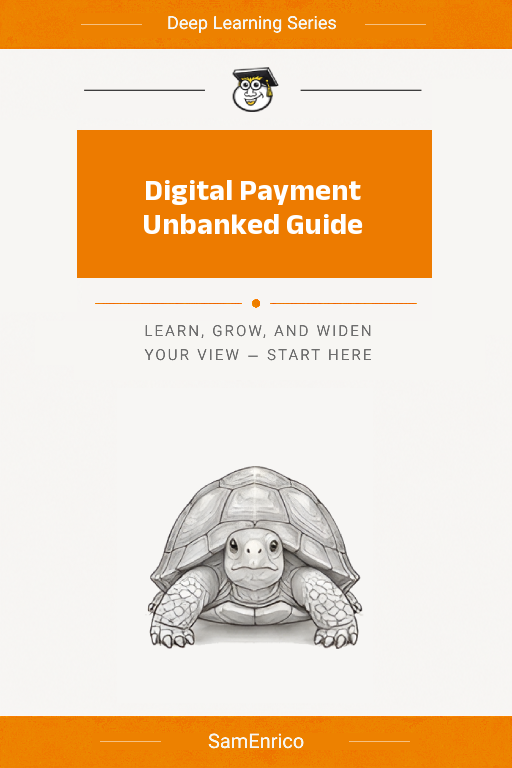
Non-FictionForecast & OutlookFinancial Inclusion
Digital Payment Unbanked Guide eBook
Discover mobile wallet adoption, QR code standardi
Discover mobile wallet adoption, QR code standardization, and microfinance opportunities for underbanked populations.
Formats
Free sample
Chapter 1: The Cashless Delusion--–- The first time I met Asha, she was counting coins in the dust. It was a Tuesday afternoon in Bihar, India, the temperature hovering just above uncomfortable, and she had arranged her earnings from the morning's vegetable sales into six small piles—one for rice, one for kerosene, one for her daughter's school fees, one for the moneylender, one for savings hidden in a clay pot, and one for the unexpected. She did not own a smartphone. She had never seen a QR code. Her "bank" was a folded plastic bag buried beneath the floor of her hut.
She was, by every formal definition, profoundly unbanked.–- And yet, Asha understood money better than most Silicon Valley product managers ever will.–- She knew the weight of a rupee in her palm. She knew that the moneylender would charge her twenty percent interest but would also walk to her house to collect, which mattered because the nearest bank branch was a two-hour bus ride away. She knew that if the government deposited a subsidy into an account she could not access, that money might as well not exist. She knew that cash was slow, risky, and heavy—but she also knew that cash had never asked her for a password she might forget or a signal that might fail.–- For the past decade, the developed world has been telling Asha that her future is cashless. Fintech conferences in London and San Francisco have declared that physical currency is dying, that we are on the cusp of a frictionless digital utopia, and that the unbanked simply need to download the right app.
These pronouncements are made in auditoriums with gigabit Wi-Fi, by people whose phones cost more than Asha earns in a year.–- They are, to put it gently, delusional.–- This book is not for them. Or rather, it is for them—but as a corrective, not a confirmation. The Digital Payment Unbanked Guide is for anyone who actually wants to serve the 1.4 billion adults who remain outside the formal financial system. It is for the policymaker who has read one too many white papers about blockchain solving poverty. It is for the NGO worker who has watched a beautifully designed app fail because the target users did not have email addresses.
It is for the fintech developer who is about to make the same mistakes that have doomed dozens of financial inclusion projects before.–- And it starts with a simple, uncomfortable truth: the cashless society is a myth for the rich. For the unbanked, cash is not a problem to be eliminated. It is a reality to be understood, respected, and eventually—partially—complemented.The Four Populations Behind the Number–- Before we go any further, we need to talk about the number. You have probably heard it before: 1.4 billion unbanked adults worldwide. It is a staggering figure, repeated in World Bank reports and fintech pitch decks with such frequency that it has lost its texture.
It has become a statistic to be optimized rather than a population to be understood.–- The first thing to understand is that "unbanked" is not one thing. It is an umbrella term that covers at least four distinct populations, each with different barriers, different behaviors, and different pathways to inclusion. If you design a solution for "the unbanked" as a single category, you will fail. You will fail because you will build a smartphone app for a feature-phone user. You will fail because you will require identity documents that do not exist.
You will fail because you will assume connectivity that is not there.–- Let us break them down.–- First, there are the unbanked proper: approximately 1.4 billion adults who have no account at a financial institution or mobile money provider. This is the headline number, but it obscures as much as it reveals. Within this group, some have never had an account because they see banks as irrelevant, untrustworthy, or inaccessible. Others had accounts and abandoned them after hidden fees or opaque terms. Still others would open an account tomorrow if someone showed up at their village with a simple, transparent, affordable option.–- Second, there are the underbanked.
These individuals have an account somewhere—perhaps a basic savings account at a rural bank branch—but they continue to use cash for the vast majority of their transactions. They are not, in any meaningful sense, participants in the digital economy. They might receive a government payment into their account and then immediately withdraw the entire amount because they do not trust digital value or because no one in their village accepts digital payments. The underbanked are often invisible in official statistics because they technically have accounts. But they are not banking.
They are cashing out.–- Third, there are the offline-dependent. These individuals may have accounts and may even want to use digital payments. But they live in areas where connectivity is unreliable or nonexistent. A payment app that requires an internet connection is useless to them. They need solutions that work offline—biometric smart cards, USSD codes, or agent-assisted transactions that can be settled when a signal eventually returns.
The offline-dependent are not technologically resistant. They are infrastructure-constrained.–- Fourth, there are the feature-phone users. Approximately 3.4 billion people globally still rely on feature phones—devices that can make calls and send texts but cannot run modern smartphone apps. Some of these individuals are banked. Many are not.
But crucially, they cannot be reached through the app-based solutions that dominate Western fintech. They require USSD interfaces, voice-based systems, or SMS banking. Designing for feature-phone users is not a niche concern. It is the majority of the global population.–- Asha, the woman counting coins in the dust, was all four at once. She had no formal account (unbanked).
She used cash for everything (underbanked). Her village lost signal during monsoon season (offline-dependent). And she owned a ten-year-old Nokia (feature-phone user). Any solution that hoped to serve her would have to address all four realities simultaneously.The $380 Billion Question–- Now let us talk about why you should care. Not because you are a good person—though perhaps you are—but because there is a massive, untapped market hiding in plain sight.–- The unbanked and underbanked collectively move approximately $380 billion annually through purely cash-based transactions.
That is not a typo. Three hundred and eighty billion dollars. Every year. In cash. Outside the formal economy.
Untaxed. Unrecorded. Unlent.–- To put that number in perspective, it is roughly the GDP of Chile. It is more than the combined market capitalization of dozens of major corporations. It is a sum large enough that capturing even a fraction of it would transform a fintech startup from a speculative venture into a generational enterprise.–- And yet, most digital payment companies are fighting over the same saturated customers.
They are competing to be the fifteenth wallet in the pocket of a wealthy urbanite who already has three credit cards and a Venmo account. They are reducing interchange fees by basis points while ignoring a market where the profit per transaction is irrelevant because the volume is…
This is the end of the free sample. Get the eBook to keep going. Buy now
About this book
Details
- Author
- Bradbury Maple
- Publisher
- SamEnrico
- Language
- English
- Genre
- Non-Fiction, Forecast & Outlook, Financial Inclusion
- Released
- 2026-05-30
- Pages (approx.)
- 151
- Available as
- eBook, Audiobook

Read better in the ZLOADR app
Your eBooks on your phone or tablet. Sign in with your SamEnrico account and start reading.
More by Bradbury Maple
 Suicide Loss and AnxietyBradbury Maple$11.99
 Talent Migration and Urban Decline ReversalBradbury Maple$11.99
 The Knox Wrongful Conviction CompensationBradbury Maple$11.99
 Seasonal Eating Blue ZonesBradbury Maple$11.99
 Jeff Bezos Customer ObsessionBradbury Maple$11.99
 The Last Voyage of the Komagata MaruBradbury Maple$11.99
 African Exporter Foreign Exchange Risk ManualBradbury Maple$12.99
 Understanding Lewis–pashayan SyndromeBradbury Maple$17.99
 Decorator CakeBradbury Maple$11.99
You may also like
 Hong Kong Handover 1997Dunn Johnnie$11.99
 Zumba For Postnatal Recovery CourseNeal Christian$11.99
 Zumba for BeginnersLadner Nikia$11.99
 YouTube Comment Mining GuideHumes Pandora$12.99
 Worry Box MeditationCarlin Rudy$11.99
 Workplace Stress MeditationNguyen Lynn$11.99
 Workplace Stress and Sleep RepairHawley Ivory$11.99
 Workplace Perfectionism CureDelaney Jeffry$11.99
 Workplace Injustice Anger GuideWallen Isabelle$11.99
 Work Addiction and Burnout LinkGreenwood Ester$11.99
 Women in Yoga and WellnessBeattie Galina$11.99
 Women in Stand Up ComedyChun Evangeline$11.99