
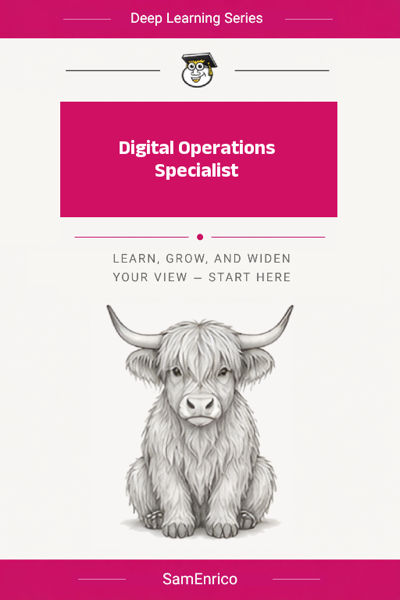
Non-FictionInformativeEducational
Digital Operations Specialist eBook
A Coursebook on Digital Operations Specialist
by Sauls Will
A Coursebook on Digital Operations Specialist
Formats
Free sample
Chapter 1: The Swivel Chair...--You have just spent forty-seven minutes copying customer data from a spreadsheet into your CRM. You have done this exact sequence of clicks—Ctrl+C, Alt+Tab, Ctrl+V, Tab, Tab, Type—so many times that your fingers now perform it without conscious thought. Your boss calls it “data entry.” Your job description calls it “cross-system synchronization.” But you have another name for it. You call it the Swivel Chair.Not because your chair actually swivels, though it does. You call it that because your entire workday has become a slow, maddening dance of turning away from one screen, facing another, and moving numbers back and forth like a bank teller from the 1950s.
Except the bank teller had pneumatic tubes. You have a million-dollar software stack, and somehow, you are still the tube.This chapter is not a history lesson. It is not a theoretical framework. It is an intervention. If you have ever looked at your calendar at 4:47 PM and realized you have accomplished nothing except moving information from one rectangle to another rectangle, you are in the right place.
If you have ever been asked “What do you actually do all day?” and felt a cold flush of existential dread because you could not articulate it without sounding like you do nothing—this chapter is for you.Let us name the enemy before we slay it.The enemy is not your coworkers. The enemy is not your tools. The enemy is not even your boss, though your boss probably does not help. The enemy is a specific, measurable, pernicious form of organizational waste that most companies treat as normal. It has many aliases: manual data entry, re-keying, copy-paste work, swivel-chair integration, the human API.
But whatever you call it, it is stealing your time, your focus, and your sanity. And it is entirely optional.This book is about one thing: teaching you to eliminate the Swivel Chair from your organization, permanently, systematically, and at scale. Not with heroics. Not with all-nighters. Not with a custom software engineering team that costs a million dollars and takes eighteen months.
But with a disciplined, repeatable methodology called Digital Operations—or Digital Ops for short—that turns manual chaos into automated flow.Before we build anything, before we learn a single tool, before we write a single line of configuration, we need to understand what Digital Operations actually is, why it matters to your career, and why the old ways of running operations—the spreadsheets, the email chains, the emergency Friday afternoon fire drills—are not just inefficient but actively dangerous in a world that moves at digital speed.Let us begin.The Day the Spreadsheet Broke A story.In 2018, a mid-sized online retailer—let us call them Swift Cart—was growing fast. Thirty percent month over month. The kind of growth that makes founders giddy and operations managers reach for antacids. Swift Cart sold artisanal coffee equipment. High margin, loyal customers, simple business.
Or so it seemed.Behind the scenes, the operations team ran on what they called “the system.” The system was not software. The system was a person named Kevin.Kevin, a patient thirty-two-year-old with a spreadsheet addiction, spent his days moving order data from Shopify (the web store) into Quick Books (the accounting system) and then into a warehouse management system (a creaky piece of software called WMS-2000 that ran on an emulator). When a customer bought a pour-over stand and a burr grinder, Kevin copied the name, address, and SKUs from one window, pasted them into another, clicked “create invoice,” switched to the third system, updated inventory counts, and then marked the order as fulfilled in a fourth system—a Google Sheet that someone had built three years ago and that no one fully understood but everyone was afraid to touch.Kevin was good at his job. Fast fingers. Few typos.
He processed about eighty orders per day.On a Tuesday in October, Swift Cart ran a flash sale. A thousand orders came in within four hours. Kevin, working furiously, processed two hundred orders before his eyes went blurry and his error rate spiked. By Thursday, fifty customers had received the wrong product. Forty orders were double-billed.
Twenty-three shipments went to wrong addresses. The returns process—also manual, also Kevin—collapsed entirely.The company lost seventy thousand dollars in refunds, replacement shipping, and chargeback fees. Kevin quit three weeks later. His farewell email said, simply, “I can’t do this anymore.”The tragedy of Swift Cart is not that it had bad technology. Swift Cart had fine technology.
Shopify, Quick Books, WMS-2000—each tool worked as designed. The tragedy was that Swift Cart treated Kevin as the integration layer. Kevin was the API. Kevin was the middleware. Kevin was the orchestrator of a digital symphony that should have conducted itself.This is the problem that Digital Operations exists to solve.Defining Digital Operations Digital Operations is the discipline of managing, automating, and continuously improving the end-to-end digital workflows that deliver value to customers.
That sentence is dense. Let us unpack it.Managing means you know what your processes are, how they perform, and where they break. You do not guess. You measure. You do not hope.
You monitor.Automating means you replace human execution with machine execution wherever the machine can do the work faster, more accurately, or more consistently. Not everywhere—machines are terrible at judgment, empathy, and creativity—but wherever the work is repetitive, rule-based, and high-volume.Continuously improving means you never declare victory. You do not build an automation and walk away. You treat operations like a garden: it grows weeds. You tend it.End-to-end digital workflows means you follow the work from the moment a customer clicks a button to the moment they receive value—and beyond, through returns, support tickets, and renewals.
You do not stop at departmental boundaries. The customer does not care that your CRM and your ERP are different systems with different owners and different budget cycles. The customer cares that their order arrives correctly.Deliver value to customers is the most important phrase in that definition. Digital Operations is not about efficiency for its own sake. It is not about cutting costs by automating people out of jobs.
It is about removing friction so that customers get what they want, when they want it, without having to wait for Kevin to finish his copy-paste shift.If you take nothing else from this chapter, take this: Digital Operations is not a technology project. It is a customer experience project that uses technology as its primary tool.Three Roles, One Confusion One reason Digital Operations is so poorly understood is that it sits at the intersection of three older, better-defined disciplines. To know what Digital Ops is, you must first know what it is not.Traditional IT Operations cares about infrastructure. Servers, networks, databases, uptime, security patches, disaster recovery. The IT Ops person asks: “Is the system running?” They monitor CPU usage and memory leaks.
They keep the lights on. They are essential, but they do not care (and should not care) whether a specific order made it from Shopify to Quick Books. That is…
This is the end of the free sample. Get the eBook to keep going. Buy now
About this book
Details
- Author
- Sauls Will
- Publisher
- SamEnrico
- Language
- English
- Genre
- Non-Fiction, Informative, Educational
- Released
- 2026-05-09
- Pages (approx.)
- 147
- Available as
- eBook, Audiobook

Read better in the ZLOADR app
Your eBooks on your phone or tablet. Sign in with your SamEnrico account and start reading.
More by Sauls Will
 Energy Management KPIs GuideSauls Will$11.99
 Last Mile Delivery Driver Incentive Structures HandbookSauls Will$11.99
 Suicide Prevention Hotline GuideSauls Will$11.99
 Body Neutrality Self Esteem GuideSauls Will$11.99
 The Silk Road's Forgotten Guardian: The Tale of Aurel Stein and the Lost Treasures of DunhuangSauls Will$11.99
 Barley & Blood: The Brewing Wars of Ancient SumerSauls Will$11.99
 Understanding Heterotaxy With Polysplenia Or AspleniaSauls Will$17.99
 Artificial Intelligence Talent 2026-2030Sauls Will$12.99
 Global Business Phone Number GuideSauls Will$12.99
 How to Start a Bricks Made of Silica Business (Beginners Guide)Sauls Will$11.99
You may also like
 Hong Kong Handover 1997Dunn Johnnie$11.99
 Zumba For Postnatal Recovery CourseNeal Christian$11.99
 Zumba for BeginnersLadner Nikia$11.99
 YouTube Comment Mining GuideHumes Pandora$12.99
 Worry Box MeditationCarlin Rudy$11.99
 Workplace Stress MeditationNguyen Lynn$11.99
 Workplace Stress and Sleep RepairHawley Ivory$11.99
 Workplace Perfectionism CureDelaney Jeffry$11.99
 Workplace Injustice Anger GuideWallen Isabelle$11.99
 Work Addiction and Burnout LinkGreenwood Ester$11.99
 Women in Yoga and WellnessBeattie Galina$11.99
 Women in Stand Up ComedyChun Evangeline$11.99