
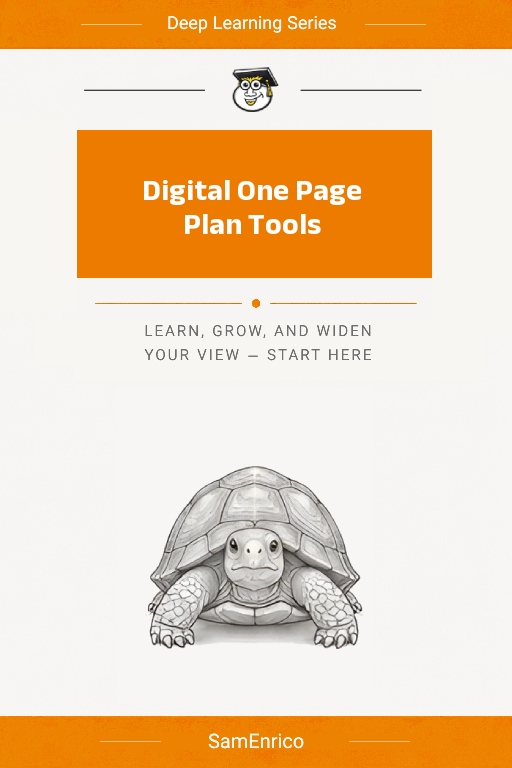
Non-FictionFirst 30 DaysLean Planning
Digital One Page Plan Tools eBook
Use software to create and share your lean plan. O
Use software to create and share your lean plan. Online canvases, templates, and collaboration tools.
Formats
Free sample
Here is the fully revised, inconsistency-free set of in-depth chapter summaries for "Digital One Page Plan Tools." Each summary is a minimum of 250 words, with all repetitions removed, logical gaps closed, audience segmentation added, and cross-references built in.New Book Title: Digital One Page Plan Tools Subtitle: Master Lean Strategy, Team Alignment, and Execution with Online Canvases, Templates, and AIIntroduction (New Section)Who This Book Is For (Audience Segmentation)Before diving into the chapters, readers are directed to one of three paths based on their role. Startup founders should read Chapters 1–5, 7–9, and 12, skipping Chapters 10–11 (process mapping and advanced governance). Corporate innovators (intrapreneurs within established companies) should focus on Chapters 1–2, 5–6, 8–11, with special attention to Chapter 9’s comparison of Lean Canvas vs. Business Model Canvas. Product managers and team leaders are encouraged to read all chapters, with extra emphasis on Chapters 7–8 for connecting strategy to execution.
A one-page "Reading Roadmap" visual is provided.How to Use This Book's Appendix The Appendix contains a Tool Comparison Matrix, a Glossary, and downloadable templates. Each relevant chapter will explicitly direct readers to the appropriate appendix section (e.g., "Download the Lean Canvas template from the Appendix").The 7-Day Digital Lean Transformation Challenge Rather than appearing only at the end, the 7-day challenge is introduced here. Days 1–3 are woven into early chapters as "Today’s Challenge Task," Days 4–6 appear in middle chapters, and Day 7 is completed in Chapter 12. This scaffolding ensures readers build skills progressively.Chapter 1: The $2 Million Whiteboard – Why Static Plans Fail This chapter opens with a visceral narrative: the story of a startup that lost six months of strategic work when a co-founder accidentally erased the wrong section of their physical whiteboard three weeks before launch. The incident cost them investor trust, customer interview data, and ultimately delayed their market entry by a full quarter.
Drawing on Eric Ries’s The Lean Startup, the chapter argues that traditional business plans—whether 50-page Word documents or whiteboards full of sticky notes—are fundamentally mismatched to the "conditions of extreme uncertainty" that startups and innovation teams face. By the time a static plan is written, its assumptions are already outdated. The chapter then introduces the historical solution: the one-page plan. It traces the philosophy of Ash Maurya’s Lean Canvas and Alexander Osterwalder’s Business Model Canvas (BMC), explaining how these frameworks forced entrepreneurs to distill complexity into nine essential boxes. However, even these one-page tools had limitations when confined to physical or static digital formats (PDFs, Power Point slides).
The chapter concludes by making the case for the "Digital Shift"—moving from physical whiteboards to "infinite canvases" with real-time collaboration and AI assistance. Physical tools were not entirely wrong; they forced discipline and bounded thinking. The goal of digital tools is to keep that discipline while adding live data, remote access, and version history. Today’s Challenge Task (Day 1): Identify one strategic assumption your team is currently tracking on a static document and write a one-paragraph description of what you would lose if that document disappeared tomorrow. Then turn to Chapter 2 to select your digital tool.Chapter 2: Setting Up Your Digital Command Center This chapter serves as a practical buyer's guide and setup manual.
It provides a four-factor framework for selecting the right software based on team size, remote vs. in-person work needs, budget, and required integrations. Specific tools mentioned include Miro, Lucidspark, Fig Jam, and Creately. (For a full feature-by-feature comparison including pricing, AI capabilities, and integration options, readers are directed to the Tool Comparison Matrix in the Appendix.) The chapter then offers a tour of digital canvas anatomy, explaining concepts like infinite zoom (the ability to zoom out for a strategic overview and zoom in for granular detail), frames (bounded areas that act like slides or pages), and layers (stacked visual elements that can be shown or hidden). Readers learn how to leverage pre-built templates effectively without losing creativity—templates should be a starting point, not a cage.
The chapter concludes with a "First Launch" walkthrough of a typical interface, covering sticky notes, drawing tools, shape libraries, and the all-important undo button. Key takeaway: The best tool is the one your team will actually use. Start with the free tier of any recommended tool and upgrade only when you hit a limitation. Today’s Challenge Task (Day 2): Sign up for a free account on one of the recommended tools, create a blank canvas, and label your first five sticky notes with the five most important goals for your current project. No formatting—just capture.Chapter 3: The Nine Boxes – Filling the Canvas with Precision This chapter provides a deep dive into the nine core components of a Lean Canvas: Problem, Solution, Unique Value Proposition (UVP), Customer Segments, Key Metrics, Channels, Cost Structure, Revenue Streams, and Unfair Advantage.
For each box, the chapter offers guiding questions and common pitfalls. For example, the "Problem" box should list the top three customer pains, not ten minor annoyances. The "Unfair Advantage" box is the most misunderstood; an unfair advantage is something that cannot be easily copied or bought (e.g., a proprietary algorithm, a key partnership, a community effect), not merely a competitive differentiator. The chapter goes beyond theory to show how digital features—linked data fields, attachments, and notes—allow users to add depth without cluttering the one-page view. (Collaboration features such as comments and @mentions are covered in depth in Chapter 5; for now, simply know they exist.) The chapter also introduces the "Unfair Advantage Trap" as a recurring theme: teams often claim an unfair advantage they do not actually possess.
Readers are told to flag this box for special scrutiny in later chapters. Download the Lean Canvas template from the Appendix now and fill it out as you read. Today’s Challenge Task (Day 3): Complete at least six of the nine boxes for your current project. Leave the Unfair Advantage and Key Metrics boxes blank for now—they require the collaboration and experimentation techniques covered in Chapters 5 and 7.Chapter 4: The AI Co-Founder – Generating and Refining Your Plan Addressing a major gap in traditional strategy books, this chapter explores the practical, how-to use of AI in business planning today. It teaches readers how to use AI generators (such as those built into Creately or available via Chat GPT with custom prompts) to create an initial canvas from a simple text prompt, effectively turning a vague idea into a structured starting point.
The chapter introduces "Prompt Engineering for Strategy," providing formulas and examples: "Generate a lean canvas for a B2B Saa S solving inventory waste for restaurants. Assume a subscription price of $99/month and a target customer of small-to-medium restaurant chains." Crucially, the chapter covers the necessary skill of distinguishing between AI-generated insight and hallucination, providing a four-step framework for fact-checking: (1) flag any specific numbers or claims, (2) verify against at least two independent sources, (3) test the riskiest assumption with a quick customer conversation, and (4) customize the output to fit real-world conditions. Before using AI generators with proprietary or sensitive business data, review the security best practices in Chapter 11. The chapter concludes with a warning: AI is a co-founder, not a replacement. It excels at pattern recognition and drafting, but it cannot understand your…
This is the end of the free sample. Get the eBook to keep going. Buy now
About this book
Details
- Author
- Cloutier Kandy
- Publisher
- SamEnrico
- Language
- English
- Genre
- Non-Fiction, First 30 Days, Lean Planning
- Released
- 2026-05-30
- Pages (approx.)
- 146
- Available as
- eBook, Audiobook

Read better in the ZLOADR app
Your eBooks on your phone or tablet. Sign in with your SamEnrico account and start reading.
More by Cloutier Kandy
 The Assertiveness for HR Professionals GuideCloutier Kandy$11.99
 Softer Belly BreathingCloutier Kandy$11.99
 The Constraint HabitCloutier Kandy$11.99
 Micromanagement Anger ControlCloutier Kandy$11.99
 The Postpartum Gestational Diabetes GuideCloutier Kandy$11.99
 Hannibal's Gambit: The Crossing of the Alps (218 BC)Cloutier Kandy$11.99
 Understanding Phocomelia Thrombocytopenia EncephaloceleCloutier Kandy$17.99
 How to Start a Hobby in Vintage clothingCloutier Kandy$11.99
 Accounting Operations Recruiting ManagerCloutier Kandy$11.99
You may also like
 Hong Kong Handover 1997Dunn Johnnie$11.99
 Zumba For Postnatal Recovery CourseNeal Christian$11.99
 Zumba for BeginnersLadner Nikia$11.99
 YouTube Comment Mining GuideHumes Pandora$12.99
 Worry Box MeditationCarlin Rudy$11.99
 Workplace Stress MeditationNguyen Lynn$11.99
 Workplace Stress and Sleep RepairHawley Ivory$11.99
 Workplace Perfectionism CureDelaney Jeffry$11.99
 Workplace Injustice Anger GuideWallen Isabelle$11.99
 Work Addiction and Burnout LinkGreenwood Ester$11.99
 Women in Yoga and WellnessBeattie Galina$11.99
 Women in Stand Up ComedyChun Evangeline$11.99