
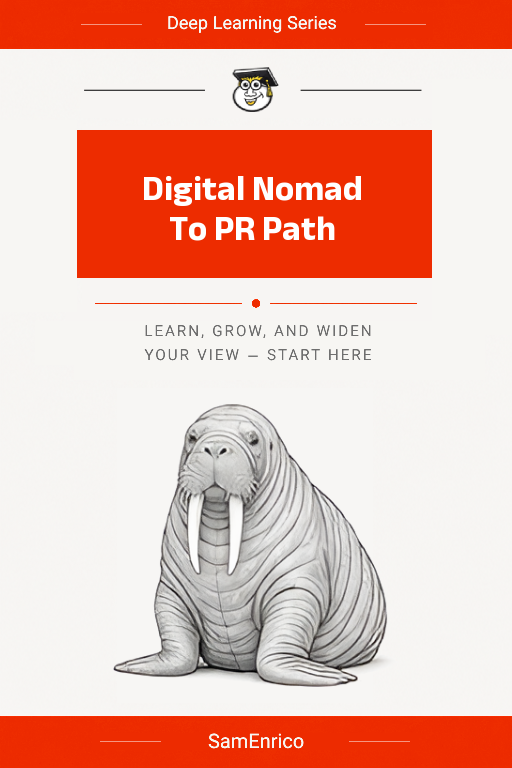
Non-FictionStudent's ShortcutDigital NomadRemote Work
Digital Nomad To PR Path eBook
Study in Canada then work remotely for foreign emp
Study in Canada then work remotely for foreign employers while gaining Canadian experience for Express Entry.
Formats
Free sample
Chapter 1: The $100,000 Loophole--–- The email arrived at 11:47 PM on a Tuesday. Priya had been staring at her screen for fourteen hours, tweaking pixel alignments on a fintech dashboard, when her phone buzzed with the subject line she had been dreading for three years: *H-1B Lottery Results – Not Selected.*She closed her laptop and sat in the dark of her Bangalore apartment. This was her fourth attempt. Four years of working for a San Francisco startup at 2 AM her time, four years of excelling in every performance review, four years of watching colleagues with fewer qualifications get selected while she remained in immigration limbo. Her manager had already told her the company wouldn't sponsor another attempt.
"It's not you," he had said. "It's the system."Priya was twenty-six years old. She had $18,000 in savings, a portfolio of UI/UX work that had won two industry awards, and a future that had just slammed shut.What she did not know, as she sat in the dark that night, was that she was asking the wrong question. She had been asking, How do I get an American work visa? The question she should have been asking was, Where else in the world can I turn my remote job into permanent residency in less than two years?The answer was Canada.
And the path was not what any immigration consultant had ever told her.The False Choice That Keeps Smart People Stuck Every day, thousands of skilled professionals make the same mistake Priya made. They assume that immigrating to a new country means choosing between two identities: student or worker. You either pay tuition and study full-time, or you find a local employer to sponsor your work permit. These two paths are presented as mutually exclusive, like forks in a road where you must pick one and abandon the other.This assumption is wrong. And that wrongness has cost international students billions of dollars in wasted tuition, missed income, and delayed permanent residency.Let us examine the three archetypes currently populating Canada's immigration ecosystem.
Each represents a different strategy, but only one leads to the fastest, most profitable path to permanent residency.Archetype One: The Traditional International Student This is the most common profile. A student from India, China, the Philippines, or Brazil arrives in Canada with a study permit, enrolls in a two or three-year diploma or degree program, and pays international tuition ranging from 20,000to20,000 to 20,000to60,000 CAD per year. During the academic year, they work the maximum permitted twenty hours per week at a local retail or food service job, earning 15to15 to 15to20 CAD per hour. During summer breaks, they work full-time at the same minimum wage jobs.By graduation, this student has accumulated:Tuition debt or savings depletion: 50,000to50,000 to 50,000to120,000 CADCanadian work experience: Approximately 1,200 to 1,500 hours (mostly in TEER 4 or 5 jobs – food service, retail, cleaning – which do not count toward Canadian Experience Class)Local professional network: Minimal, because they have been working service jobs unrelated to their field Post-graduation plan: Find any employer willing to sponsor them for a Post-Graduation Work Permit (PGWP) job, then work for one to two years in an entry-level position before qualifying for Express Entry The traditional international student typically achieves permanent residency in three to five years after graduation. They have spent most of their savings, delayed career progression, and endured years of precarious immigration status.Archetype Two: The Pure Digital Nomad This is the romanticized figure of Instagram reels and You Tube vlogs.
A freelance web developer, copywriter, or designer works remotely from cafés in Chiang Mai, hostels in Medellín, or beach towns in Portugal. They earn in US dollars or euros, live on a fraction of that income, and enjoy the freedom of border-hopping every ninety days.The digital nomad's financials look excellent on paper: 50,000to50,000 to 50,000to100,000 USD in annual revenue, low cost of living, no income tax if they structure their residency correctly. But there is a fatal flaw in this lifestyle for anyone seeking long-term stability.The pure digital nomad accumulates zero residency credit toward any country's permanent residency or citizenship. Every ninety days, they reset their clock. They cannot vote, cannot access public healthcare in most countries, cannot buy property with financing, and cannot plan beyond the next visa run.
When they turn forty and want to settle down, they discover that no country owes them a path to stay.Archetype Three: The Hybrid Nomad – The $100,000 Loophole This is the path Priya would discover, and the path this book exists to teach. The hybrid nomad combines the legal residency vehicle of a Canadian study permit with the income engine of a foreign remote job, while using their physical presence in Canada to accumulate qualifying experience for Express Entry.Let us examine the numbers for a hybrid nomad who follows the strategies in this book.A two-year diploma program at a designated learning institution in Nova Scotia or Manitoba costs approximately 15,000to15,000 to 15,000to25,000 CAD per year in international tuition. Our hybrid nomad works remotely for a US employer earning 55,000USDperyear(approximately55,000 USD per year (approximately 55,000USDperyear(approximately77,000 CAD at current exchange rates). During the academic year, they work fifteen hours per week – leaving a five-hour buffer under the twenty-hour cap. During scheduled breaks (winter break, reading week, summer), they work forty hours per week.The two-year breakdown:Year One:Tuition: $22,000 CADLiving expenses (Halifax or Winnipeg): $24,000 CADRemote income after Canadian taxes: $65,000 CADNet position after Year One: +$19,000 CADHours banked toward CEC: 15 hrs/week × 32 academic weeks = 480 hours + 40 hrs/week × 16 summer weeks = 640 hours.
Total: 1,120 hours.Year Two:Same tuition and living expenses Same remote income Net position after Year Two: another +$19,000 CADHours banked: additional 480 academic hours + 640 summer hours = 1,120 hours Total hours upon graduation: 2,240 hours (well above the 1,560 hours required for CEC)By graduation, the hybrid nomad has:Saved $38,000 CAD (or used it to pay down existing debt)Accumulated more than enough Canadian work experience to apply for PR immediately Maintained their career trajectory (working in their skilled field, not minimum wage jobs)Built a verifiable Canadian footprint through co-working spaces, utilities, and tax filings Achieved PR eligibility within two years of arrival – not five or six The difference between Archetype One and Archetype Three is not a small margin. It is a gap of approximately 100,000inlifetimeearningsandopportunitycost.Thatisthe100,000 in lifetime earnings and opportunity cost. That is the 100,000inlifetimeearningsandopportunitycost.Thatisthe100,000 loophole – and it is not a loophole at all. It is simply a legal strategy that most international students never consider because they assume the study permit is only for studying.Why Most Immigration Consultants Will Not Tell You This If the hybrid path is so advantageous, why do most immigration consultants not recommend it?There are three reasons, none of them flattering to the industry.First, consultants are paid to minimize risk, not maximize returns. A typical immigration consultant charges 2,000to2,000 to 2,000to5,000 to prepare a study permit application.
Their business model depends on high approval rates. The safest application is one that presents the applicant as a traditional, unemployed student with strong ties to their home country. Introducing a foreign remote job adds complexity. Complexity creates the possibility of refusal. Refusal means a refund or a…
This is the end of the free sample. Get the eBook to keep going. Buy now
About this book
Details
- Author
- Hornsby Heide
- Publisher
- SamEnrico
- Language
- English
- Genre
- Non-Fiction, Student's Shortcut, Digital Nomad, Remote Work
- Released
- 2026-05-27
- Pages (approx.)
- 160
- Available as
- eBook, Audiobook

Read better in the ZLOADR app
Your eBooks on your phone or tablet. Sign in with your SamEnrico account and start reading.
More by Hornsby Heide
 The HALT Urge CheckHornsby Heide$11.99
 AI Video Editing for YouTube CreatorsHornsby Heide$11.99
 Co Parenting Stress ManagementHornsby Heide$11.99
 Micro Expressions Mastery PrimerHornsby Heide$11.99
 Panic Disorder Hormonal Fluctuation WorkbookHornsby Heide$11.99
 The Unseen Playbook: How Vince Lombardi Built a Dynasty Through DisciplineHornsby Heide$11.99
 The Last Stand of the 300 Spartans at ThermopylaeHornsby Heide$11.99
 Understanding Burn–goodship SyndromeHornsby Heide$17.99
 Security Guard FTHornsby Heide$11.99
 Automated Bank Fee Analysis GuideHornsby Heide$12.99
 How to Become a CarbonizerHornsby Heide$11.99
You may also like
 Hong Kong Handover 1997Dunn Johnnie$11.99
 Zumba For Postnatal Recovery CourseNeal Christian$11.99
 Zumba for BeginnersLadner Nikia$11.99
 YouTube Comment Mining GuideHumes Pandora$12.99
 Worry Box MeditationCarlin Rudy$11.99
 Workplace Stress MeditationNguyen Lynn$11.99
 Workplace Stress and Sleep RepairHawley Ivory$11.99
 Workplace Perfectionism CureDelaney Jeffry$11.99
 Workplace Injustice Anger GuideWallen Isabelle$11.99
 Work Addiction and Burnout LinkGreenwood Ester$11.99
 Women in Yoga and WellnessBeattie Galina$11.99
 Women in Stand Up ComedyChun Evangeline$11.99