
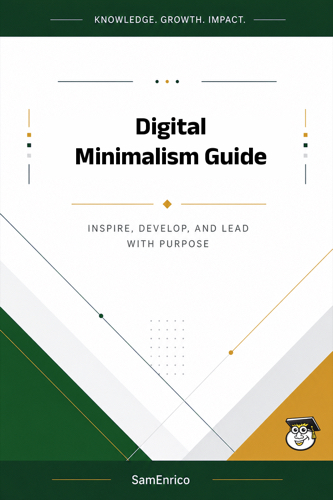
Non-FictionSelf-HelpDigital Minimalism
Digital Minimalism Guide eBook
Reducing app usage to lower exposure to comparison
Reducing app usage to lower exposure to comparison triggers and social pressure.
Formats
Free sample
Chapter 1: The Billion-Dollar Hollow--–- It begins, as it always does, not with a dramatic crash or a loud argument, but with a quiet flick of the thumb. Maya, a 31-year-old marketing manager in Austin, Texas, is sitting on her couch at 10:47 PM on a Tuesday. She has already brushed her teeth, checked her work email for the fifth time, and scrolled through Instagram twice. She is tired. She should sleep.
Instead, she pulls down on the screen to refresh her feed one more time. That single motion—pull and release—costs her nothing in dollars but will cost her the next two hours of her life and a significant chunk of her self-worth.The first post is harmless: a friend’s dog wearing a Halloween costume. Maya smiles. She scrolls. The second post is a former college classmate’s engagement announcement in the south of France.
Maya feels a tiny, almost invisible pang. She scrolls faster. The third post is a colleague’s promotion announcement at a competing firm—a job Maya had secretly applied for and been rejected from three months ago. The pang hardens into a lump in her throat. By the fourth post, an influencer she follows (but does not like) is unboxing a free luxury handbag in a kitchen twice the size of Maya’s entire apartment.
By the fifteenth post, Maya has forgotten the dog entirely. She is now comparing her salary, her relationship status, her vacation history, her kitchen countertops, and her entire life trajectory against a curated feed of strangers and acquaintances. She closes the app feeling smaller than when she opened it. She does not know it yet, but she has just participated in a trillion-dollar transaction where she paid with her attention and received nothing but envy in return.This is not a story of personal weakness. This is a story of engineering.
The hollow feeling Maya experienced is not a bug in the software; it is the primary feature. And until you understand how that feature works, you will remain trapped in what this book calls the Comparison Economy—a system where your attention is the currency, your envy is the product, and your peace of mind is the raw material being extracted.The Slot Machine in Your Pocket To understand why Maya spiraled from a dog photo to self-loathing in less than ninety seconds, you must first understand a psychological mechanism so powerful that it has bankrupted millions of gamblers and enslaved billions of phone users: intermittent positive reinforcement.In the 1950s, psychologist B.F. Skinner conducted a series of experiments with hungry rats. He placed each rat in a box with a lever. When the rat pressed the lever, it received a food pellet.
The rats learned quickly: press lever, get food. But then Skinner changed the rules. Instead of delivering a pellet every time, he programmed the lever to deliver a pellet randomly—sometimes after one press, sometimes after ten, sometimes after fifty. The rats went insane. They pressed the lever obsessively, far more than when the reward was guaranteed.
They pressed until they collapsed from exhaustion. They ignored food available elsewhere in the box. They could not stop.This is intermittent positive reinforcement. When a reward is unpredictable, the brain’s dopamine system goes into overdrive—not because the reward is large, but because the anticipation of a possible reward is neurologically intoxicating. A guaranteed reward produces satisfaction.
An unpredictable reward produces addiction.Now look at your phone. The “pull to refresh” motion on Instagram, Twitter, Facebook, Tik Tok, and even your email inbox is a digital lever. When you pull down, you do not know what you will get. Maybe a like. Maybe a comment.
Maybe a funny meme. Maybe nothing. Maybe a photo of an ex’s engagement. The unpredictability is the poison. Tech companies did not stumble into this design.
They reverse-engineered Skinner’s box and miniaturized it into a device that fits in your pocket. As former Google design ethicist Tristan Harris has testified before Congress, the pull-to-refresh mechanism was explicitly modeled on slot machines. The difference is that slot machines cost you quarters. Social media costs you your sense of self.The Tribal Brain in a Digital World But intermittent reinforcement alone does not explain the specific pain of comparison. For that, we need to travel back 200,000 years to the African savanna, where your brain was originally assembled.The human brain did not evolve to scroll through thousands of curated lives per hour.
It evolved to monitor a tribe of approximately 150 people—the maximum number of stable social relationships that our neocortex can manage, a figure known as Dunbar’s Number. In that ancestral environment, social information was survival information. Who was sleeping with whom? Who had found a new water source? Who was angry at you?
Who was sick? Your brain developed a hyper-sensitive radar for social status because falling in status could mean being exiled from the tribe—and exile meant death. Your ancestors did not have anxiety disorders; they had early warning systems.Your need for social approval is not a weakness. It is a survival instinct hardwired into your limbic system. When you feel the urge to check your notifications, you are not being vain.
You are being vigilant. Your brain is asking, “Am I still safe? Is the tribe still accepting me?” The problem is that you are now receiving social information at a rate and scale your brain never evolved to handle. Your great-grandmother saw perhaps a few dozen faces in a typical week. You see thousands before lunch.
Each face, each post, each like, each comment triggers the same ancient circuits that once kept you alive in a small tribe. But instead of monitoring 150 people you actually know, you are now monitoring a firehose of strangers, celebrities, influencers, and former classmates—most of whom would not recognize you on the street.This is the foundation of the Comparison Economy. Tech companies have hacked your tribal brain. They have figured out that the most reliable way to keep you pulling the lever is to serve you content that triggers social comparison. Not neutral content.
Not even positive content. Comparison content. Because comparison is the emotion that never resolves. Happiness is a destination; you can reach it and stop. Envy is a treadmill; the faster you run, the more you see, and the more you see, the more you need to run.Defining the Comparison Economy Let me introduce a term that will appear throughout this book: The Comparison Economy.An economy is a system of production, distribution, and consumption.
In a traditional economy, you produce goods, you distribute them to consumers, and consumers pay with money. In the attention economy—a concept popularized by Tim Wu and others—users pay with their attention. Platforms like Facebook and Tik Tok give you free content in exchange for your time and eyeballs, which they then sell to advertisers.The Comparison Economy is one layer deeper. In this system, attention is still the currency you pay at the door. But the product being sold—the actual good that changes hands—is not content.
It is envy. Or more precisely, it is the feeling of inadequacy that drives you to seek solutions through consumption.Here…
This is the end of the free sample. Get the eBook to keep going. Buy now
About this book
Details
- Author
- Farias Petronila
- Publisher
- SamEnrico
- Language
- English
- Genre
- Non-Fiction, Self-Help, Digital Minimalism
- Released
- 2026-06-09
- Pages (approx.)
- 139
- Available as
- eBook, Audiobook

Read better in the ZLOADR app
Your eBooks on your phone or tablet. Sign in with your SamEnrico account and start reading.
More by Farias Petronila
 Moonlight Visualization SleepFarias Petronila$11.99
 Pelvic Floor Obesity ImpactFarias Petronila$11.99
 The German Zollverein GuideFarias Petronila$11.99
 Grandparent Childcare Health BenefitFarias Petronila$11.99
 Blood and Jade: The Olmec Colossal Heads' Secret WhisperFarias Petronila$11.99
 Delivery LeadFarias Petronila$11.99
 Non Resident LLC SaaS GuideFarias Petronila$12.99
 Cape Town Edtech GuideFarias Petronila$12.99
 How to Start a Body for Locomotive Business (Beginners Guide)Farias Petronila$11.99
 The Breeder's Guide to Cornish ChickensFarias Petronila$11.99
You may also like
 Hong Kong Handover 1997Dunn Johnnie$11.99
 Zumba For Postnatal Recovery CourseNeal Christian$11.99
 Zumba for BeginnersLadner Nikia$11.99
 YouTube Comment Mining GuideHumes Pandora$12.99
 Worry Box MeditationCarlin Rudy$11.99
 Workplace Stress MeditationNguyen Lynn$11.99
 Workplace Stress and Sleep RepairHawley Ivory$11.99
 Workplace Perfectionism CureDelaney Jeffry$11.99
 Workplace Injustice Anger GuideWallen Isabelle$11.99
 Work Addiction and Burnout LinkGreenwood Ester$11.99
 Women in Yoga and WellnessBeattie Galina$11.99
 Women in Stand Up ComedyChun Evangeline$11.99