
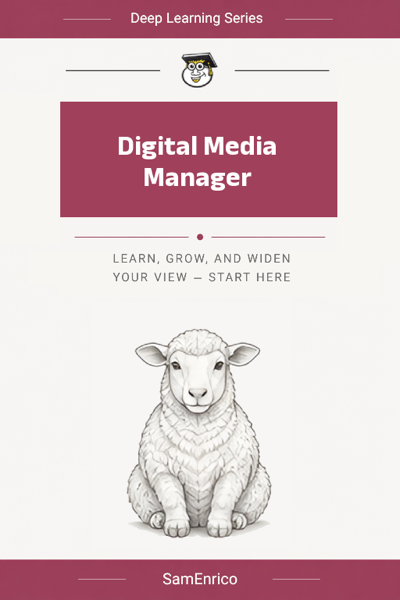
Non-FictionInformativeEducational
Digital Media Manager eBook
A Coursebook on Digital Media Manager
A Coursebook on Digital Media Manager
Formats
Free sample
Chapter 1: The Hidden Map...--–- Most digital media managers wake up on Monday morning already behind. Their inbox has forty-seven unread messages. The content calendar has three empty slots for today. A client from last week is asking why their video “only” got five thousand views. The analytics dashboard is blinking red on something called “engagement rate,” though no one can quite agree on what that means.
And somewhere, buried in a Slack channel, is the note that a major platform changed its algorithm overnight.This is the world you have inherited. It is fast, fragmented, and frequently exhausting. You were hired—or promoted, or voluntold—to be the person who makes sense of digital media. But the truth is that no one gave you a map. You learned on the job, which is another way of saying you learned by making mistakes and hoping no one noticed.
You figured out Tik Tok by watching Tik Tok. You learned about metadata because you spent three hours searching for a video file that someone named “final_FINAL_actuallyfinal.mp4.” You understand that “going viral” is mostly luck, but your boss still asks for it like it is a checkbox.This chapter is the map you never received. It is not a collection of tips or hacks. It will not tell you the best time to post on Instagram—because that answer changes every six months, and because that is not management. Management is understanding why the best time to post changes.
Management is seeing the entire landscape, not just the next post. By the end of this chapter, you will understand the architecture of the modern digital media world. You will know how content moves from an idea in someone’s head to a video on someone’s phone to a dollar in your company’s bank account. You will see the invisible structures that determine whether your work feels like chaos or like a system.And most importantly, you will understand the single most counterintuitive truth of digital media: you do not have one customer. You have two.
And they want completely different things.The Great Unlearning: From Broadcast to Digital Before you can manage digital media, you have to unlearn what the twentieth century taught everyone about how media works. For most of modern history, media was a one-way street. A television network broadcast a show. A radio station transmitted a song. A newspaper printed an edition.
The audience received. The audience consumed. The audience did not talk back.This was the broadcast model, and its logic shaped every media business for nearly a hundred years. Production was expensive, so only large organizations could play. Distribution was controlled by scarce resources—broadcast licenses, printing presses, cable franchises—so gatekeepers decided what the public saw.
Audiences were measured in large, blunt instruments (Nielsen ratings, circulation numbers) that told you how many people watched but almost nothing about who they were or what they actually wanted.Then the internet happened. Suddenly, production costs collapsed. A teenager with a smartphone could produce a video that reached millions. Distribution became infinite—no more “shelf space” constraints. And the audience discovered that they could talk back.
They could comment. They could share. They could create their own content and bypass the gatekeepers entirely.This is the digital model, and it operates on completely different rules. The shift is often described as moving from “push” marketing (the broadcaster pushes content to passive audiences) to “pull” marketing (users pull content they actually want). But that undersells the transformation.
The real change is that power moved from institutions to individuals. A user is no longer an audience member to be counted. They are a participant to be understood.Consider the difference between watching a network television show in 1995 and watching a You Tube video in 2025. In 1995, you had three choices. You watched what was on, when it was on, with no ability to skip ads, no way to talk to other viewers during the show, and no recourse if you hated it beyond changing the channel.
In 2025, you have millions of choices. You watch what you want, when you want, on any device. You can skip ads after five seconds. You can comment, like, share, remix, and reply. You can even make your own video responding to the original.That is the world you are managing.
It is not just a different set of tools. It is a different physics.The most important implication for a digital media manager is this: in a broadcast world, your job was to produce content and distribute it. In a digital world, your job is to attract attention and hold it. Users are not captive. They are one click away from leaving forever.
Every piece of content competes not just with your other content but with every other piece of content on every other platform, plus text messages, email, video games, and the real world outside their window. This is called the attention economy, and it is the single most important constraint on everything you will ever do.The Content Value Chain: How Ideas Become Money Every media business, no matter how simple or complex, follows the same underlying logic. Content moves through a series of stages from raw idea to final revenue. This is the Content Value Chain, and understanding it is the single most useful framework in this entire book.The chain has four links.Creation is where content is born. A writer types a sentence.
A videographer presses record. A designer opens Photoshop. This is the stage that most people think of when they imagine “media.” It is also the stage that digital media managers spend the least amount of time on, because creation is usually done by specialists—writers, editors, videographers, designers. Your job is not to create. Your job is to enable creation.Packaging is what happens after creation.
A raw video file is not content. It becomes content when it is edited, captioned, thumbnailed, described, and formatted for a specific platform. A blog post is not content until it has a headline, subheadings, images, and metadata. Packaging is the invisible work of making content findable, usable, and appealing. Most content failures are not creation failures.
They are packaging failures.Distribution is how content travels from you to the user. This includes everything from posting on social media to sending an email newsletter to running a paid ad campaign to appearing in search results. Distribution is where most digital media managers spend most of their time, because distribution is where the attention battle is fought. You can have the best content in the world, but if no one sees it, it might as well not exist.Monetization is how content turns into revenue. This is the stage that separates a hobby from a business.
Monetization can take many forms—advertising, subscriptions, affiliate commissions, donations, licensing, or direct sales—but the underlying question is always the same: how does this content create value that someone will pay for?Here is the critical insight: every problem in digital media management can be traced to a broken link in this chain. If your content is not getting views, the problem could…
This is the end of the free sample. Get the eBook to keep going. Buy now
About this book
Details
- Author
- Simone Mirtha
- Publisher
- SamEnrico
- Language
- English
- Genre
- Non-Fiction, Informative, Educational
- Released
- 2026-05-25
- Pages (approx.)
- 139
- Available as
- eBook, Audiobook

Read better in the ZLOADR app
Your eBooks on your phone or tablet. Sign in with your SamEnrico account and start reading.
More by Simone Mirtha
 Global Influencer Disclosure LawsSimone Mirtha$11.99
 Car Wash Operation Portuguese TwistSimone Mirtha$11.99
 From Statehouse to SenateSimone Mirtha$11.99
 Writing Goal Action PlanSimone Mirtha$11.99
 The Multigenerational Housing SolutionSimone Mirtha$11.99
 Dot-Bomb: The Rise and Fall of WebvanSimone Mirtha$11.99
 A Beginners Guide to Bocce Ball (Volume 1)Simone Mirtha$11.99
 B2B Payment Terms Evolution GuideSimone Mirtha$12.99
 Notification Overload FixSimone Mirtha$12.99
 Understanding IntoeingSimone Mirtha$17.99
You may also like
 Hong Kong Handover 1997Dunn Johnnie$11.99
 Zumba For Postnatal Recovery CourseNeal Christian$11.99
 Zumba for BeginnersLadner Nikia$11.99
 YouTube Comment Mining GuideHumes Pandora$12.99
 Worry Box MeditationCarlin Rudy$11.99
 Workplace Stress MeditationNguyen Lynn$11.99
 Workplace Stress and Sleep RepairHawley Ivory$11.99
 Workplace Perfectionism CureDelaney Jeffry$11.99
 Workplace Injustice Anger GuideWallen Isabelle$11.99
 Work Addiction and Burnout LinkGreenwood Ester$11.99
 Women in Yoga and WellnessBeattie Galina$11.99
 Women in Stand Up ComedyChun Evangeline$11.99