
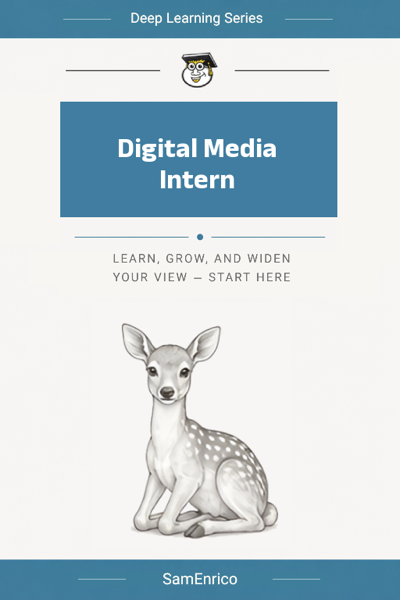
Non-FictionInformativeEducational
Digital Media Intern eBook
A Coursebook on Digital Media Intern
by Mora Sibyl
A Coursebook on Digital Media Intern
Formats
Free sample
Chapter 1: The Zero-to-One Lie--You have been told, probably by a well-meaning professor or a career counselor with a laminated poster, that your internship is about “learning the ropes” or “getting your foot in the door.” That is a comfortable, gentle, and utterly useless lie. The digital media industry does not pay you—or not pay you, in the case of the 43% of media internships that remain unpaid—to learn. It tolerates your presence because there is work no one else wants to do, and because every once in a while, an intern accidentally creates something valuable. Your job, starting now, is to stop being accidental.This chapter reframes the entire internship experience around a single, ruthless principle: Zero to One. You have 120 hours (or 240, or 400—whatever your program requires) to create something that did not exist before you arrived and that will survive your departure.
Not a line on a resume. Not a good reference. A tangible, linkable, screenshot-able, presentable piece of work that you can drop into a portfolio and say, “I made this. It was not here before me. And it proves I can do the job you are hiring for.”If you leave your internship with nothing but a thank-you note and a vague sense of having “networked,” you have failed.
Not morally. Not academically. Strategically. And this book is designed to make sure that does not happen.The 120-Hour Laboratory Let us start with a radical reframing. An internship is not a job.
It is also not school. It is a laboratory—a time-boxed, low-stakes environment where you are allowed to make mistakes, ask stupid questions, and fail publicly, provided you fail forward. The difference between a laboratory and a classroom is that in a laboratory, you produce something. Chemists produce compounds. Biologists produce cultures.
Digital media interns produce portfolio pieces.The average undergraduate internship in digital media runs between 10 and 15 weeks. At 10 hours per week, that is 100 to 150 hours. Call it 120. That is the raw material. The question is not “What will they teach me?” The question is “What can I build in 120 hours that proves I am worth a salary?”Here is what you are competing against.
A recent analysis of 500 entry-level digital media job postings found that 78% required a portfolio. Only 34% required a specific degree. The same analysis found that hiring managers spent an average of 90 seconds on a resume but 4 minutes on a portfolio link. The math is not subtle. Your portfolio is your resume.
Your resume is just the envelope.The Zero-to-One principle, borrowed and brutalized from Peter Thiel’s startup manifesto, means this: Do not copy what exists. Create what is missing. An intern who schedules 120 Instagram posts that were already in the content calendar has done work, but not Zero-to-One work. An intern who notices that the company has no Tik Tok presence, pitches a 10-video pilot series, gets approval, shoots and edits three of them before leaving—that intern has gone from zero to one. The Tik Tok channel existed in possibility.
Now it exists in fact. And that fact is a portfolio piece.GPA Is a Ghost Here is a sentence that will anger your academic advisor: Your GPA does not matter. Not zero. Not completely irrelevant. But close enough that you should stop losing sleep over the difference between a 3.7 and a 3.9.Digital media hiring managers are not stupid.
They know that grade inflation has turned A’s into participation trophies. They know that the skills tested in a multiple-choice exam—memorization, compliance, test-taking speed—have almost nothing to do with the skills required to write a clickable headline, edit a vertical video in 20 minutes, or respond to a brand crisis on Twitter at 10 PM on a Sunday. What they want is proof. Proof that you can do the thing they need done.I have interviewed dozens of digital media professionals over the last three years. I asked each one the same question: “When you look at an intern’s application, what do you look for first?” Seventy-three percent said some version of “work samples.” Twenty-one percent said “relevant experience.” Four percent said “the school they attended.” Two percent said “GPA.” Those two percent were hiring for academic publishing roles.The implication is clear.
Every hour you spend polishing a paper from a B+ to an A- is an hour you are not spending building something a hiring manager can click on. That is not to say you should fail your classes. It is to say that you should treat your coursework as infrastructure—necessary, but not sufficient. The degree gets you past the HR filter. The portfolio gets you the offer.The Traditional Track Versus the Digital Track Not all media internships are created equal.
In fact, they are diverging so rapidly that we now need two separate maps. The traditional track includes television stations, newspapers, radio networks, and legacy magazine publishers. The digital track includes Tik Tok brands, SEO agencies, AI content farms, influencer management companies, and the creator arms of legacy brands (e.g., The Washington Post’s Tik Tok team or NPR’s Instagram operation).The traditional track offers structure, mentorship, and a brand name that your parents have heard of. It also offers declining audiences, slower decision-making, and a higher probability that you will be asked to fetch coffee. The digital track offers chaos, velocity, and a portfolio that looks like modern media.
It also offers a higher probability of burnout and a lower probability of anyone explaining anything to you.Here is the honest assessment. If you want to work at a legacy institution after graduation—the BBC, The New York Times, CNN—the traditional track internship is still the golden ticket. Those organizations hire from their own intern pools. They value institutional knowledge. They move slowly, but they move with weight.If you want to work anywhere else—a startup, a creator economy company, a brand’s in-house media team, an agency—the digital track is not just better; it is necessary.
A traditional newspaper internship will not teach you how to optimize for Tik Tok’s algorithm. An influencer management internship will. A broadcast news internship will not teach you how to read a Meta Ads Manager report. An SEO agency internship will.The trap is the hybrid applicant. The student who applies to 50 digital track jobs with a traditional track portfolio.
Those applications go into the trash. The reverse is also true but less common: a digital track portfolio is increasingly acceptable to traditional employers who are desperate to modernize. If you have to choose, choose digital. The traditional skills (writing, ethics, deadline discipline) are taught in your classes. The digital skills (platform fluency, data literacy, algorithm awareness) are not.The Creator Intern: 2025 Update Something new emerged in the last 18 months.
Call it the Creator Intern. This is an intern who works not for a media company but for a social media influencer—or for a legacy brand’s “creator arm,” a dedicated team that produces content in the style of an influencer rather than a broadcaster.The Creator Intern learns a different set of skills. Not journalism. Not broadcast production. Audience psychology, platform-specific editing, engagement hacking, and the art…
This is the end of the free sample. Get the eBook to keep going. Buy now
About this book
Details
- Author
- Mora Sibyl
- Publisher
- SamEnrico
- Language
- English
- Genre
- Non-Fiction, Informative, Educational
- Released
- 2026-05-25
- Pages (approx.)
- 145
- Available as
- eBook, Audiobook

Read better in the ZLOADR app
Your eBooks on your phone or tablet. Sign in with your SamEnrico account and start reading.
More by Mora Sibyl
 Kim Clijsters Mother ChampionMora Sibyl$11.99
 Overnight Binge StopperMora Sibyl$11.99
 Menopause Protein GuideMora Sibyl$11.99
 Equifax Patching Process FailureMora Sibyl$11.99
 Toxic Shame Healing HandbookMora Sibyl$11.99
 The Glass Ceiling: How One Woman Built the World's Tallest SkyscraperMora Sibyl$11.99
 The Beast of the Black Forest: A Hunter’s SecretMora Sibyl$11.99
 Understanding Geen Sandford Davison SyndromeMora Sibyl$17.99
 How to Start a Software Store BusinessMora Sibyl$11.99
 Sustainable Travel SpendingMora Sibyl$12.99
 Australian Trade Visa WorkbookMora Sibyl$12.99
You may also like
 Hong Kong Handover 1997Dunn Johnnie$11.99
 Zumba For Postnatal Recovery CourseNeal Christian$11.99
 Zumba for BeginnersLadner Nikia$11.99
 YouTube Comment Mining GuideHumes Pandora$12.99
 Worry Box MeditationCarlin Rudy$11.99
 Workplace Stress MeditationNguyen Lynn$11.99
 Workplace Stress and Sleep RepairHawley Ivory$11.99
 Workplace Perfectionism CureDelaney Jeffry$11.99
 Workplace Injustice Anger GuideWallen Isabelle$11.99
 Work Addiction and Burnout LinkGreenwood Ester$11.99
 Women in Yoga and WellnessBeattie Galina$11.99
 Women in Stand Up ComedyChun Evangeline$11.99