
Non-FictionInformativeEducational
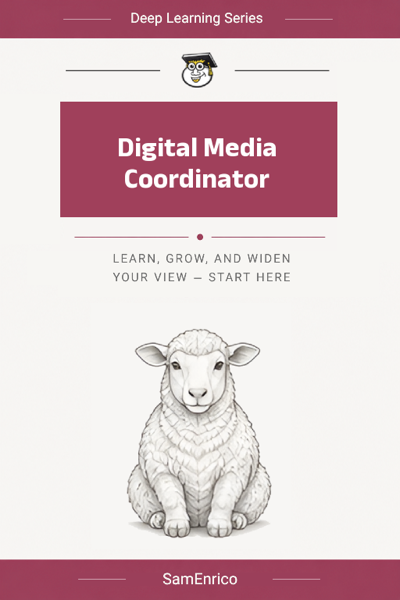
Digital Media Coordinator eBook
A Coursebook on Digital Media Coordinator
by Weems Corrie
A Coursebook on Digital Media Coordinator
Formats
Free sample
Chapter 1: The Calendar Lie--–- Rachel had been a Digital Media Coordinator for eleven months. Every morning, she opened her meticulously planned content calendar, copied the pre-written post into Meta Business Suite, added the link, selected the thumbnail, and clicked "Publish." Then she did it again at noon. Then again at 4 PM. She had 347 posts scheduled for the next quarter. She had color-coded everything: green for product posts, blue for educational content, yellow for engagement.
Her manager loved the calendar. Her team loved the predictability. There was just one problem.Nothing was working.Her engagement rate had flatlined three months ago. Her click-through rate was actually dropping. And when she pulled the year-to-date analytics for her monthly report, she discovered something that made her stomach drop: of the 847 posts she had published in the last eleven months, exactly fourteen had driven measurable business results.
Fourteen. That was a success rate of 1.6 percent.Rachel had done everything right. She had read the blogs, attended the webinars, and built the kind of content calendar that case studies praised. She had balanced promotional content with educational content. She had posted three times per day on every platform.
She had never missed a scheduled post, not once. And yet, she was failing. Her job felt like a treadmill that was slowly accelerating while she stood still.Rachel's problem was not her work ethic. It was not her creativity. It was not even her platforms.
Rachel's problem was that she had confused activity with impact. She had built a calendar that looked impressive but delivered nothing. And she was not alone.Every week, thousands of Digital Media Coordinators open their content calendars and ask the same question: "Why am I doing this?" The calendar tells them to post. The calendar tells them what to say. But the calendar has no idea if anyone is actually listening.
A content calendar that schedules posts without a strategic framework is not a tool. It is a trap.This chapter is called The Calendar Lie because that is what most content calendars are: lies we tell ourselves to feel productive. We fill them with posts, we color-code them, we share them with our teams, and we mistake the act of planning for the act of succeeding. But a calendar is not a strategy. It is a container.
And if you put random things into that container, you will get random results.By the end of this chapter, you will understand why most content calendars fail, how to conduct a ruthless content audit that reveals what is actually working, and how to build a calendar that serves your goals instead of serving itself. You will also learn the three workflow tools that separate professional coordinators from overwhelmed amateurs. And you will never, ever schedule a "just because" post again.The Three Deadly Sins of Content Calendars Before we fix your calendar, we need to understand how it broke. After analyzing the calendars of over two hundred Digital Media Coordinators across nonprofits, startups, and Fortune 500 companies, a clear pattern emerged. Almost every failing calendar commits at least one of three deadly sins.
Most commit all three.Sin Number One: The Holiday Hangover The most common calendar sin is also the most seductive. It looks like this: January has posts about New Year's resolutions. February has posts about Valentine's Day and Black History Month. March has International Women's Day and St. Patrick's Day.
April has Earth Day. May has Memorial Day. June has Pride Month. July has Independence Day. August has back-to-school.
September has Labor Day. October has Halloween. November has Thanksgiving. December has holiday gift guides.This is called the Holiday Hangover, and it is everywhere. It is also almost completely useless.Here is the truth that no one tells you: most holidays do not matter to your audience.
Unless you sell greeting cards, flowers, or themed party supplies, posting about National Pancake Day is not going to move your business metrics. It might get a few likes from people who enjoy pancakes, but likes do not pay rent. The Holiday Hangover is a trap because it fills your calendar with content that feels timely but is actually generic. Every brand posts about the same holidays on the same days. Your audience has seen it all before.
They have stopped paying attention.The fix is brutal but liberating: delete every holiday post that does not directly connect to your product, service, or mission. If you run a pet supply company, National Dog Day matters. If you run an accounting firm, it does not. Be ruthless. Your calendar will look emptier, but that emptiness is actually space for content that works.Sin Number Two: The Volume Vow The second deadly sin is the belief that more content equals better results.
This sin usually begins with a manager saying something like, "We need to post three times per day on every platform to stay relevant." Or worse, the coordinator internalizes this belief without anyone saying it at all.The Volume Vow leads to exhaustion, burnout, and diminishing returns. When you post three times per day, you run out of good ideas by day four. By day ten, you are recycling old content. By day thirty, you are posting things that even you do not believe in. Your audience can tell.
They may not consciously notice that your quality has dropped, but they will unconsciously engage less. Your reach will fall. Your click-through rate will plummet. And you will respond by posting even more, because surely the problem is not enough volume.It is not. The problem is not enough value.Research consistently shows that for most organizations, posting once per day on each primary platform is the maximum effective frequency.
For many, three to five times per week is better. For some, once per week is optimal. The right frequency is not determined by what your competitors are doing or what a blog post told you. It is determined by your audience's appetite and your capacity to create genuinely valuable content.The fix is to cut your planned volume in half. If you were posting twenty times per week, schedule ten.
Use the time you save to make those ten posts twice as good. Then measure what happens. Almost always, engagement increases, not decreases, when you post less but better.Sin Number Three: The Calendar as Master The third and most insidious sin is when the calendar becomes the master instead of the servant. This happens when a coordinator schedules posts weeks or months in advance and then follows that schedule blindly, regardless of what is happening in the world, in their organization, or with their audience.The Calendar as Master leads to spectacular failures. You have seen them: a brand posts a cheerful promotional message hours after a national tragedy.
A company's automated tweet goes out during a PR crisis, completely ignoring the context. A coordinator schedules a post about "getting away from it all" while their audience is struggling with a natural disaster.But the problem is not just about major crises. The Calendar as Master also kills everyday relevance. If you schedule a post about a product feature three weeks in…
This is the end of the free sample. Get the eBook to keep going. Buy now
About this book
Details
- Author
- Weems Corrie
- Publisher
- SamEnrico
- Language
- English
- Genre
- Non-Fiction, Informative, Educational
- Released
- 2026-06-02
- Pages (approx.)
- 149
- Available as
- eBook, Audiobook

Read better in the ZLOADR app
Your eBooks on your phone or tablet. Sign in with your SamEnrico account and start reading.
More by Weems Corrie
 Retail Customer Rage De escalationWeems Corrie$11.99
 OCD And Skin Picking ExcoriationWeems Corrie$11.99
 Nonverbal Cues In Courtroom Jury Selection CourseWeems Corrie$11.99
 Mind Mapping for ManagersWeems Corrie$11.99
 Survey Data Deduplication with AIWeems Corrie$11.99
 The Amazon Sky: Brazil's Bold Leap into SpaceWeems Corrie$11.99
 Silent Witness: The Vanishing of the Queen Mary’s Ghostly PassengerWeems Corrie$11.99
 Understanding CancerWeems Corrie$17.99
 PhD Waiver for Publication RequirementWeems Corrie$12.99
 Estonian Master Degree GuideWeems Corrie$12.99
 How to Start a Hobby in LetterboxingWeems Corrie$11.99
You may also like
 Hong Kong Handover 1997Dunn Johnnie$11.99
 Zumba For Postnatal Recovery CourseNeal Christian$11.99
 Zumba for BeginnersLadner Nikia$11.99
 YouTube Comment Mining GuideHumes Pandora$12.99
 Worry Box MeditationCarlin Rudy$11.99
 Workplace Stress MeditationNguyen Lynn$11.99
 Workplace Stress and Sleep RepairHawley Ivory$11.99
 Workplace Perfectionism CureDelaney Jeffry$11.99
 Workplace Injustice Anger GuideWallen Isabelle$11.99
 Work Addiction and Burnout LinkGreenwood Ester$11.99
 Women in Yoga and WellnessBeattie Galina$11.99
 Women in Stand Up ComedyChun Evangeline$11.99