
Non-FictionInformativeEducational
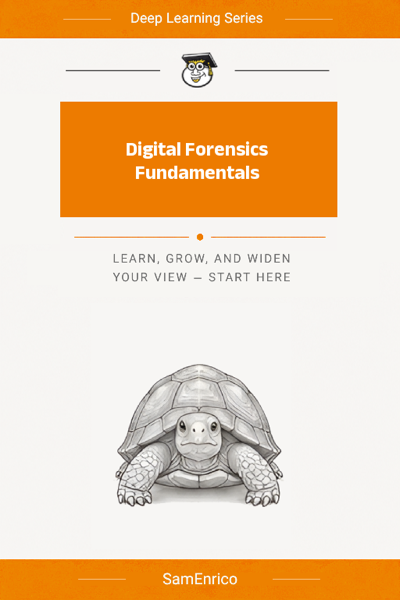
Digital Forensics Fundamentals eBook
A Coursebook on Digital Forensics Fundamentals
by Downs Gianna
A Coursebook on Digital Forensics Fundamentals
Formats
Free sample
Chapter 1: The Digital Crime Scene...--The phone rang at 2:47 AM. On the other end, a voice—fractured, urgent—said three words that would become etched into the memory of every forensic examiner who heard them: “We’ve been breached.” By sunrise, a team of investigators would be staring at a screen showing encrypted hard drives, deleted logs, and a timeline that had been deliberately shattered. Somewhere in that digital wreckage was the evidence needed to identify the attacker. But finding it would require more than technical skill. It would require a fundamentally different way of thinking about evidence itself.This is not the opening scene of a thriller novel.
It is a Tuesday morning for thousands of digital forensic examiners worldwide. And it is the reality that this book prepares you to face.Before you learn a single command, before you open a single forensic tool, before you image your first hard drive, you must understand what digital forensics actually is—not as a textbook definition, but as a discipline that operates at the intersection of technology, law, and human behavior. This chapter establishes that foundation. It distinguishes digital forensics from fields it is often confused with. It traces how digital evidence evolved from floppy disks to cloud servers.
It contrasts two radically different investigative environments: criminal justice and corporate response. And it introduces the role you may one day occupy—the expert witness—while saving the technical details for the chapters that follow.If you are seeking a career where every case is unique, where your work can send a criminal to prison or exonerate the innocent, and where the adversary is constantly innovating, then digital forensics is your arena. But first, you must learn to see the digital crime scene.Defining the Discipline: What Digital Forensics Is (and Is Not)Digital forensics is the process of identifying, preserving, analyzing, and presenting digital evidence in a manner that is legally acceptable. That definition contains four distinct verbs—identifying, preserving, analyzing, presenting—and one critical qualifier: “legally acceptable.” Without legal acceptability, your work is merely data recovery. With it, your work can determine guilt, innocence, liability, or policy violations.The confusion begins with neighboring disciplines.
Three fields are frequently conflated with digital forensics, but the distinctions matter profoundly.First, E-discovery (electronic discovery) operates in the civil litigation context. When two corporations sue each other over a contract dispute, E-discovery professionals collect emails, documents, and spreadsheets from servers and workstations. The rules of civil procedure govern their work. The standard of evidence is relevance, not integrity. Metadata can be altered as long as the substance remains authentic.
In contrast, digital forensics operates primarily in criminal or regulatory contexts where even a single changed timestamp can render evidence inadmissible. An E-discovery professional who accidentally modifies a file’s last access time may face a sanctions motion. A forensic examiner who does the same thing may cause a guilty person to walk free.Second, data recovery prioritizes salvaging lost files over preserving evidentiary integrity. When you accidentally delete your thesis and run Recuva, you are performing data recovery. The goal is getting the file back, regardless of whether timestamps remain intact or chain of custody is documented.
Forensic examiners recover deleted files too, but they do so within a framework of write-blocking, hashing, and documentation that ensures the recovered file is indistinguishable from the original state. Data recovery is about saving. Forensics is about proving.Third, incident response is sometimes a subset of digital forensics and sometimes a separate discipline, depending on the organization. During an active cyberattack, incident responders focus on containment, eradication, and recovery—often destroying evidence in the process (unintentionally). A forensic examiner called into the same breach may prioritize evidence preservation over stopping the attack, leading to tension.
The best organizations integrate both functions, but as a forensic professional, you must understand the difference: incident response answers “How do we stop this right now?” while forensics answers “What happened, who did it, and can we prove it in court?”The best-selling textbooks in this field—including Kävrestad et al.’s “Fundamentals of Digital Forensics” (2024 edition) and Sammons’ “The Basics of Digital Forensics”—all begin with these distinctions for a reason. Without them, students enter the technical content confused about the legal and procedural boundaries of their work. You now have that clarity.The History of Digital Evidence: From Floppy Disks to the Cloud Digital forensics did not emerge from an academic laboratory. It emerged from courtrooms, police stations, and the desperate need to make sense of a new kind of crime.The earliest known case involving computer-generated evidence is United States v. Andrus (1984).
A defendant challenged the admission of magnetic tape records showing financial fraud. The court allowed the evidence, establishing that computer records could be admitted under the business records exception to the hearsay rule. This was a modest beginning: floppy disks, dot-matrix printouts, and hours of expert testimony explaining what a “file” even was.The 1990s brought two transformative developments. First, the internet turned local crimes into global investigations. The creation of the Federal Bureau of Investigation’s Computer Analysis and Response Team (CART) in 1991 marked the first formalized digital forensics unit within a major law enforcement agency.
Second, the proliferation of personal computers meant that nearly every crime—not just cybercrime—left digital traces. Murder investigations began to include laptop examinations. Fraud cases turned on spreadsheet metadata. The term “digital evidence” entered the legal lexicon.The 2000s saw the formalization of the discipline. Organizations like the Scientific Working Group on Digital Evidence (SWGDE) and the International Organization on Computer Evidence (IOCE) published standards for digital evidence handling.
The Daubert standard (addressed in Chapter 2) forced forensic examiners to justify their methodologies scientifically. Universities began offering degrees in digital forensics. Commercial tools like En Case and FTK matured from niche products to courtroom necessities.The 2010s and 2020s introduced the challenges that define modern practice: encryption (full-disk, file-level, and cloud-based), smartphones that resist even physical acquisition, solid-state drives that erase deleted data automatically via the TRIM command, and cloud environments where “the evidence” is distributed across three continents and accessible only via legal process. The 2016 FBI attempt to unlock an i Phone used by the San Bernardino shooters—which cost over one million dollars and required a novel exploit—illustrated how encryption has fundamentally changed the playing field. As of 2025, the cat-and-mouse game between forensic examiners and device manufacturers has only intensified.This history matters because it explains why your job will be harder than it looks in the textbooks.
The pioneers of digital forensics worked in an era when deleted files stayed on the drive, encryption was rare, and suspects did not know how to wipe their own logs. You work in an era where every adversary has read the same books you have. But you also work in an era where the volume of digital evidence is staggering—and each piece of that evidence is a potential thread to pull.Two Investigative Worlds: Criminal vs. Corporate Forensics Not all digital forensics investigations are the same. The differences between criminal and corporate forensics are so fundamental that many examiners specialize in one domain exclusively.
Understanding these differences early will help you chart your career path and avoid costly mistakes if you cross between them.Criminal…
This is the end of the free sample. Get the eBook to keep going. Buy now
About this book
Details
- Author
- Downs Gianna
- Publisher
- SamEnrico
- Language
- English
- Genre
- Non-Fiction, Informative, Educational
- Released
- 2026-05-11
- Pages (approx.)
- 160
- Available as
- eBook, Audiobook

Read better in the ZLOADR app
Your eBooks on your phone or tablet. Sign in with your SamEnrico account and start reading.
More by Downs Gianna
 Procrastination Overcoming WorkbookDowns Gianna$11.99
 Research Proposal Pilot Study PlanningDowns Gianna$11.99
 Myanmar Rohingya Family ReunitedDowns Gianna$11.99
 Self Esteem for Aging LGBTQ+ SeniorsDowns Gianna$11.99
 Luxury Goods EconomicsDowns Gianna$11.99
 Gymnastics Routine Lock InDowns Gianna$11.99
 Digital Nomad Visa TrendsDowns Gianna$11.99Digital Nomad Visa TrendsDowns Gianna$11.99
 Everglades Swamp SinkingsDowns Gianna$11.99
 The Great Cookie Heist: How a 1980s Baking Empire Collapsed OvernightDowns Gianna$11.99
 The Magnificent Merchants of the Sahara: The Gold Caravans of the WangaraDowns Gianna$11.99
 Growing DiphylleiaDowns Gianna$11.99
You may also like
 Hong Kong Handover 1997Dunn Johnnie$11.99
 Zumba For Postnatal Recovery CourseNeal Christian$11.99
 Zumba for BeginnersLadner Nikia$11.99
 YouTube Comment Mining GuideHumes Pandora$12.99
 Worry Box MeditationCarlin Rudy$11.99
 Workplace Stress MeditationNguyen Lynn$11.99
 Workplace Stress and Sleep RepairHawley Ivory$11.99
 Workplace Perfectionism CureDelaney Jeffry$11.99
 Workplace Injustice Anger GuideWallen Isabelle$11.99
 Work Addiction and Burnout LinkGreenwood Ester$11.99
 Women in Yoga and WellnessBeattie Galina$11.99
 Women in Stand Up ComedyChun Evangeline$11.99