
Non-FictionInformativeEducational
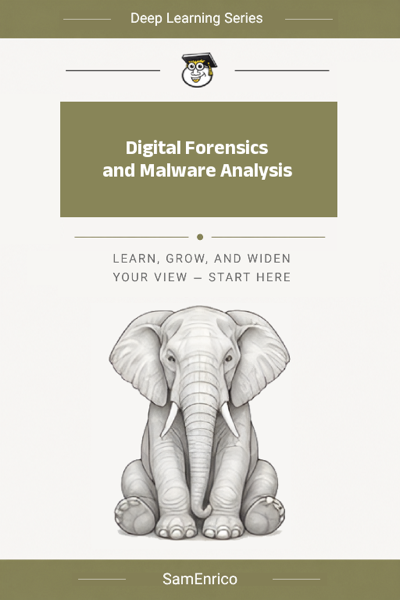
Digital Forensics and Malware Analysis eBook
A Coursebook on Digital Forensics and Malware Anal
A Coursebook on Digital Forensics and Malware Analysis
Formats
Free sample
Chapter 1: The 3 AM Phone Call--–- The phone rang at 3:14 AM on a Tuesday. Not the normal ringtone—this was the emergency line, the one reserved for active breaches, ransomware detonations, and the kind of calls that end careers. On the other end of the line was Sarah, the overnight SOC lead at a regional hospital network. Her voice carried that particular strain of controlled panic that only comes from watching a decade of patient records encrypt in real time.“We have a problem,” she said. “A big one.”Within thirty minutes, you are on a VPN connection, staring at a screen filled with alarming telemetry.
Fifty-seven servers showing signs of encryption. Fourteen hundred workstations locked. A ransom note appearing on every急诊 intake computer. The attacker is demanding $4.7 million in cryptocurrency. And somewhere in the chaos, someone already suggested “just pull the plugs.”That suggestion, as you are about to learn, would have been a catastrophic mistake.This chapter exists because most organizations respond to breaches exactly the way the hospital almost did: reactively, in panic, destroying evidence while trying to stop the bleeding.
The difference between a career-defining investigation and a career-ending failure comes down to one concept—forensic readiness. This chapter will transform you from a reactive cleaner into a strategic investigator. You will learn the fundamental difference between incident response and digital forensics, build your first “jump bag” of essential tools, and understand why the decisions you make in the first five minutes determine whether the attacker goes to prison or walks free.By the end of this chapter, you will not only know what to do when the 3 AM call comes—you will have practiced it.The Critical Distinction: Incident Response vs. Digital Forensics Let us start with a truth that most security professionals learn the hard way: incident response and digital forensics are not the same thing. They are related, they overlap, and they often involve the same people.
But they have different goals, different timelines, and—most critically—different priorities that can come into direct conflict.Incident response is about the present and the future. Its job is to contain the breach, eradicate the attacker, and recover normal operations. The incident responder asks: “How do we stop this right now?” They want to shut down compromised systems, block IP addresses, reset passwords, and restore from backups. These are good things. They save businesses.Digital forensics is about the past and the future—but a different future.
Forensics asks: “What happened, who did it, and how do we prove it?” The forensic analyst wants to preserve every byte of evidence, document every action, and build a timeline that will hold up in court or boardroom. They are horrified by the idea of shutting down a system before capturing its volatile memory.Here is the conflict: The responder wants to pull the plug. The forensic analyst wants to leave the system running to capture RAM. Both are correct. Both cannot happen simultaneously.Consider the hospital breach.
If the response team had simply powered off the infected servers, they would have lost everything in memory: the attacker’s active command channel, the encryption keys still in RAM, the network connections showing the command and control (C2) server. That evidence would have been gone forever. But if they had done nothing while forensic analysts captured memory, the ransomware would have continued encrypting patient data for another hour.The solution—and the reason you are reading this book—is forensic readiness. Forensic readiness means pre-positioning tools, playbooks, and authority so that when the breach happens, you can collect evidence without slowing down containment. It means having a memory capture tool ready to deploy alongside the containment script.
It means knowing that you can capture RAM in thirty seconds while the responder kills network connectivity at the same time.Throughout this book, we will build your forensic readiness from the ground up. But first, you need to understand the terrain.The Six Phases of a Forensic Investigation Every digital forensic investigation follows a well-established methodology. Memorize these six phases. They will guide every decision you make from this chapter through the final report in Chapter 12.Phase 1: Identification Something has gone wrong. An alert fired.
A user reported strange behavior. A ransom note appeared. Your job in this phase is to recognize that an incident requiring forensic investigation is occurring. This sounds obvious, but experienced investigators know that the first sign of a breach is rarely a clear alert—it is often a small anomaly: an unexpected outbound connection, a odd registry key, a user account logging in at 3 AM from a foreign country.In the hospital breach, identification came from the encryption alert. But a better investigator would have identified the breach hours earlier—when the attacker first established persistence, before the ransomware deployed.
Later chapters will teach you to spot those early indicators.Phase 2: Preservation This is where most investigations fail. Preservation means protecting the evidence from alteration or destruction. It includes the order of volatility (which we cover fully in Chapter 5) and the chain of custody (Chapter 2). Preservation is not passive—it requires active decisions about what to capture first, what tools to use, and what to document.The golden rule of preservation: Never trust the original. You work exclusively from forensic images and verified copies.
If you modify the original evidence, you have destroyed its admissibility.Phase 3: Collection Collection is the mechanical act of acquiring the evidence: imaging disks, capturing RAM, exporting logs, saving PCAPs. This phase is governed by strict procedures. You will use write-blockers. You will verify hashes. You will complete chain of custody forms.
Collection without documentation is just data—it is not evidence.Phase 4: Examination Examination is the technical deep dive. You parse file systems, extract registry keys, run YARA rules, and build timelines. This phase answers the question: “What artifacts exist?” Note that examination does not yet draw conclusions—it simply identifies what is present. In the hospital breach, examination would reveal that a specific executable ran, that it created certain registry keys, and that it communicated with a specific IP address.Phase 5: Analysis Analysis takes the artifacts from examination and draws conclusions. Analysis answers: “What does this mean?” The executable is identified as a known ransomware variant.
The registry keys show persistence. The IP address belongs to a known malicious hosting provider. Analysis connects the dots.Phase 6: Reporting Reporting is where your work becomes actionable. You must communicate findings to two very different audiences: technical teams (who need Io Cs to hunt elsewhere) and executives (who need to know business impact and legal exposure). Chapter 12 is entirely dedicated to this critical skill.Throughout this book, each chapter builds skills for specific phases.
Chapters 1-4 focus on identification and preservation. Chapters 5-7 cover collection. Chapters 8-11 teach examination and analysis. Chapter 12 ties everything to reporting.Building Your Jump Bag: Essential Tools Before the Breach A “jump bag” is a pre-assembled collection of tools that you can deploy immediately when an incident occurs. You do not want to be downloading software at 3 AM while a hospital is being encrypted.
Your jump bag lives on a trusted USB drive or secured network share, with verified hashes for every executable.Here are…
This is the end of the free sample. Get the eBook to keep going. Buy now
About this book
Details
- Author
- Burden Junita
- Publisher
- SamEnrico
- Language
- English
- Genre
- Non-Fiction, Informative, Educational
- Released
- 2026-06-02
- Pages (approx.)
- 142
- Available as
- eBook, Audiobook

Read better in the ZLOADR app
Your eBooks on your phone or tablet. Sign in with your SamEnrico account and start reading.
More by Burden Junita
 Young Widow Survival GuideBurden Junita$11.99
 Business Credit for Startups GuideBurden Junita$12.99
 John Nicholson BiographyBurden Junita$11.99
 Azeri Armenian EscapeBurden Junita$11.99
 Teen Walking MindfulnessBurden Junita$11.99
 Work Addiction Mindfulness PracticeBurden Junita$11.99
 The Product Manager Creativity GuideBurden Junita$11.99
 The Magician Dream FigureBurden Junita$11.99
 Pain Catastrophizing InterruptBurden Junita$11.99
 Dreams About Foster CareBurden Junita$11.99
 The Visionary and the Void: Ridley Scott’s Unseen BattlesBurden Junita$11.99
 The Calculus of Kings: How African Mathematicians Shaped the Ancient WorldBurden Junita$11.99
You may also like
 Hong Kong Handover 1997Dunn Johnnie$11.99
 Zumba For Postnatal Recovery CourseNeal Christian$11.99
 Zumba for BeginnersLadner Nikia$11.99
 YouTube Comment Mining GuideHumes Pandora$12.99
 Worry Box MeditationCarlin Rudy$11.99
 Workplace Stress MeditationNguyen Lynn$11.99
 Workplace Stress and Sleep RepairHawley Ivory$11.99
 Workplace Perfectionism CureDelaney Jeffry$11.99
 Workplace Injustice Anger GuideWallen Isabelle$11.99
 Work Addiction and Burnout LinkGreenwood Ester$11.99
 Women in Yoga and WellnessBeattie Galina$11.99
 Women in Stand Up ComedyChun Evangeline$11.99