
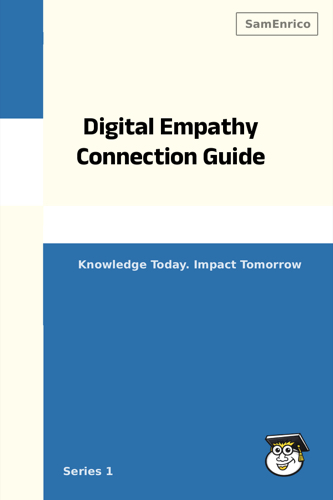
Non-FictionSelf-HelpEmotional Intelligence
Digital Empathy Connection Guide eBook
Convey care and understanding when you can't read
by Dorn Mayola
Convey care and understanding when you can't read facial expressions or body language.
Formats
Free sample
Chapter 1: The Invisible Chasm--–- The first time I realized I had accidentally ended a friendship with a single period, I was sitting alone in my kitchen at 11:47 PM, staring at a blue-lit screen that had somehow become a weapon.The message I had sent seemed harmless. Innocuous, even. A colleague had shared some difficult personal news over text—a family member's sudden illness—and I had responded the way I was taught to respond. "Let me know if you need anything," I typed, followed by a period. Not an exclamation point, which might have seemed too cheerful.
Not an ellipsis, which might have seemed hesitant. Just a clean, grammatically correct period at the end of a perfectly polite sentence.What I intended to convey: "I care about you, and I want to help, but I don't want to impose."What my colleague received, as she later explained to me in a tense phone call three days after she had stopped replying to my messages: "I don't actually care, I'm just saying what people say, and the period makes it clear you're closing the door on this conversation."I was stunned. I re-read the message. The words themselves were kind. The sentiment was genuine.
But somewhere between my heart and her eyes, the meaning had shattered into something unrecognizable. She hadn't heard my tone, seen my concerned expression, or felt the hesitation in my voice. She had seen a period. And in the barren landscape of digital text, that tiny punctuation mark had become a wall.That night, I did something I had never done before. I scrolled back through six months of my own text messages, emails, and Slack conversations.
What I found was humiliating. Dozens of messages I had intended as caring had landed as cold. Questions I had meant as curious had landed as interrogations. Brief replies I had offered out of efficiency had landed as anger. I was not a bad person.
I was not unkind. I was, quite simply, communicating in a medium my brain had never evolved to handle, using rules I had never been taught.This book exists because that night happened to me, and I suspect it has happened to you too.The Problem Nobody Is Talking About Every day, billions of people type words into screens with the genuine intention of connecting, comforting, or caring for another human being. And every day, billions of those messages fail. Not because the sender is malicious. Not because the receiver is too sensitive.
But because we are trying to perform one of the most complex and nuanced human activities—conveying empathy—using a tool that was designed to transmit information, not emotion.Consider what happens when you try to comfort someone in person. You don't just use words. You use a constellation of signals that work together to create the experience of being understood. You tilt your head slightly to one side, a universal gesture of attentiveness. You soften your voice, lowering both its volume and its pitch.
You might reach out a hand, or lean in, or simply hold space with a silence that feels like presence rather than absence. Your facial muscles arrange themselves into an expression that neuroscientists call "empathic concern"—eyebrows raised and drawn together, eyes widened, mouth slightly open. The other person's mirror neurons fire in response, and they feel, at a biological level, that you are with them.Now strip all of that away. Remove the head tilt, the soft voice, the hand, the facial expression, the mirror neurons. Remove the 93% of emotional communication that happens without a single word being spoken.
What remains? Text. Just text. Flat, ambiguous, emotionally nearsighted text.This is what I call the Invisible Chasm—the gap between what you feel and what your words actually communicate in a medium that cannot see your face, hear your voice, or feel your presence. It is not a small gap.
It is a canyon, and every day, well-intentioned people fall into it.The 93% Myth and Why It Actually Matters You have probably heard the statistic before. In the 1960s, psychologist Albert Mehrabian conducted two small studies on the communication of feelings and attitudes. His findings suggested that when there is inconsistency between a person's words, tone of voice, and facial expression, people tend to believe the tone and the expression over the words. The specific numbers he proposed: 7% of emotional meaning comes from words, 38% from tone of voice, and 55% from facial expression.These numbers have been repeated, misquoted, and exaggerated so many times that many communication experts now roll their eyes at the mention of "93%." And they are right to be skeptical. Mehrabian himself made clear that his findings only apply to specific situations—specifically, when a person is communicating emotion or attitude, and when the verbal and nonverbal channels are in conflict.
It was never meant to apply to all communication, and certainly not to the transmission of factual information.But here is what the critics get wrong: the fact that the 93% statistic is oversimplified does not make the underlying insight any less urgent for digital communication. In fact, it makes it more urgent.Think about what Mehrabian actually discovered. He found that when words and nonverbal cues disagree, the nonverbal cues win. People trust the face and the voice over the text. Now consider what happens in digital communication.
The face and the voice are not just in disagreement with the text—they are absent entirely. There is nothing to override or clarify the words. The words stand alone, naked and vulnerable to every possible misinterpretation.This is why a message that would feel warm and caring in person can land as cold and dismissive over text. In person, your words are accompanied by a hundred small signals that say, "I mean this kindly." Over text, those signals are gone. Your words have to do all the work, and words, it turns out, are remarkably bad at carrying emotion on their own.Emotion-Blind Communication I want to introduce a concept that will appear throughout this book: Emotion-Blind Communication.
This is the state of sending and receiving messages without access to the non-verbal cues that our brains have evolved over hundreds of thousands of years to process.Here is what happens in your brain when you communicate with someone in person. As you speak, your mirror neurons fire, allowing you to unconsciously mimic the other person's facial expressions and body language. This mimicry does two things. First, it helps you understand what the other person is feeling by allowing you to experience a faint echo of that feeling yourself. Second, it signals back to the other person that you are attuned to them, which deepens their sense of being understood.
It is a beautiful, ancient, and largely invisible dance.Now here is what happens when you communicate over text. Your mirror neurons have nothing to fire at. There is no face to mimic, no posture to echo, no tone to harmonize with. You are, in a very real sense, emotionally blind. You cannot see the other person's flinch, so you do not know you have hurt them.
You cannot see their nod, so you do not know they agree. You cannot see their hesitation, so you do…
This is the end of the free sample. Get the eBook to keep going. Buy now
About this book
Details
- Author
- Dorn Mayola
- Publisher
- SamEnrico
- Language
- English
- Genre
- Non-Fiction, Self-Help, Emotional Intelligence
- Released
- 2026-06-10
- Pages (approx.)
- 124
- Available as
- eBook, Audiobook

Read better in the ZLOADR app
Your eBooks on your phone or tablet. Sign in with your SamEnrico account and start reading.
More by Dorn Mayola
 Sexual Fantasy Addiction Recovery HandbookDorn Mayola$11.99
 Postpartum Period Return GuideDorn Mayola$11.99
 Dreams After Dental Trauma GuideDorn Mayola$11.99
 Dreamwork for Vicarious TraumaDorn Mayola$11.99
 The Frozen Odyssey: Medieval Mariners and the First Antarctic ExplorersDorn Mayola$11.99
 Whispers of the Forgotten: The Last Song of the NeanderthalsDorn Mayola$11.99
 Renewable Energy in China OutlookDorn Mayola$12.99
 Content AnalystDorn Mayola$11.99
 Understanding Heart Situs AnomalyDorn Mayola$17.99
 How to Start a Brush (not Electrical) for Machines Business (Beginners Guide)Dorn Mayola$11.99
You may also like
 Hong Kong Handover 1997Dunn Johnnie$11.99
 Zumba For Postnatal Recovery CourseNeal Christian$11.99
 Zumba for BeginnersLadner Nikia$11.99
 YouTube Comment Mining GuideHumes Pandora$12.99
 Worry Box MeditationCarlin Rudy$11.99
 Workplace Stress MeditationNguyen Lynn$11.99
 Workplace Stress and Sleep RepairHawley Ivory$11.99
 Workplace Perfectionism CureDelaney Jeffry$11.99
 Workplace Injustice Anger GuideWallen Isabelle$11.99
 Work Addiction and Burnout LinkGreenwood Ester$11.99
 Women in Yoga and WellnessBeattie Galina$11.99
 Women in Stand Up ComedyChun Evangeline$11.99