
Non-FictionSelf-HelpDigital Productivity
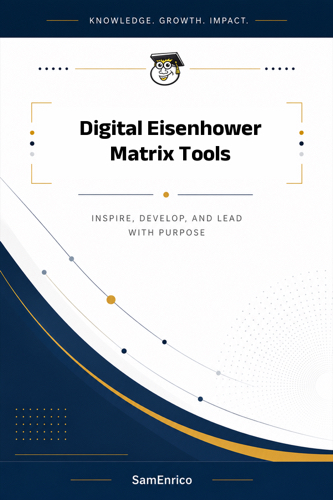
Digital Eisenhower Matrix Tools eBook
Use apps and templates to implement quadrant sorti
Use apps and templates to implement quadrant sorting electronically.
Formats
Free sample
Chapter 1: The Urgency Trap--–- The alarm on your phone reads 7:15 AM. You haven't even brushed your teeth, but your thumb has already swiped away three notifications: an email from a client marked "URGENT," a Slack message from your manager asking for a "quick sync," and a calendar reminder that a report is due in forty-eight hours. Your coffee hasn't brewed yet. Your brain is already on fire.This is not an unusual morning. This is not a crisis.
This is Tuesday.By 9:00 AM, you have checked email seventeen times, responded to twelve Slack messages, attended a standup meeting where nothing was resolved, and added four new tasks to your mental to-do list without writing any of them down. By 11:00 AM, you have switched between your email client, your project management tool, your calendar, and your messaging app more than forty times. By 3:00 PM, you cannot remember what you accomplished this morning, though you know you were very, very busy. By 5:30 PM, you leave work feeling exhausted and vaguely ashamed, because the one thing that actually mattered—the strategic project, the deep work, the thing you were hired to do—remains untouched.You fell into the urgency trap.The urgency trap is the defining cognitive hazard of the digital age. It is the gradual, almost invisible slide from working on what matters to working on what screams loudest.
It is the substitution of reactive firefighting for proactive strategy. It is the slow death of importance at the hands of urgency.And it is not your fault.Why "Urgent" Hijacks Your Brain To understand the urgency trap, you must first understand a quirk of human neurology that predates smartphones by about two hundred thousand years. Your brain is wired to prioritize immediate threats over long-term opportunities because, on the savanna, the rustling bush might contain a predator. The brain that reacted to the rustling survived. The brain that stopped to ask, "Is this rustling strategically aligned with my quarterly goals?" did not.This neurological bias is called temporal discounting: the tendency to value immediate rewards (or threats) more highly than future ones, even when the future reward is objectively larger.
In laboratory studies, people will choose $50 today over $100 in a year. The future is discounted. The present is overvalued.Email, Slack, text messages, and push notifications are engineered to exploit this bias. Every notification is a rustling bush. Every unread badge is a potential threat.
Your brain reacts to a red notification dot with the same neural circuitry it would use to detect a predator. Cortisol rises. Attention narrows. Rational prioritization shuts down.The result is a state that researchers call reactive attention: you are not choosing what to focus on. You are simply responding to whatever arrived most recently, from whoever shouted loudest, about whatever seemed most urgent at that exact moment.This is not productivity.
This is a neurological hack being exploited by software companies who profit from your attention. And the Eisenhower Matrix—properly digitized—is the only known countermeasure.A Brief History of the Matrix (And Why It Still Matters)President Dwight D. Eisenhower did not invent the distinction between urgent and important. Philosophers and military strategists had noted it for centuries. But Eisenhower was the first to make it the centerpiece of a practical decision-making framework.
In a 1954 speech, he quoted a university president who said, "I have two kinds of problems: the urgent and the important. The urgent are not important, and the important are never urgent." Eisenhower added his own observation: that mastering this distinction was the secret to effective leadership.Decades later, Stephen Covey popularized the matrix in The 7 Habits of Highly Effective People. Covey's insight was to visualize the distinction as a two-by-two grid:Urgent Not Urgent Important Quadrant 1: Do First (Crises, deadlines, firefighting)Quadrant 2: Schedule (Strategy, planning, relationships, deep work)Not Important Quadrant 3: Delegate (Interruptions, some emails, minor requests)Quadrant 4: Delete (Time-wasters, distraction, busywork)The matrix works because it forces a separation between two variables that our brains naturally conflate. Urgency and importance are independent dimensions. A task can be urgent without being important (most email).
A task can be important without being urgent (learning a new skill, exercising, building a relationship). The matrix makes this independence visible.But the matrix, as originally conceived, assumed a world of paper and scheduled meetings. Eisenhower and Covey could not have anticipated the fragmentation crisis of the digital age. They could not have imagined that a single person would manage hundreds of inputs per day across a dozen channels. They could not have known that urgency would be weaponized by software designers competing for attention.The matrix is not broken.
It is undertooled. This book provides the tools.The Four Digital Ds: Your New Decision Engine The classic Eisenhower framework uses four verbs: Do, Decide, Delegate, Delete. For a paper-based system, "Decide" made sense. You would look at a task, decide when to do it, and write that decision on your calendar. But in a digital environment, "Decide" is a bottleneck.
It is vague. It invites procrastination. It allows tasks to linger in a gray zone of undecided ambiguity.This book replaces "Decide" with Schedule. The Digital Four Ds are:Action Quadrant Time Horizon Digital Tool Required Do Q1Within 1 hour Focus timer, no notifications Schedule Q2Within 2 weeks Calendar, time blocking, recurring tasks Delegate Q3Within 24 hours Task assignment, "Waiting For" tracking Delete Q4Immediately Archive, auto-filter, unsubscribe Each action has a specific meaning, a specific time horizon, and a specific digital implementation.Do means now. Not today.
Not after lunch. Now. If a task belongs in Quadrant 1—urgent and important—you stop everything else and complete it within the next hour. This requires a digital tool that supports a focus timer (Pomodoro or similar) and can suppress notifications during the do block.Schedule means put it on the calendar with a specific start time and a specific duration. Vague commitments like "work on Q2 project this week" are not scheduling.
Scheduling is "Tuesday, 10:00 AM to 12:00 PM, block labeled 'Strategy: Q4 Planning.'" Your digital tool must integrate with your calendar (Google Calendar, Outlook, or a calendar view within the tool itself) and support recurring blocks for ongoing Quadrant 2 activities.Delegate means assign to someone else with clear instructions and a tracking mechanism. The instructions must answer three questions: What is the desired outcome? What is the deadline? What is the constraint? The tracking mechanism is the "Waiting For" tag (introduced in Chapter 7), which removes delegated tasks from your "Do" quadrant while keeping them visible for follow-up.Delete means permanent removal.
Not "archive for later." Not "move to a someday folder." Delete. If a task is neither urgent nor important, it does not belong in your system at all. The digital implementation includes email filters that auto-delete newsletters, unsubscribing from promotional lists, and the regular purging of Quadrant 4 items during the weekly review (Chapter 10).The key insight is that every task in your system must be in exactly one of these four states at all times. There is no fifth state called "undecided" or "maybe later" or "I'll get to it when I have time." Ambiguity is the enemy of prioritization.The Capture…
This is the end of the free sample. Get the eBook to keep going. Buy now
About this book
Details
- Author
- Keeler Xavier
- Publisher
- SamEnrico
- Language
- English
- Genre
- Non-Fiction, Self-Help, Digital Productivity
- Released
- 2026-06-08
- Pages (approx.)
- 149
- Available as
- eBook, Audiobook

Read better in the ZLOADR app
Your eBooks on your phone or tablet. Sign in with your SamEnrico account and start reading.
More by Keeler Xavier
 Forgiveness EQ ProcessKeeler Xavier$11.99
 Step Two Came to BelieveKeeler Xavier$11.99
 Stress Autoimmune Disease LinkKeeler Xavier$11.99
 The Hollow Lanterns: Ghosts of the Abandoned ShrineKeeler Xavier$11.99
 Impost TaxKeeler Xavier$11.99
 Learn to Play the DahuKeeler Xavier$11.99
 AI for Campaign Sentiment MeasurementKeeler Xavier$12.99
 How to Become a Lingo CleanerKeeler Xavier$11.99
You may also like
 Hong Kong Handover 1997Dunn Johnnie$11.99
 Zumba For Postnatal Recovery CourseNeal Christian$11.99
 Zumba for BeginnersLadner Nikia$11.99
 YouTube Comment Mining GuideHumes Pandora$12.99
 Worry Box MeditationCarlin Rudy$11.99
 Workplace Stress MeditationNguyen Lynn$11.99
 Workplace Stress and Sleep RepairHawley Ivory$11.99
 Workplace Perfectionism CureDelaney Jeffry$11.99
 Workplace Injustice Anger GuideWallen Isabelle$11.99
 Work Addiction and Burnout LinkGreenwood Ester$11.99
 Women in Yoga and WellnessBeattie Galina$11.99
 Women in Stand Up ComedyChun Evangeline$11.99