
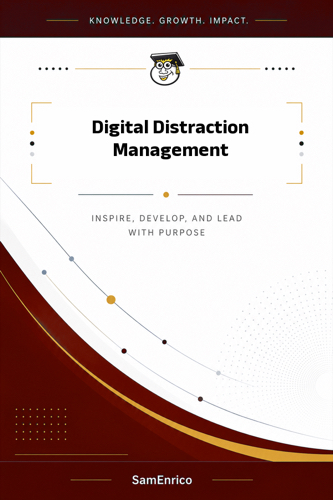
Non-FictionSelf-HelpDigital Wellness
Digital Distraction Management eBook
Teaches students to control phone and social media
Teaches students to control phone and social media during study sessions.
Formats
Free sample
Chapter 1: The 10-Cent Tollbooth--It is 11:47 PM on a Tuesday, and you have been “studying” for three hours. Your textbook is open to page 147. A highlighter rests in your hand. Your laptop displays half-finished problem sets across three tabs. And yet, you have just spent the last fourteen minutes watching a stranger build a tiny brick house for a rescued squirrel on Instagram Reels.You are not lazy.
You are not stupid. You are not lacking in ambition or discipline. You are, quite simply, being robbed.Every day, while you sit in the library, at your dorm desk, or in a coffee shop surrounded by the noble intention of learning, a silent transaction takes place. You look away from your work for “just a second” to check a notification. In that moment, you hand over a ten-cent toll.
By the end of a study session, you have paid dozens of these tolls. By the end of a week, you have paid hundreds. By the end of a semester, you have paid thousands—not in currency, but in something far more precious: your attention.This chapter is about understanding the true nature of that transaction. Before we can fix your relationship with your phone, you must first recognize that you are not fighting a bad habit. You are fighting a trillion-dollar industry that has weaponized the architecture of your own brain against you.
The good news is that once you see the tollbooth, you can choose to stop paying.The Attention Economy: You Are Not the Customer Let us begin with a fundamental truth that most students never stop to consider. When you use Tik Tok, Instagram, Snapchat, or any other free social media platform, you are not the customer. You are the product.In a traditional business, a company sells a product to a customer. You walk into a store, hand over ten dollars, and walk out with a sandwich. The transaction is clear: money for goods.
But when you open Instagram, you hand over nothing—no money, no credit card, no cash. So how does Instagram, a company with thousands of employees and billion-dollar valuations, make money?It sells your attention to advertisers.Every second you spend scrolling, every video you watch, every post you linger over—all of this is data. The platform learns what makes you stop, what makes you laugh, what makes you anxious, what makes you jealous, and what makes you keep scrolling for “just one more minute.” That data is packaged and sold to companies who want to show you ads. You are not the customer. You are the inventory.
The advertisers are the customers. And your attention is the product being bought and sold in an open market called the Attention Economy.This is not a conspiracy theory. This is the publicly stated business model of every major social media company. Meta (which owns Facebook and Instagram) reported over $130 billion in ad revenue in a single year. Google reported over $200 billion.
These companies do not make money by selling you a better experience. They make money by extracting as many seconds of your focused attention as possible and reselling that attention to the highest bidder.For a student, this creates a catastrophic conflict of interest. You open your phone intending to check one message from a study partner. The platform has a different goal: keep you there for as long as possible. It is not your friend.
It is not a neutral tool. It is a tollbooth operator, and every time your attention drifts from your textbook to your screen, the operator reaches out its hand and collects its fee.The Slot Machine in Your Pocket Why does your phone feel so hard to put down? Why does a boring textbook chapter trigger an almost irresistible urge to check Instagram? The answer lies in a psychological mechanism called the dopamine loop, and it is the same mechanism that makes slot machines addictive.Dopamine is a neurotransmitter often misunderstood as the “pleasure chemical.” In reality, dopamine is the “anticipation chemical.” It is released not when you experience pleasure, but when you expect that pleasure might be coming soon. A slot machine does not pay out every time you pull the lever.
Sometimes you win. Sometimes you lose. Sometimes you win a little. Sometimes you win a lot. That unpredictability—what psychologists call variable rewards—is what makes the machine addictive.
Your brain releases dopamine not when you win, but in the moment before you pull the lever, wondering if this time might be the big one.Your phone operates on the exact same principle.When you pull down to refresh your Instagram feed, you do not know what you will see. It might be a funny meme. It might be a friend’s vacation photo. It might be an ad. It might be absolutely nothing interesting.
That uncertainty—that variable reward—is what keeps you pulling the lever again and again. Sometimes you find something engaging. Sometimes you do not. But your brain, trained on the promise of possibility, keeps you scrolling.The dopamine loop has four stages. First, a trigger—either external (a notification buzz) or internal (boredom, anxiety, the urge to escape a difficult problem).
Second, an action—you pick up the phone and open the app. Third, a variable reward—you see something unpredictable, which might be satisfying or might be dull. Fourth, an investment—you scroll further, comment, like, or save a post, which deepens your engagement with the platform.By the time you look up from your phone, twenty minutes have passed. You have paid dozens of tolls. And your textbook is still open to page 147.The 23-Minute Lie You Tell Yourself Here is where the tollbooth metaphor becomes truly expensive.
Most students believe that checking their phone “for just a second” costs them only that second. This is catastrophically wrong.Research on attention residue, pioneered by business professor Sophie Leroy, reveals a hidden cost of task switching. When you interrupt a focused task—like studying—to do something else—like check a text message—your brain does not fully disengage from the first task. A “residue” of the original task remains in your working memory, reducing your cognitive capacity for whatever you do next. When you return to studying, you are not operating at 100 percent.
You are operating at perhaps 60 or 70 percent, because part of your brain is still processing that text message.But the cost is even higher than that. Studies on context switching show that after a brief interruption—even an interruption lasting only one second—it takes an average of twenty-three minutes to return to a state of deep, uninterrupted focus. Twenty-three minutes. That means a single glance at a notification does not cost you one second. It costs you twenty-three minutes of reduced cognitive performance.Let us do the math.
If you check your phone just five times during a three-hour study session, you have lost nearly two hours of productive focus. Five glances. Two hours. You are effectively paying a 40 percent tax on your study time. You could have finished in two hours, but instead you are still sitting there four hours later…
This is the end of the free sample. Get the eBook to keep going. Buy now
About this book
Details
- Author
- Longo Latesha
- Publisher
- SamEnrico
- Language
- English
- Genre
- Non-Fiction, Self-Help, Digital Wellness
- Released
- 2026-06-06
- Pages (approx.)
- 138
- Available as
- eBook, Audiobook

Read better in the ZLOADR app
Your eBooks on your phone or tablet. Sign in with your SamEnrico account and start reading.
More by Longo Latesha
 Infidelity Recovery After AddictionLongo Latesha$11.99
 Grounding Meditation for DissociationLongo Latesha$11.99
 Mobile Game Addiction HelpLongo Latesha$11.99
 Child Soldier, Now FreeLongo Latesha$11.99
 Anger Trigger VisualizationLongo Latesha$11.99
 Iceland Traverse InteriorLongo Latesha$11.99
 Progress Billing ImplementationLongo Latesha$11.99
 When Yahoo Lost the InternetLongo Latesha$11.99
 The Jade Phoenix's Last Lesson: Wisdom from the Celestial SageLongo Latesha$11.99
 The Divine Fire: Mozart, Haydn, and the Birth of Classical BrillianceLongo Latesha$11.99
 The Mineral Guide to ArtiniteLongo Latesha$11.99
 Growing CynodonLongo Latesha$11.99
You may also like
 Hong Kong Handover 1997Dunn Johnnie$11.99
 Zumba For Postnatal Recovery CourseNeal Christian$11.99
 Zumba for BeginnersLadner Nikia$11.99
 YouTube Comment Mining GuideHumes Pandora$12.99
 Worry Box MeditationCarlin Rudy$11.99
 Workplace Stress MeditationNguyen Lynn$11.99
 Workplace Stress and Sleep RepairHawley Ivory$11.99
 Workplace Perfectionism CureDelaney Jeffry$11.99
 Workplace Injustice Anger GuideWallen Isabelle$11.99
 Work Addiction and Burnout LinkGreenwood Ester$11.99
 Women in Yoga and WellnessBeattie Galina$11.99
 Women in Stand Up ComedyChun Evangeline$11.99