
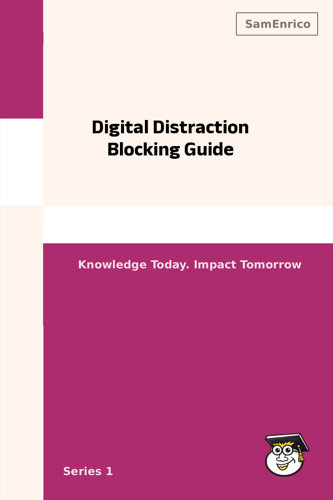
Non-FictionSelf-HelpDigital Wellness
Digital Distraction Blocking Guide eBook
Use website blockers and phone locking apps to pro
Use website blockers and phone locking apps to protect study time.
Formats
Free sample
Chapter 1: The $2,000 Hour...--–- Maria was a third-year pre-med student at the University of Michigan, and by all external measures, she was doing everything right. She woke up at 6:00 AM every morning, packed her bag with three highlighters and a thermos of black coffee, and walked twenty minutes to the library before her first lecture. She tracked her study hours religiously in a bullet journal. At the end of each week, she would tally the numbers with a certain pride: Monday, 6 hours. Tuesday, 5.5 hours.
Wednesday, 7 hours. Thursday, 6 hours. Friday, 4 hours. Saturday, 8 hours. Total: 36.5 hours.
That was more than a full-time job. That was dedication. That was the kind of effort that got you into a top-tier medical school.Maria failed the MCAT. Not spectacularly—she didn't get a 472, the lowest possible score. She got a 498, which is the kind of score that doesn't close every door but opens none of the ones she wanted.
The ones that opened led to schools she had never heard of, in towns she would never visit, with residency placement rates that made her stomach clench. She applied anyway. She was rejected from seventeen programs. Waitlisted at two. Accepted by none.Here is what her bullet journal did not show: the 47 times per study session that she picked up her phone.Not to make calls.
Not to send urgent texts. Maria picked up her phone to "check something quickly." A notification. A news alert. A friend's Instagram story. A Reddit thread about study tips that somehow led to a Reddit thread about conspiracy theories that somehow led to a forty-five-minute deep dive into whether birds are real.
(They are, Maria concluded, but she was not happy about the time she had spent confirming this.) Each of those "quick checks" lasted between thirty seconds and three minutes. Each one triggered a switching cost of approximately twenty-three minutes—the time required for her brain to fully re-engage with organic chemistry after being interrupted by a meme about anxious dogs.Forty-seven interruptions per session. Twenty-three minutes of recovery per interruption. That is 1,081 minutes—over eighteen hours—of switching cost per week. Eighteen hours of cognitive limbo.
Eighteen hours of feeling like she was studying while actually recovering from the decision to study. Maria was not studying 36.5 hours per week. She was studying approximately 5 hours per week and spending the other 31.5 hours in a state of distracted half-focus that produced no learning, no retention, and no results.The bullet journal lied. The bullet journal always lies.The Calculation That Will Change How You See Every Study Hour Let us perform a calculation together. This is not a hypothetical exercise.
This is the single most important arithmetic you will do this year, and I want you to take out your phone—yes, that phone—and open the calculator app. If you cannot find your calculator because your home screen is buried under fourteen folders of apps you never use, that is not a coincidence. That is a design feature. We will fix it in Chapter 6.For now, do the math with me.Assume you are a typical college student paying in-state tuition at a public university. According to the National Center for Education Statistics, the average annual cost of tuition, fees, room, and board for an in-state student at a four-year public university is approximately $20,000.
Some of you pay more. Some of you pay less because of scholarships or because you live at home and eat your parents' groceries. Some of you are reading this as a high school student or a professional studying for a certification, in which case the numbers shift but the logic remains identical. For now, we will use $20,000 as our anchor.Assume you study 10 hours per week. This is a reasonable average.
Some weeks you study more—midterms, finals, the week your professor announces a surprise paper. Some weeks you study less—the week after finals, the week you had the flu, the week you decided that watching all six hours of the director's cut of The Lord of the Rings was a form of cultural education. Over a 40-week academic year, 10 hours per week gives you 400 study hours.$20,000 divided by 400 hours equals $50 per study hour.That is your nominal hourly rate. Every hour you spend with a textbook open, a lecture playing, or a problem set half-finished is costing you $50 in tuition. If you fall asleep during that hour, you have wasted $50.
If you daydream during that hour, you have wasted $50. If you check Instagram during that hour, you have wasted $50 and also incurred a switching cost that will waste more of the next hour.But $50 per hour is a lie. It is a dramatic understatement. It is like valuing a winning lottery ticket at the price you paid for it rather than the millions it will pay out.Here is the real calculation.The Multiplier Effect of a Focused Hour A degree is not worth the tuition you paid for it. A degree is worth the lifetime earnings differential it creates between you and someone without that degree.
According to the Social Security Administration, men with bachelor's degrees earn approximately $900,000 more in median lifetime earnings than men with only high school diplomas. Women with bachelor's degrees earn approximately $630,000 more than women with only high school diplomas. These numbers vary by field—an engineering degree is worth more than a sociology degree, which is worth more than a degree in a field you chose because you liked the color of the brochure—but the trend is consistent across all disciplines. More education correlates with more earnings.But the key variable is not the degree itself. The key variable is what you learn while earning that degree.A student who skates through four years with C-minuses, cramming before exams and forgetting everything two weeks later, has the same piece of paper as a student who mastered every concept, built every skill, and emerged as a top performer.
Both have bachelor's degrees. Both will check the same box on job applications. But their lifetime earnings will diverge dramatically because the top performer does not just have a credential; they have capabilities. They can solve problems that the C-minus student cannot. They can communicate ideas that the C-minus student cannot.
They can focus for hours while the C-minus student reaches for their phone every seven minutes.The difference between a top performer and an average performer is not intelligence. It is not background. It is not access to better tutors or more expensive textbooks. The difference is the ability to sustain focused attention on cognitively demanding tasks for extended periods of time. That ability is what employers pay for.
That ability is what graduate schools select for. That ability is what separates the student who gets into medical school from the student who does not.So let us return to the calculation, but now we are going to value a focused study hour not at the tuition cost but at the lifetime earnings it enables.A top-performing student in a competitive field—medicine, law, engineering, computer science, finance—can expect lifetime earnings in the top quintile of their profession. For physicians, median lifetime earnings exceed $6 million. For lawyers at…
This is the end of the free sample. Get the eBook to keep going. Buy now
About this book
Details
- Author
- Teague Catharine
- Publisher
- SamEnrico
- Language
- English
- Genre
- Non-Fiction, Self-Help, Digital Wellness
- Released
- 2026-06-09
- Pages (approx.)
- 152
- Available as
- eBook, Audiobook

Read better in the ZLOADR app
Your eBooks on your phone or tablet. Sign in with your SamEnrico account and start reading.
More by Teague Catharine
 Entry Point Identification GuideTeague Catharine$11.99
 Norwegian Resistance Lighthouse GuideTeague Catharine$11.99
 Remote Retreats Alcohol PolicyTeague Catharine$11.99
 Precommitment Devices for FocusTeague Catharine$11.99
 Gold in the Shadows: The Untold Story of Wilma Rudolph's ComebackTeague Catharine$11.99
 Golden Serpent: The Lost Expedition of Zheng He’s Treasure FleetTeague Catharine$11.99
 Understanding Chromosome 1, Monosomy 1p22 P13Teague Catharine$17.99
 JEE Girls Reservation GuideTeague Catharine$12.99
 Emerging Market Vendor GuideTeague Catharine$12.99
 How to Become a Cake StripperTeague Catharine$11.99
 Rehabilitation SpecialistTeague Catharine$11.99
You may also like
 Hong Kong Handover 1997Dunn Johnnie$11.99
 Zumba For Postnatal Recovery CourseNeal Christian$11.99
 Zumba for BeginnersLadner Nikia$11.99
 YouTube Comment Mining GuideHumes Pandora$12.99
 Worry Box MeditationCarlin Rudy$11.99
 Workplace Stress MeditationNguyen Lynn$11.99
 Workplace Stress and Sleep RepairHawley Ivory$11.99
 Workplace Perfectionism CureDelaney Jeffry$11.99
 Workplace Injustice Anger GuideWallen Isabelle$11.99
 Work Addiction and Burnout LinkGreenwood Ester$11.99
 Women in Yoga and WellnessBeattie Galina$11.99
 Women in Stand Up ComedyChun Evangeline$11.99